
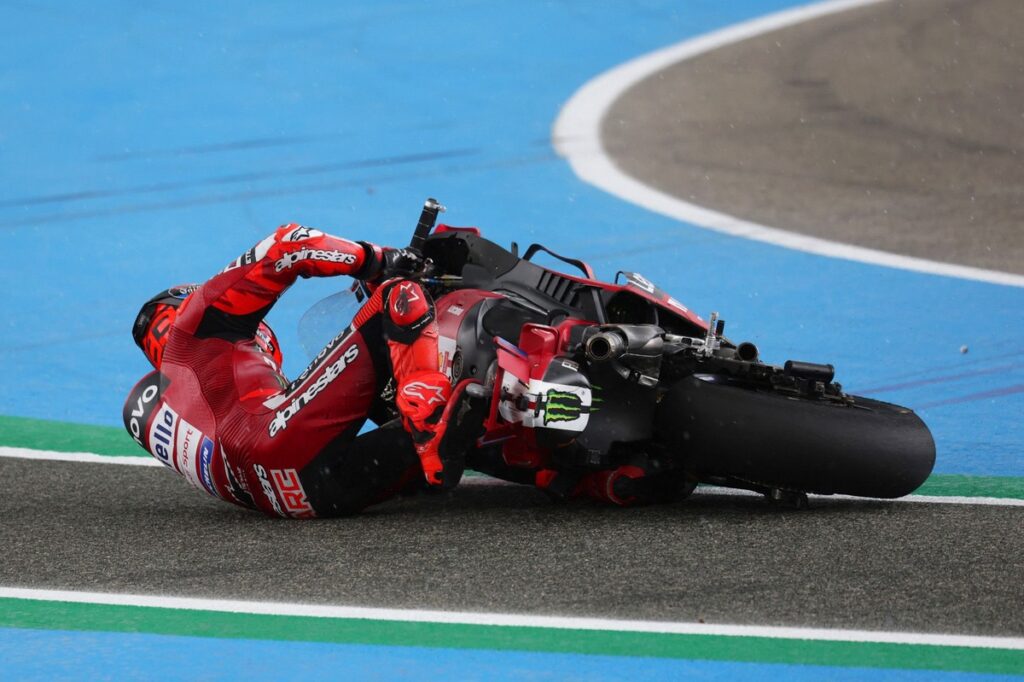
Image: from Gerard Grouve Sport X @Grouve_Sport
Open Chronicle | Sport
The latest MotoGP Sprint race at Jerez has ignited a fresh debate about the limits of racing ingenuity and the grey areas within the sport’s rulebook. At the center of the controversy is Marc Márquez, whose dramatic comeback from a crash to secure victory has left fans, analysts, and competitors divided.
With just five laps remaining, Márquez was running in second place, closely chasing his brother, Álex Márquez. Entering the final corner, Turn 13, he lost control on a damp track and slid off. What followed was a sequence that would redefine the race.
Displaying his trademark instinct and speed of decision-making, Márquez quickly lifted his bike, allowed other riders to pass, and then cut across the track, riding over the grass to reach the pit lane. With the race declared flag-to-flag due to changing weather conditions, he executed a bike swap and rejoined the race.
At that moment, he had fallen 38 seconds behind the leader and dropped down the order. Yet, amid widespread pit stops and confusion, he rapidly climbed back through the field. Within a single lap after his return, he had already surged to fourth place. From there, he overtook key rivals, including Francesco Bagnaia, before ultimately taking an improbable victory.
Despite the extraordinary performance, the incident has raised serious questions. Notably, no “under investigation” message appeared during the race, and Race Control took no visible action. No official protest has been filed either, leaving the result intact.
The controversy stems from a regulatory gap. The Fédération Internationale de Motocyclisme, known as Fédération Internationale de Motocyclisme, maintains an extensive rulebook exceeding 400 pages. Yet, there is no explicit rule covering the exact scenario Márquez created.
Article 1.21.3 broadly states that gaining an advantage by exceeding track limits or cutting the track may be penalized, depending on the Race Direction protocols. However, the interpretation in this case remains unclear. Supplementary guidance emphasizes respecting the solid white line at pit entry and exit, but Márquez’s trajectory did not technically breach this specific boundary.
An unofficial explanation suggests that his maneuver did not violate any rules. He entered the pit lane correctly, respected the timing loop speed limit, and did not ignore any instructions from race stewards, largely because none were issued.
Still, the absence of a clear ruling has fueled debate. Critics argue that the act of crossing grass and rejoining via the pit lane constitutes an advantage, even if not explicitly prohibited. Others defend Márquez, pointing to his awareness of the rules and his ability to exploit them within legal limits.
What remains undeniable is the level of skill displayed. The nine-time world champion turned a near race-ending mistake into a tactical masterclass. Yet, the incident also highlights a broader issue within MotoGP: the difficulty of regulating every possible scenario in a sport defined by split-second decisions and unpredictable conditions.
The Jerez Sprint may be remembered not only for its dramatic finish but also for exposing the limits of the rulebook. Whether it leads to regulatory clarification or remains a one-off moment of brilliance will depend on how the sport chooses to respond.