
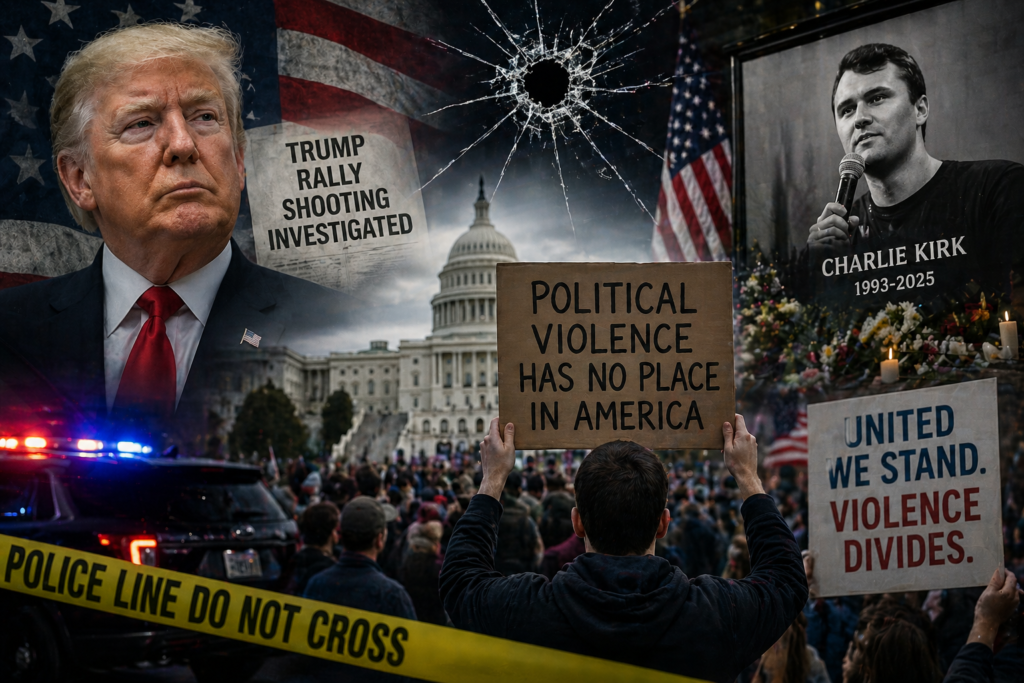
Image Credentials: Image Title: The Alarming Rise of Political Violence in the United States Source: (chatgpt.com) Date: April 2026. Attribution: This image was created using AI-generated imagery (chatgpt.com) by Open Chronicle and does not depict a real-world scene.
By José Carlos Palma | The Grand Strategy Institute
The latest security scare at a high-profile political gathering in Washington, D.C., has once again forced a difficult question into the national conversation. Is political violence becoming normalized in the United States?
Even before investigators determine the motive behind the most recent incident, the broader pattern is becoming harder to ignore. Public officials, activists, and political figures across the spectrum are facing an increasingly volatile environment, where threats are no longer abstract and, in some cases, turn deadly.
U.S. President Donald Trump is among those who have lived under this shadow. He has faced multiple attempts on his life, a reality that underscores the intensity of political polarization in the country. While presidential security remains among the most sophisticated in the world, recent events suggest that even the most robust systems cannot eliminate risk.
The killing of Charlie Kirk last year served as a stark reminder that political violence is not confined to threats or isolated incidents. It can have fatal consequences, and it increasingly targets individuals whose visibility makes them symbols in broader ideological conflicts.
What makes this trend particularly troubling is the contradiction at its core. Surveys consistently show that a vast majority of Americans reject political violence. Yet, the frequency of incidents, attempted attacks, and violent rhetoric suggests a growing gap between stated values and real-world behavior.
Part of the problem lies in the ecosystem that surrounds modern politics. Social media platforms amplify outrage, reward extreme language, and create echo chambers where opponents are not just disagreed with but dehumanized. In such an environment, the leap from rhetoric to action becomes shorter, especially for individuals already predisposed to radicalization.
At the same time, institutional trust has eroded. For many Americans, politics is no longer seen as a contest of ideas but as an existential struggle. When political outcomes are framed as matters of survival rather than governance, the justification for extreme measures can begin to take hold at the fringes.
Law enforcement and security agencies are adapting, expanding protective measures, and monitoring threats more closely than ever. But prevention alone cannot address the root causes. The deeper challenge is cultural and political, a need to restore a sense of shared reality, mutual legitimacy, and democratic restraint.
Political leaders also carry responsibility. Language matters. When public figures normalize hostility or frame opponents as enemies rather than adversaries, they contribute, whether intentionally or not, to a climate where violence becomes easier to justify.
The United States has faced periods of political violence before, from the assassinations of the 1960s to the Oklahoma City bombing. Each era prompted reflection and, at times, reform. The current moment demands a similar reckoning.
What is at stake is not only the safety of individual leaders or activists, but the resilience of the democratic system itself. A politics defined by fear and intimidation cannot sustain open debate or peaceful transitions of power.
The warning signs are already visible. The question now is whether they will be taken seriously or dismissed until the next incident forces the issue back into focus.
The Grand Strategy Institute
Continue Exploring Strategic Analysis
Return to The Grand Strategy Institute for strategic assessments, long-form analysis and research examining geopolitics, military affairs, international security, emerging technologies and the changing international order.
← Back to The Grand Strategy Institute