
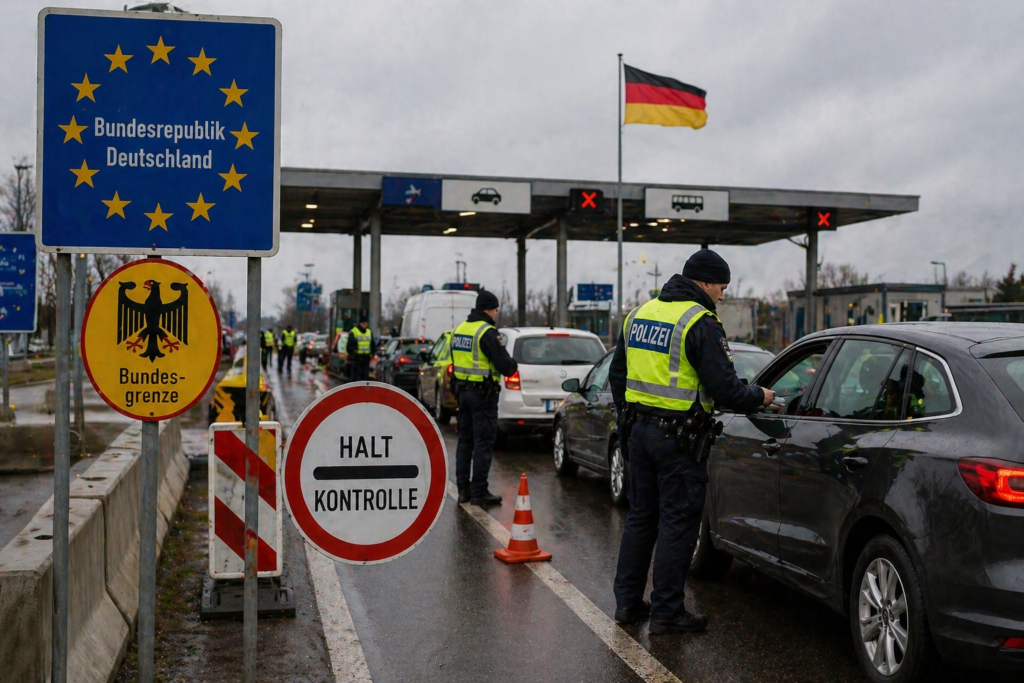
Image Credentials: Image Title: Dutch Mayors Urge Germany to End Border Controls After Fatal Crash Source: (chatgpt.com) Date: April 2026. Attribution: This image was created using AI-generated imagery (chatgpt.com) by Open Chronicle and does not depict a real-world scene.
By Open Chronicle with Agencies
A fatal multi-vehicle crash near the Dutch-German border has intensified political pressure on Berlin to end its controversial border controls, with Dutch local leaders warning of growing safety risks, economic disruption, and potential violations of European law.
The incident occurred near Babberich in the province of Gelderland, where a 66-year-old man was killed in a collision involving seven vehicles. Local officials have pointed to congestion linked to German border checkpoints as a contributing factor, reigniting debate over controls introduced in 2024 to curb irregular migration.
Hubert Bruls described the accident as “extraordinarily tragic,” arguing that such incidents make the continued enforcement of what he called “quasi-permanent” border checks increasingly difficult to justify. While acknowledging that the measures were initially understandable amid high migration pressures, Bruls said the situation has since changed significantly.
He also raised concerns about whether the controls remain compliant with the rules of the Schengen Area, which guarantees free movement across most EU countries. Legal experts, he noted, are increasingly questioning their validity under European law.
Similar criticism came from Mark Boumans, who expressed frustration at Germany’s failure to find alternative solutions to manage migration without imposing what he described as “enormously harmful side effects.” Border municipalities, he said, are bearing the brunt of the policy, with traffic congestion spilling into local roads and increasing accident risks.
The economic impact is also mounting. According to Transport and Logistics Netherlands, delays affecting freight transport have already resulted in losses amounting to millions of euros. Businesses operating across the border report significant disruptions, particularly in sectors reliant on just-in-time delivery.
Despite the criticism, German authorities have indicated that the controls will remain in place, with the next policy review scheduled for September. Officials argue that the measures are effective, citing police data showing thousands of detentions for illegal entry and arrests of suspected human smugglers since their introduction.
Bruls, who also chairs the Euregio Rhine-Waal regional network, has suggested that Germany adopt more flexible enforcement methods, such as mobile patrols further inland. He argued that such an approach would be more efficient and less disruptive to daily life in border regions.
The crash has added urgency to a debate that balances security concerns with the principles of European integration. For many in the affected regions, the question is no longer just about migration policy, but about the human and economic cost of maintaining barriers within what is meant to be a borderless Europe.