
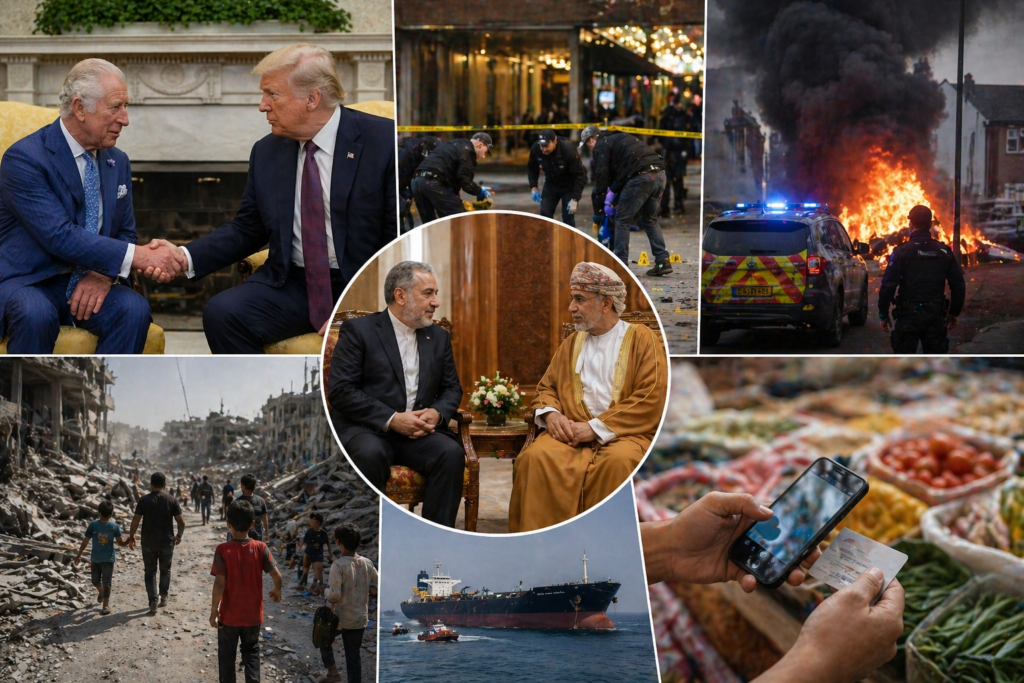
Image Credentials: Image Title: Global News Brief: Key Events and Developments for April 27, 2026 Source: (chatgpt.com) Date: April 2026. Attribution: This image was created using AI-generated imagery (chatgpt.com) by Open Chronicle and does not depict a real-world scene.
Global Tensions, Security Fears, and Economic Strains Shape Monday’s Headlines
By Open Chronicle with Agencies
A series of security incidents, diplomatic developments, and economic warnings is setting the tone for the week, reflecting a volatile international landscape shaped by political tension and conflict.
Security concerns dominate U.S. headlines
New details have emerged from the shooting incident that disrupted the White House Correspondents’ Dinner in Washington. According to reports, the suspect, identified as Cole Allen, told authorities he intended to target officials linked to U.S. President Donald Trump’s administration. While Trump himself was not explicitly named as a target, the statement has heightened concerns about political violence in the United States.
Despite the incident, Trump confirmed that King Charles III will proceed with his planned state visit. The British monarch is expected to arrive as scheduled, under heightened security, in a visit aimed at reinforcing historic ties between the two nations.
Elsewhere, tensions extended to Northern Ireland, where an explosion was reported outside a police station in the Dunmurry area near Belfast. Authorities confirmed evacuations in the surrounding area after a vehicle was seen on fire outside a Police Service of Northern Ireland base, raising fears of a potential targeted attack.
Diplomatic activity amid rising geopolitical pressure
In the Middle East, diplomatic efforts continue against the backdrop of ongoing conflict. Oman’s Sultan Haitham bin Tariq met with Iranian Foreign Minister Abbas Araghchi to discuss mediation efforts related to the war involving Iran, the United States, and Israel.
Araghchi is expected to continue his diplomatic tour with visits to Pakistan and Russia, signaling ongoing attempts to ease regional tensions.
Meanwhile, Türkiye’s President Recep Tayyip Erdoğan condemned the Washington shooting and also held discussions with President Trump, underscoring the interconnected nature of current global crises.
In Israel, former prime ministers Naftali Bennett and Yair Lapid are reportedly preparing a joint electoral bid, a move that could reshape the country’s political landscape.
Conflict and instability persist
Violence continues to escalate in several regions. Israeli airstrikes in southern Lebanon have reportedly killed at least 14 people, including children, marking a significant escalation despite a recent ceasefire.
In another development, a cargo vessel has reportedly been hijacked off the coast of Somalia, adding to concerns over maritime security in a region already affected by instability.
Economic pressures and energy disruption
The global economy is also feeling the strain of the ongoing conflict. Russia’s Deputy Prime Minister Alexander Novak warned that it could take months for global oil markets to stabilize, even if the Strait of Hormuz reopens fully. The disruption has created a significant supply gap, with shipments delayed and energy prices under pressure.
In Egypt, authorities have lifted early closing restrictions imposed during the height of the energy crisis, signaling a partial return to normality despite ongoing challenges.
Humanitarian strain in Gaza
In Gaza, daily life remains fragile. A temporary outage in the PalPay digital payment system caused widespread disruption, halting transactions in a territory where cash shortages have made digital wallets essential. What might be a minor technical issue elsewhere quickly became a major hardship, affecting access to food, transport, and basic services.
From Washington to the Middle East and beyond, the start of the week reflects a world grappling with overlapping crises, security threats, diplomatic friction, and economic uncertainty. As events continue to unfold, the coming days are likely to test both political leadership and global stability.