
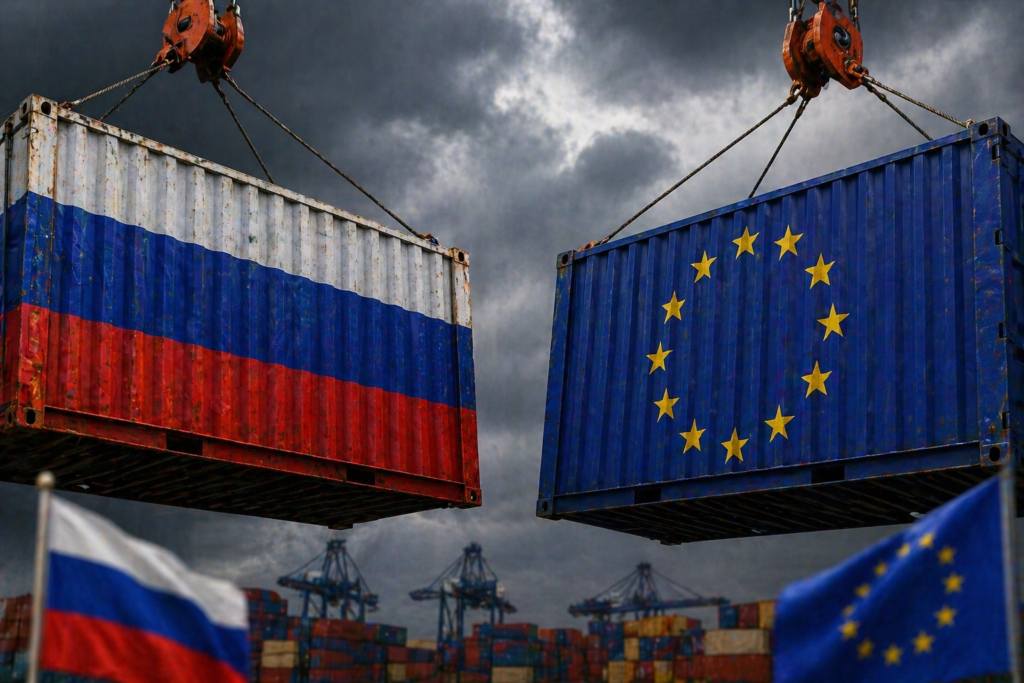
Image Credentials: Image Title: Medvedev Proposes Tariffs on Russian Exports to EU Amid Escalating Sanctions Dispute Source: (chatgpt.com) Date: April 2026. Attribution: This image was created using AI-generated imagery (chatgpt.com) by Open Chronicle and does not depict a real-world scene.
By Open Chronicle with Agencies
Russia has signaled a potential escalation in its economic standoff with the European Union, after Dmitry Medvedev proposed imposing tariffs on Russian exports to the bloc in response to calls for new taxes on Russian imports.
Medvedev’s remarks came after Estonian Prime Minister Kristen Michal suggested taxing Russian goods entering the European Union to help fund Ukraine’s reconstruction. The proposal reflects growing efforts within Europe to maintain financial and political pressure on Moscow as the war continues.
In a statement posted on Russia’s social media platform Max, Medvedev argued that Moscow should “respond in kind,” specifically mentioning exports such as fertilizers as potential targets for retaliatory tariffs. His comments also carried a sharper tone, linking economic measures to Russia’s military capacity and ongoing operations.
The exchange underscores a widening economic confrontation between Russia and the EU, which has intensified since the start of the conflict in Ukraine. The European Commission recently approved its 20th sanctions package against Russia, expanding restrictions across sectors including energy, finance, trade, and defense.
EU foreign policy chief Kaja Kallas indicated that preparations are already underway for a 21st round of sanctions, signaling that Brussels intends to sustain pressure on the Kremlin.
For Moscow, the prospect of new EU tariffs adds another layer to an already complex economic environment shaped by sanctions and shifting global trade patterns. For Europe, proposals to tax Russian imports reflect both a strategic and financial dimension, aiming to weaken Russia’s economic base while supporting Ukraine’s recovery.
However, Medvedev’s response highlights the risks of further escalation. Retaliatory measures could impact European markets, particularly in sectors dependent on Russian raw materials such as fertilizers, potentially driving up costs and complicating supply chains.
As both sides continue to exchange economic measures, the dispute illustrates how the conflict in Ukraine is extending far beyond the battlefield, reshaping trade relations and deepening divisions between Russia and the European Union.