
Image: from France 3 Côte d’Azur X @F3cotedazur
By Open Chronicle with Agencies
A groundbreaking underwater mission off the southern coast of France is shedding new light on maritime history, as researchers begin to uncover a remarkably preserved 16th-century shipwreck lying 2.5 kilometres beneath the Mediterranean Sea.
The wreck, known as Camarat 4, was discovered by chance in 2025 during a military seabed survey near Ramatuelle. Now, a joint scientific effort is underway to study the site and recover artifacts, offering rare insights into early modern trade routes.
A Mission into the Deep
The operation, called Calliope 26.1, is led by Cephismer and DRASSM. Using a remotely operated vehicle capable of descending to 4,000 metres, researchers are carefully exploring the wreck without disturbing its fragile environment.
After a two-hour journey at sea aboard the research vessel Jason, the robotic submarine is deployed. Following a one-hour descent, it reaches the seabed, where the remains of the ship begin to emerge on control screens.
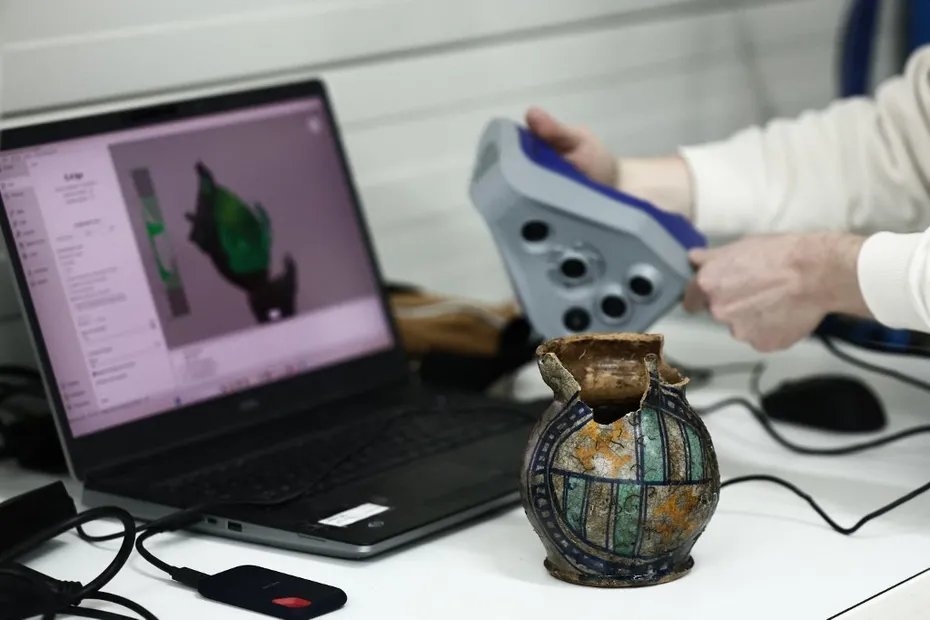
Equipped with cameras and articulated arms, the vehicle captures high-resolution images while allowing operators to manipulate objects with extreme precision. The mission has already produced tens of thousands of photographs, enabling the creation of a detailed 3D model of the site.
A Window into 16th-Century Trade
Among the most striking discoveries are hundreds of ceramic items, including pitchers and plates decorated with floral patterns, crosses, and vivid marine motifs. These artifacts are believed to be Ligurian faience, suggesting the vessel may have originated from Italian ports such as Genoa or Savona.
According to maritime archaeologist Franca Cibecchini, the exceptional visibility at such depth has allowed researchers to examine the site in unprecedented detail.
The wreck’s location, far below the reach of previous salvage efforts, means it has likely remained untouched for centuries. This makes it a rare and valuable source of information about merchant shipping and trade networks during the 1500s.
Delicate Recovery Efforts
Recovering artifacts from such depths presents significant challenges. A small number of ceramic pieces have been carefully retrieved for analysis, but the process remains highly risky.
At a laboratory in Marseille, researchers are studying the recovered items under controlled conditions. Marine Sadania emphasized the importance of developing new techniques to preserve fragile objects, noting that many deep-sea artifacts deteriorate after recovery for reasons not yet fully understood.
Preserving History
The Camarat 4 site is being treated with strict conservation measures in line with UNESCO guidelines, ensuring that the majority of the wreck remains undisturbed on the seabed.
Initial findings from the mission are expected to be presented in a public exhibition at the Toulon Maritime Museum later this year, offering a glimpse into a forgotten chapter of Mediterranean history.
As exploration continues, the mission highlights how modern technology is transforming underwater archaeology, revealing stories long hidden beneath the sea.