
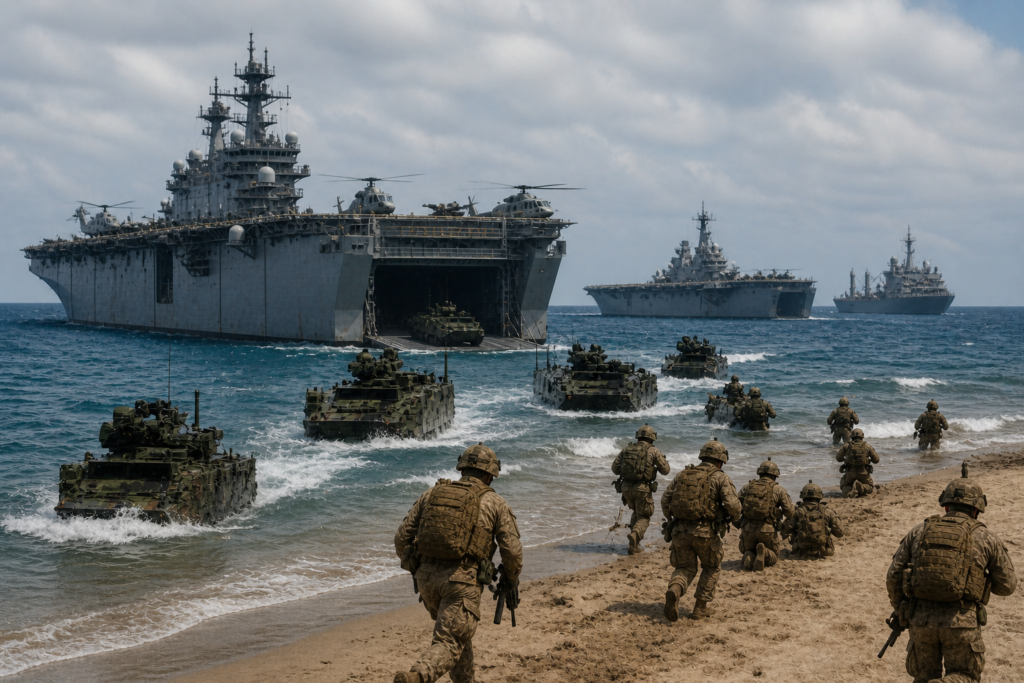
Image Credentials: Image Title: US Marines Say Around 40 Amphibious Ships Needed to Meet Strategic Goals Source: (chatgpt.com) Date: May 2026. Attribution: This image was created using AI-generated imagery (chatgpt.com) by Open Chronicle and does not depict a real-world scene.
By Open Chronicle with Agencies
Senior officials from the United States Marine Corps have indicated that the force will likely require around 40 amphibious warfare ships to meet its operational objectives, highlighting a growing gap between current capabilities and strategic demands.
Speaking at the Modern Day Marine exhibition in Washington, Lt. Gen. Jay Bargeron said ongoing assessments suggest the Corps needs a significantly larger fleet than it currently operates. While the United States Navy maintains 32 amphibious ships, the number required to sustain continuous global deployments is notably higher.
The shortfall is not just numerical. Readiness remains a major concern. According to Vice Adm. James Kilby, only about 45 percent of amphibious ships are considered “combat surge ready”, meaning they are fully prepared for rapid deployment in a crisis. This significantly limits the fleet’s real-world availability.
Marine Lt. Gen. Jay Bargeron said the Corps likely needs around 40 amphibious warfare ships in future,to sustain its goal of keeping 3 Marine Expeditionary Units deployed simultaneously.The Navy currently operates 32 amphibious ships, with only about 45% rated combat surge ready. pic.twitter.com/9KjNPOPDZD
— Valhalla (@ELMObrokenWings) May 2, 2026
Amphibious ships play a central role in deploying Marine Expeditionary Units, or MEUs, which serve as rapid response forces capable of handling a wide range of missions, from humanitarian assistance to combat operations. Each deployment group typically consists of three vessels, including a large amphibious assault ship, a transport dock, and a dock landing ship.
Maintaining three such groups deployed at all times, a strategy often referred to as a “3.0 presence”, requires far more ships than the nine vessels actively at sea. Additional ships are needed for maintenance cycles, transit, and training, creating pressure on an already stretched fleet.
The consequences of limited readiness have already been felt. In 2022, a Marine unit was unable to deploy ahead of Russia’s invasion of Ukraine due to maintenance issues affecting its assigned ships, underscoring the operational risks tied to aging vessels and logistical constraints.
Marine Corps Commandant Eric Smith has previously emphasized that sustained forward deployment is essential for deterrence and rapid response. However, officials acknowledge that demand from combatant commanders may exceed even the current 3.0 model, suggesting the need for an even larger fleet in the future.
Despite agreement between the Marine Corps and the Navy that the current legal minimum of 31 amphibious ships is insufficient, there is still no finalized plan to bridge the gap. Budget constraints, shipbuilding timelines, and maintenance challenges continue to complicate efforts to expand the fleet.
As global tensions evolve and the need for rapid military response grows, the question of how to align strategic ambitions with available resources remains unresolved.