
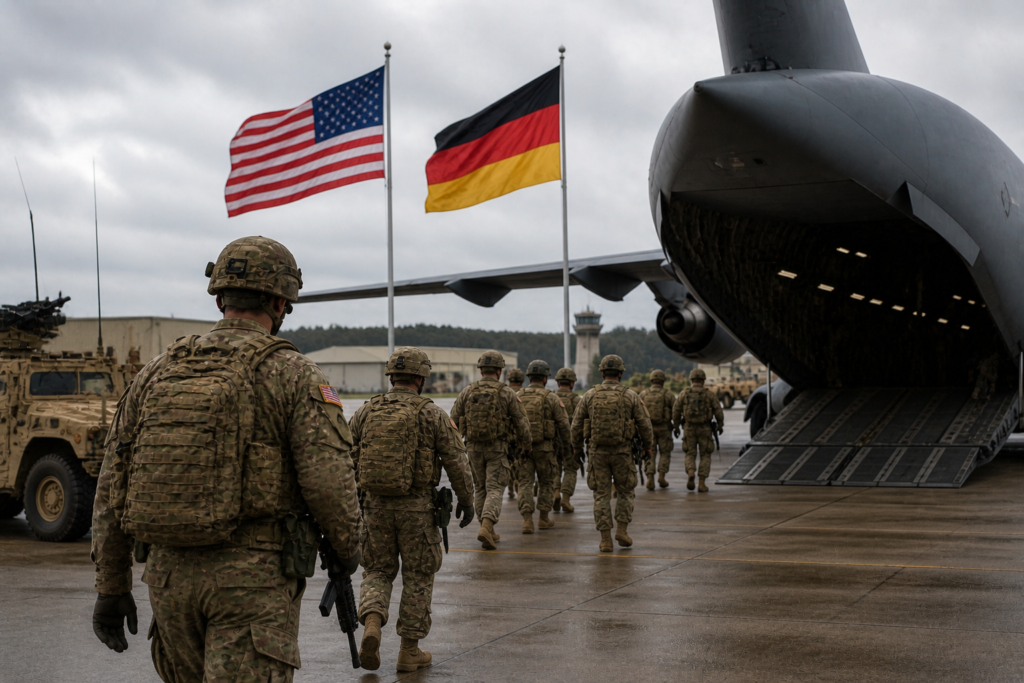
Image Credentials: Image Title: Top Republicans Voice Concern Over Planned US Troop Withdrawal from GermanySource: (chatgpt.com) Date: May 2026. Attribution: This image was created using AI-generated imagery (chatgpt.com) by Open Chronicle and does not depict a real-world scene.
By Open Chronicle with Agencies
Senior Republican lawmakers have expressed strong concerns over the decision to withdraw approximately 5,000 U.S. troops from Germany, warning it could undermine security in Europe and send the wrong message to Vladimir Putin.
In a joint statement, Roger Wicker, chairman of the Senate Armed Services Committee, and Mike Rogers, chairman of the House Armed Services Committee, said they were “very concerned” about the move.
The Republican chairmen of the House and Senate Armed Services Committees criticized on Saturday President Donald Trump’s move to withdraw 5,000 U.S. troops from Germany, amid a feud with German Chancellor Friedrich Merz. https://t.co/oFAU7hLigW
— Washington Examiner (@dcexaminer) May 2, 2026
“We are very concerned by the decision to withdraw a U.S. brigade from Germany,” the lawmakers stated, emphasizing the strategic importance of maintaining a strong American military presence in Europe.
They highlighted that Germany has increased its defense contributions in recent years, responding to calls from Donald Trump for greater burden sharing within NATO. According to the lawmakers, Berlin has provided critical support, including access to bases and operational infrastructure for U.S. forces.
Wicker and Rogers warned that a reduction in troop levels could be interpreted as a weakening of Western resolve. They argued that “prematurely reducing” U.S. forces in Europe risks emboldening Russia at a time of ongoing geopolitical tensions.
Instead of withdrawing forces entirely, the lawmakers suggested redeploying them further east within Europe, where they could reinforce NATO’s front lines. They also called for a more deliberate and comprehensive review process before implementing major changes to U.S. military posture on the continent.
The Pentagon confirmed the planned troop withdrawal earlier, noting that the repositioning is expected to take place over the next six to twelve months.
The decision comes amid diplomatic tensions between Washington and Berlin. Chancellor Friedrich Merz recently criticized the United States over its handling of the Iran conflict, remarks that drew a sharp response from Trump and reignited debate over U.S. commitments to European defense.
As discussions continue, the proposed withdrawal has become a focal point in broader debates about NATO’s future, burden sharing, and the balance of military power in Europe.