
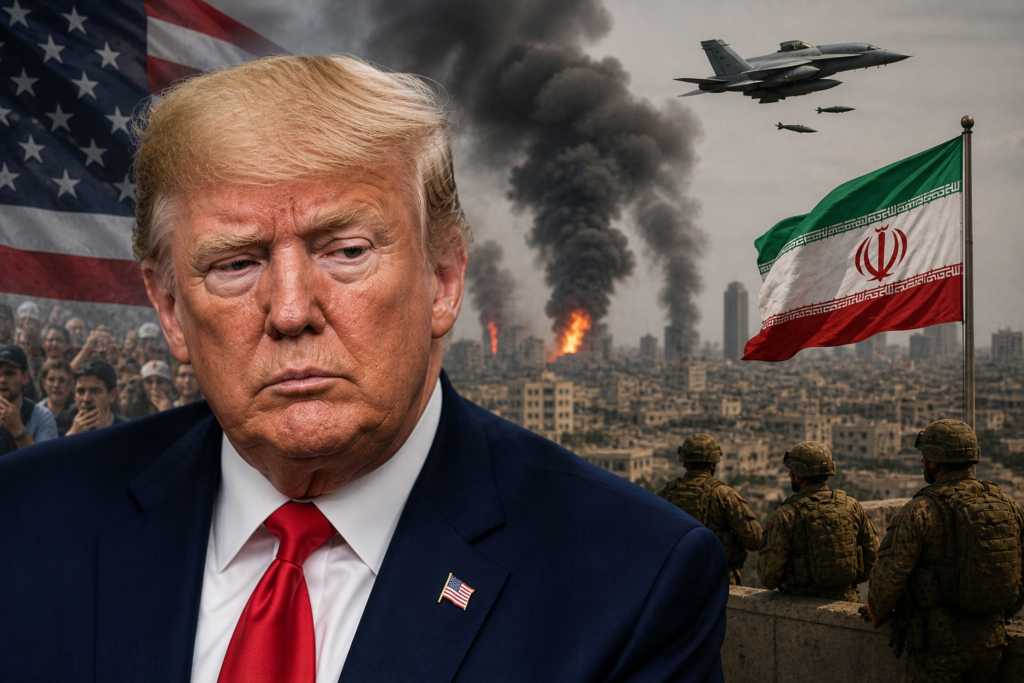
Image Credentials: Image Title: Trump Faces Growing Backlash as Iran War Becomes Deeply Unpopular Source: (chatgpt.com) Date: May 2026. Attribution: This image was created using AI-generated imagery (chatgpt.com) by Open Chronicle and does not depict a real-world scene.
By Open Chronicle with Agencies
The war between the United States and Iran is rapidly becoming one of the most politically damaging conflicts of Donald Trump’s presidency, with public opposition rising sharply and pressure mounting from across the political spectrum.
Recent polling and analysis highlighted by multiple reports, including insights tied to The New York Times, suggest that the conflict is among the least popular U.S. military engagements in modern history. Support for the war has lagged far behind early backing seen in previous conflicts, reflecting widespread skepticism about its purpose and costs.
Public frustration has been driven in large part by economic consequences. Rising fuel prices have become a central issue, with many Americans linking the surge directly to the conflict. Surveys indicate that a majority of citizens believe the war is not worth the financial burden, while a significant share blames the administration for worsening economic conditions.
Criticism has also emerged over how the war began. Reports indicate that Trump’s decision to launch strikes was heavily influenced by instinct and external pressure, despite warnings from intelligence officials and some members of his inner circle about the potential risks.
At the same time, the administration has struggled to present a consistent explanation for the conflict’s objectives. Analysts point to shifting justifications, ranging from countering threats and limiting Iran’s military capabilities to broader ambitions such as regime change, which have complicated public understanding and support.
Even as the White House claims that hostilities have “terminated” following a ceasefire, the situation remains fluid. Military deployments continue across the region, and the U.S. naval blockade targeting Iranian oil exports remains in place, raising questions about whether the conflict has truly ended.
Politically, the war has exposed divisions not only between parties but also within them. While Republican lawmakers have largely supported the administration, signs of unease have begun to surface as the economic and strategic costs become more apparent.
For Trump, the stakes are high. The speed at which public opinion has turned against the war stands out compared to past conflicts, where support typically eroded more gradually. With negotiations still uncertain and tensions lingering, the administration faces a difficult challenge in regaining public confidence.
The unfolding situation underscores a broader reality: in an era of rapid information flow and immediate economic impact, modern conflicts are judged not only on the battlefield but also in public perception at home.