
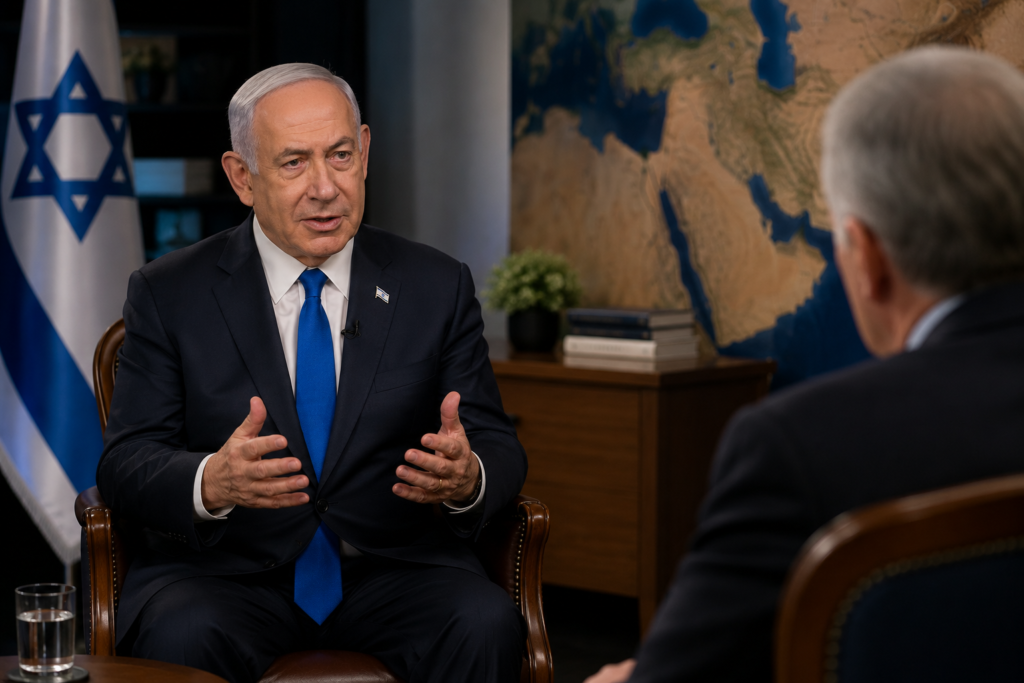
Image Credits: Image Title: Netanyahu Signals Long-Term Shift in U.S.-Israel Relations During Major CBS Interview. Source: (chatgpt.com) Date: May 2026. Attribution: This image was created using AI-generated imagery (chatgpt.com) by Open Chronicle and does not depict a real-world scene.
By Open Chronicle with agencies
Israeli Prime Minister Benjamin Netanyahu delivered one of his most expansive public assessments of the Middle East conflict and Israel’s future strategic direction during a wide-ranging interview with CBS News’ 60 Minutes, addressing the wars involving Iran, Hezbollah, and Gaza while also signaling a major long-term shift in relations with the United States.
During the interview with correspondent Major Garrett, Netanyahu said the conflict with Iran is “not over,” arguing that Tehran’s remaining highly enriched uranium stockpiles continue to pose a major threat.
The Israeli leader declined to discuss specific military plans but insisted that removing Iran’s nuclear capabilities remains a critical objective.
Netanyahu Says Iran Conflict Could Reshape Region
Netanyahu suggested that weakening or even collapsing the Iranian regime could fundamentally alter the Middle East’s balance of power.
“If this regime is indeed weakened or possibly toppled, I think it’s the end of Hezbollah, it’s the end of Hamas, it’s probably the end of the Houthis,” Netanyahu said during the interview.
The prime minister acknowledged that Israeli and American officials did not fully anticipate the scale of disruption linked to the Strait of Hormuz during the conflict, though he argued Iran eventually understood the risks involved in escalating maritime tensions.
Netanyahu also claimed several Arab governments are now increasingly interested in strengthening strategic and economic cooperation with Israel, particularly in sectors such as energy, artificial intelligence, and advanced technology.
Concerns Over China and Iran
The Israeli leader additionally raised concerns regarding China’s relationship with Iran, suggesting Beijing has provided certain forms of support connected to missile manufacturing.
Although Netanyahu declined to elaborate in detail, his remarks highlighted growing Israeli and American concerns about the broader international dimension of the Iran conflict.
The comments come ahead of a major summit between Donald Trump and Chinese President Xi Jinping scheduled this week in Beijing, where Iran and regional security are expected to feature prominently in discussions.
Netanyahu Wants Israel to Reduce Dependence on U.S. Aid
One of the interview’s most striking moments came when Netanyahu said he wants Israel to gradually phase out American military financial assistance over the next decade.
Israel currently receives approximately $3.8 billion annually in U.S. military aid under long-standing bilateral agreements.
“I want to draw down to zero the American financial support,” Netanyahu said, adding that he believes Israel should begin reducing reliance on U.S. military assistance immediately.
The remarks could signal a significant strategic and political shift in one of the closest alliances in modern international relations.
Gaza War and Global Criticism
Netanyahu also addressed growing international criticism over Israel’s military operations in Gaza.
According to the Hamas-run Gaza Health Ministry, more than 70,000 people have been killed during the conflict, including both civilians and militants.
The Israeli prime minister blamed much of the reputational damage suffered by Israel on social media and what he described as coordinated information campaigns against the country.
He rejected accusations that Israel deliberately targets civilians and argued that the Israeli military has made extraordinary efforts to minimize civilian casualties.
Netanyahu also criticized the role of digital platforms in shaping international perceptions of the war, calling social media another “front” in the conflict.
Hamas, Hezbollah, and the Future of Gaza
The prime minister insisted Israel will not allow Hamas to remain armed in Gaza after the war.
He said Gaza must ultimately be “disarmed, demilitarized and deradicalized,” though he acknowledged uncertainty over who would eventually oversee the territory.
Regarding Hezbollah, Netanyahu suggested that fighting in Lebanon could continue separately even if a ceasefire were reached involving Iran.
He argued that Hezbollah continues threatening Israeli communities and said Israel would not accept conditions that leave the group intact along its northern border.
Declining Support in the United States
The interview comes at a moment of shifting American public opinion toward Israel.
A recent Pew survey cited during the broadcast found that roughly 60% of Americans now hold unfavorable views of Israel, reflecting a significant increase over recent years.
Analysts say Netanyahu’s remarks indicate growing awareness within the Israeli leadership that long-term strategic, political and economic adjustments may be necessary as regional alliances and global perceptions continue evolving.