
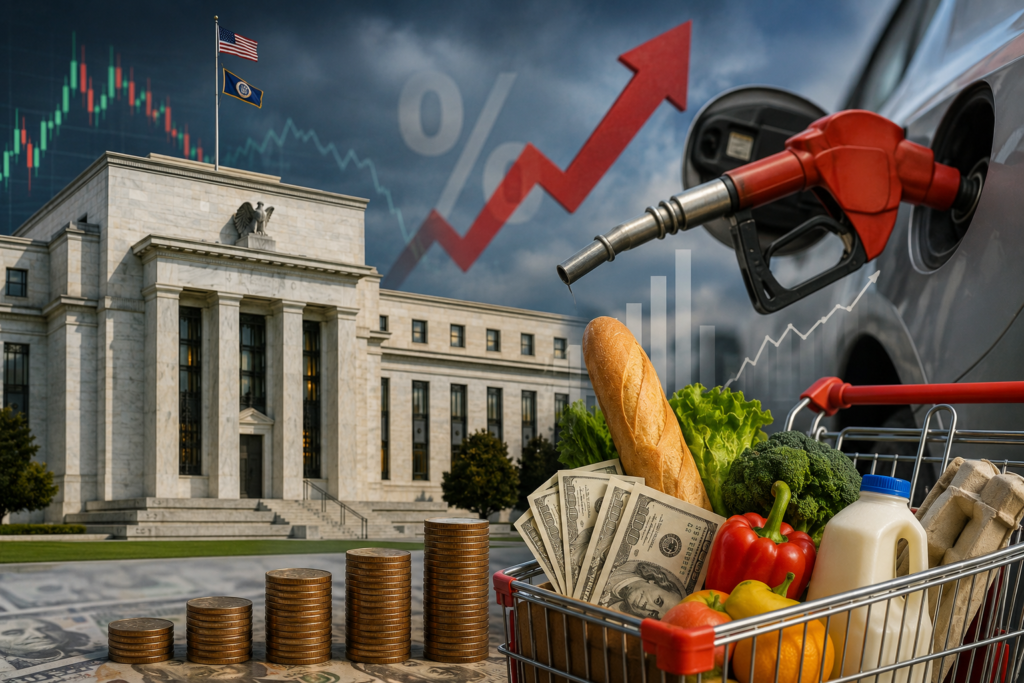
Image Credits: Image Title: Rising Inflation Complicates Federal Reserve Plans for Future Rate Cuts. Source: (chatgpt.com) Date: May 2026. Attribution: This image was created using AI-generated imagery (chatgpt.com) by Open Chronicle and does not depict a real-world scene.
By Open Chronicle with agencies
The sharp rise in inflation across the United States is making it increasingly difficult for the Federal Reserve to continue considering interest rate cuts, as policymakers confront growing economic uncertainty tied to energy prices and geopolitical tensions.
Fresh economic data released this week showed annual inflation climbing to 3.8% in April, the highest level recorded since May 2023, fueled largely by surging energy costs linked to the ongoing conflict involving Iran.
The figures have intensified debate inside the Federal Reserve over the future direction of monetary policy ahead of the central bank’s June meeting.
Energy Prices Drive Inflation Surge
According to data from the US Department of Labor, consumer prices rose 0.6% month-over-month in April, matching expectations but exceeding forecasts on an annual basis.
Energy costs were among the biggest contributors to the increase.
The energy index jumped 3.8% compared with the previous month and surged 17.9% year-over-year, accounting for more than 40% of the monthly rise in inflation.
Core inflation, which excludes volatile food and energy prices, also accelerated beyond expectations, rising 0.4% monthly and 2.8% annually.
Economists say the figures indicate that inflationary pressures are spreading into broader sectors of the economy.
Federal Reserve Faces Difficult Choices
The inflation surge comes as the labor market continues showing resilience.
US non-farm payrolls increased by 115,000 jobs in April, while unemployment remained steady at 4.3%, suggesting the economy has not yet weakened enough to justify aggressive monetary easing.
The combination of strong employment and persistent inflation complicates the Federal Reserve’s effort to balance economic growth with its long-term inflation target of 2%.
The central bank kept interest rates unchanged at its April meeting, within the 3.5%-3.75% range.
However, internal divisions among policymakers became increasingly visible.
The decision passed with eight votes against four, marking the highest level of disagreement inside the Federal Open Market Committee since 1992.
Analysts See Rate Cuts Delayed
Padhraic Garvey said rising inflation expectations make near-term interest rate cuts highly unlikely.
“Higher printed inflation and higher inflation expectations make it extremely difficult for the Fed to even consider cutting rates anytime soon,” Garvey said.
He warned that the duration of the Iran conflict and the continued disruption surrounding the Strait of Hormuz will heavily influence future monetary policy decisions.
“The longer the war, the longer the wait for eventual cuts,” he added.
Consumer Confidence Weakens
While the labor market remains relatively stable, American consumers are showing signs of growing anxiety.
The University of Michigan’s Consumer Sentiment Index fell to a record low of 48.2 in May as households reacted to higher fuel prices, rising living costs and geopolitical uncertainty.
Consumers’ inflation expectations for the coming year remained elevated despite a slight decline compared with April levels.
Analysts say weakening consumer confidence could eventually slow spending and place additional strain on the broader economy.
Debate Intensifies Over Fed Direction
Ryan Sweet said inflation figures reinforce expectations that the Federal Reserve will likely leave interest rates unchanged through the end of the year.
“Our outlook for monetary policy to remain on pause until year’s end is unchanged,” Sweet said.
He noted that while inflation remains elevated, some pressures linked to housing and tariffs could gradually ease later in the year.
Meanwhile, Steven Kamin warned the latest inflation data would strengthen the Federal Reserve’s more hawkish members.
“These data make the Fed’s hawkish wing even more hawkish,” Kamin said.
He added that any attempt by incoming Federal Reserve Chair nominee Kevin Warsh to push for rate cuts in June would likely face major resistance within the central bank.
Iran Conflict Continues, Affecting the Global Economy
The inflation surge has been closely tied to instability in global energy markets following the conflict involving Iran, the United States, and Israel.
Iran’s temporary closure of the Strait of Hormuz disrupted oil shipments and drove global fuel prices sharply higher, adding pressure to economies worldwide.
The economic impact of the conflict continues to extend beyond energy markets, influencing financial policy, consumer behavior, and global growth expectations.