
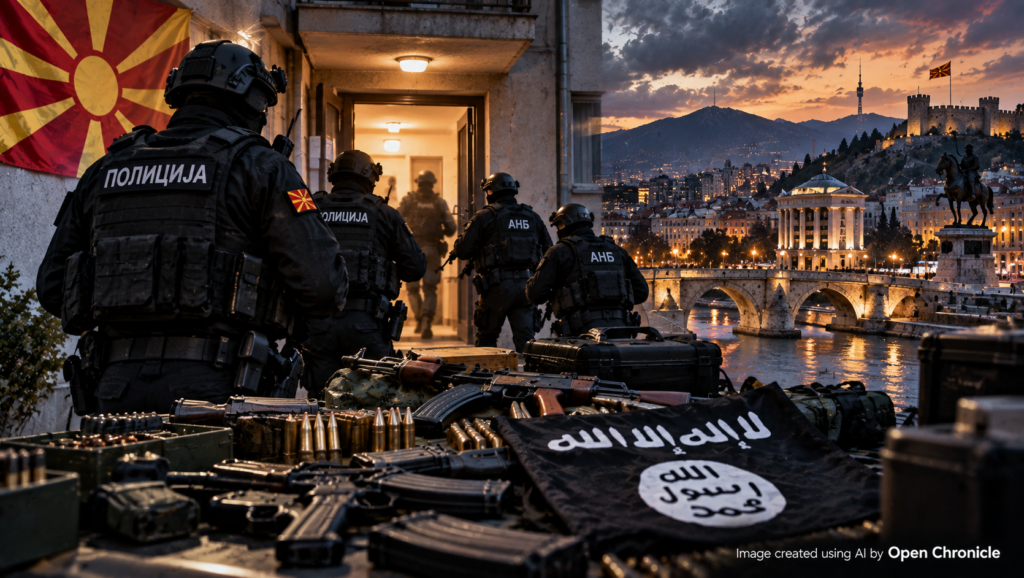
Authorities in North Macedonia have carried out a major counterterrorism operation targeting a group suspected of links to ISIS, seizing weapons, ammunition and an Islamic State flag during searches at several locations in Skopje.
By Open Chronicle with agencies | October 1, 2026
SKOPJE — Security forces in North Macedonia have carried out a large counterterrorism operation against a suspected ISIS linked cell, following an investigation into a small group allegedly involved in extremist activity, indoctrination and criminal financing.
The operation was conducted jointly by North Macedonia’s Ministry of Internal Affairs and the National Security Agency, with searches taking place at several locations in the capital, Skopje.
According to information attributed to security sources, investigators had identified a group of approximately five people suspected of involvement in illegal activities.
Authorities are investigating allegations that members of the group were involved in loan sharking, the indoctrination of civilians and incitement to terrorism.
ISIS flag discovered during searches
One of the most significant discoveries during the operation was a flag associated with the Islamic State.
Security officers also seized weapons and a substantial quantity of ammunition from locations connected with the investigation.
The combination of extremist material, firearms and ammunition is now expected to form an important part of the investigation into the group’s activities and intentions.
The information available does not establish whether authorities believe a specific attack was being prepared.
Investigators will therefore need to determine whether the weapons were intended for criminal activity, terrorist operations, logistical support or another purpose.
Around five people reportedly under investigation
The suspected network is believed to involve approximately five individuals.
Security authorities are examining several aspects of their activities, including possible radicalisation efforts and attempts to influence or recruit other people.
The investigation also includes allegations of loan sharking.
Criminal financing has long been a concern in counterterrorism investigations because relatively small networks can potentially use conventional criminal activities to finance themselves without depending on large international funding structures.
Money generated through illegal activity can potentially support recruitment, travel, equipment purchases and other logistical requirements.
However, the precise relationship between the alleged financial activities and suspected extremist activity in this case remains subject to investigation.
Authorities examine possible recruitment activity
Investigators are also examining whether members of the suspected group were involved in indoctrinating civilians and encouraging extremist activity.
That element could prove particularly important in determining whether authorities were dealing with an organised terrorist cell, a radicalisation network or individuals engaged in a combination of extremist and criminal activities.
The discovery of Islamic State material provides investigators with evidence of an apparent ideological connection, but the group’s operational capabilities and intentions will require further examination.
Authorities have not established publicly, based on the information provided, whether the suspects had direct operational contact with senior ISIS figures or organisations outside North Macedonia.
Balkans remain important to European counterterrorism efforts
The operation also draws renewed attention to the strategic position of the Balkans within European counterterrorism planning.
North Macedonia sits along routes connecting southeastern and central Europe with Turkey and areas farther east.
During the years in which ISIS controlled significant territory in Syria and Iraq, authorities across Europe closely monitored movements through the Balkans amid concerns about foreign fighters travelling toward conflict zones or returning to Europe.
The collapse of the Islamic State’s territorial control did not eliminate the organisation’s networks or ideological influence.
Security services have consequently continued monitoring individuals suspected of recruitment, financing, propaganda and logistical support.
Weapons seizure raises questions about cell’s intentions
The discovery of weapons and a large quantity of ammunition is likely to become a central focus of the investigation.
Possession of extremist propaganda or symbols can indicate ideological sympathies, while access to firearms and ammunition introduces a separate security concern.
Investigators will need to establish how the weapons were obtained, who controlled them and whether they were intended for any planned operation.
Forensic examination of electronic devices, communications and financial records could also help authorities determine whether the suspects were operating independently or communicating with individuals elsewhere.
The information provided so far does not indicate that authorities have publicly identified a planned target.
Criminal activity can provide funding for extremist networks
The allegation that members of the group engaged in loan sharking illustrates the potential overlap between organised crime and extremist financing.
Small extremist networks do not necessarily require sophisticated international financial structures.
Illegal lending, fraud, theft, trafficking and other criminal activity can provide funding for equipment, transportation, recruitment or personal expenses.
Determining whether the alleged loan sharking in North Macedonia was directly connected with extremist activities will therefore be an important part of the investigation.
Turkey detained hundreds of suspected ISIS members in May
The North Macedonian operation comes several months after Turkish authorities conducted another major crackdown on suspected Islamic State networks.
In May, Turkish authorities detained 324 people suspected of links to ISIS.
Turkey occupies a particularly important position in regional counterterrorism because of its proximity to Syria and Iraq and its connections with transportation routes running through southeastern Europe.
Security cooperation between Balkan governments and Turkey therefore remains an important component of efforts to identify suspected extremist networks and movements across the region.
Investigation continues in North Macedonia
The operation in Skopje remains an active investigation, and the evidence seized during the searches will now be examined by North Macedonian authorities.
The discovery of an ISIS flag, weapons and ammunition has increased the seriousness of the case, but several central questions remain unanswered.
Investigators must determine the extent of the suspected group’s organisation, whether recruitment was taking place, how its alleged criminal activities were financed and whether there were preparations for violence.
They will also seek to establish whether the suspected network had connections outside North Macedonia.
For the country’s security services, the investigation represents another reminder that although ISIS no longer controls the extensive territory it once held in Syria and Iraq, small networks and individuals influenced by its ideology continue to present a counterterrorism challenge far beyond the Middle East.