
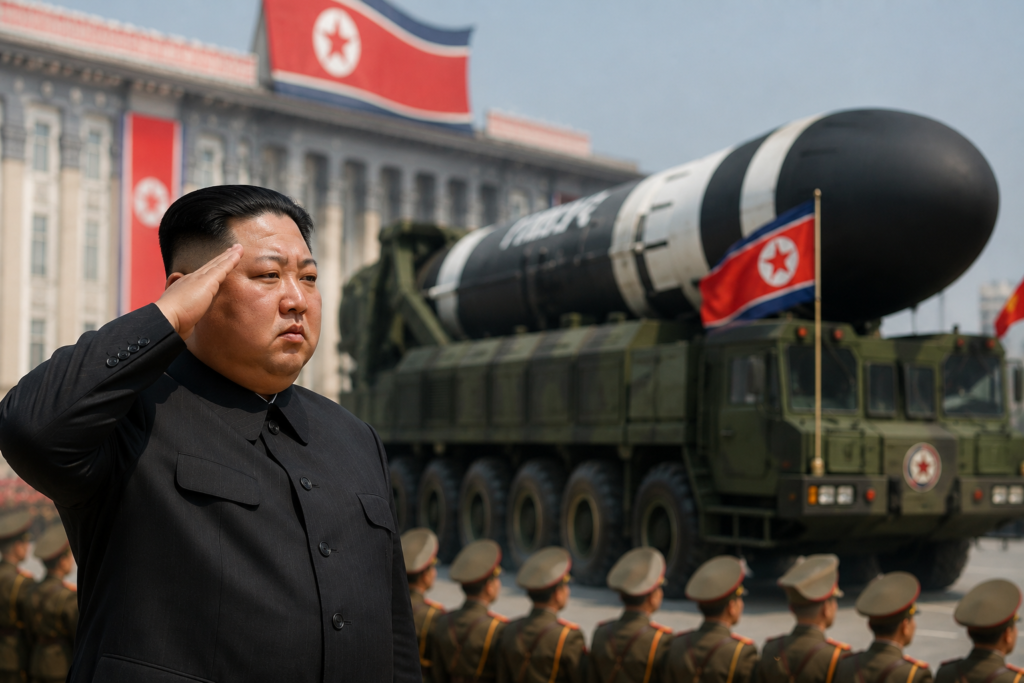
Image Credits: Image Title: North Korea Says Nuclear Weapons Would Be Used Automatically if Kim Jong-un Is Killed. Source: (chatgpt.com) Date: May 2026. Attribution: This image was created using AI-generated imagery (chatgpt.com) by Open Chronicle and does not depict a real-world scene.
By Open Chronicle with agencies
North Korea has announced a constitutional revision stating that the country’s nuclear weapons could be used automatically if leader Kim Jong-un is killed, a move that has sparked widespread international concern over regional and global security.
The announcement from Pyongyang marks one of the strongest public declarations yet regarding the country’s nuclear doctrine and succession planning in the event of an attack against its leadership.
According to North Korean state authorities, the constitutional revision is intended to strengthen the country’s deterrence posture and guarantee an immediate military response under extreme circumstances.
Constitutional Revision Raises Alarm
The changes reportedly establish automatic nuclear retaliation mechanisms if the North Korean leadership structure is decapitated during a conflict.
International analysts warn that the doctrine significantly increases the risks of rapid escalation during any future military confrontation involving the Korean Peninsula.
Security experts say the policy could reduce the possibility of diplomatic de-escalation during crises because commanders may feel pressure to act immediately under pre-authorized procedures.
The announcement has triggered concern among governments across Asia, Europe, and North America, particularly because it comes amid heightened geopolitical tensions involving nuclear powers around the world.
Pyongyang Defends Nuclear Strategy
North Korean officials have long argued that nuclear weapons are essential for the country’s survival against what they describe as hostile policies from the United States and its allies.
Pyongyang frequently cites joint military exercises conducted by the United States and South Korea as evidence of external threats against the regime.
The latest constitutional revision appears designed to further institutionalize nuclear weapons as a permanent and central component of the country’s national defense strategy.
In recent years, Kim Jong-un has repeatedly overseen missile tests, military modernization programs, and the expansion of tactical and strategic nuclear capabilities.
International Concerns Intensify
Governments and defense analysts fear the policy could increase instability in Northeast Asia, one of the world’s most heavily militarized regions.
The United States, South Korea, and Japan have strengthened defense cooperation in response to North Korea’s expanding missile and nuclear programs.
Regional observers say the announcement may also complicate future diplomatic negotiations aimed at limiting Pyongyang’s nuclear arsenal.
The constitutional revision comes as tensions remain high over ballistic missile launches, military exercises, and broader geopolitical competition involving China, Russia, and the United States.
Nuclear Doctrine Continues to Evolve
North Korea officially declared itself a nuclear weapons state several years ago and has increasingly incorporated nuclear policy into state law and constitutional structures.
Analysts say the latest move reflects Pyongyang’s determination to remove ambiguity about how it would respond to threats against the country’s leadership.
Some experts warn that automatic retaliation policies carry serious risks because they can reduce decision-making time during crises and increase the possibility of accidental escalation.
Despite international sanctions and diplomatic pressure, North Korea has continued advancing its weapons programs while deepening military cooperation with countries opposed to Western influence.
Global Attention Focused on Peninsula
The Korean Peninsula remains one of the most sensitive flashpoints in global security.
Diplomatic efforts between Pyongyang and Washington have largely stalled in recent years, while sanctions imposed by the United Nations remain in place.
Military officials and foreign policy experts are expected to closely monitor any further details regarding the constitutional revision and how it could alter North Korea’s military command structure.