
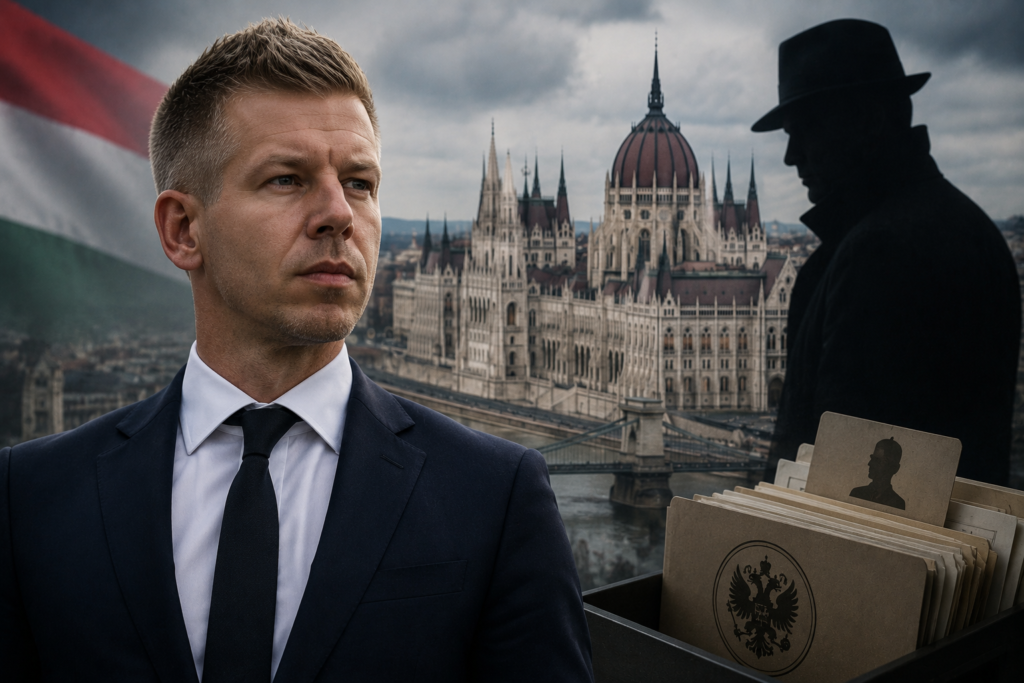
Image Credentials: Image Title: Hungary Signals Major Break with Kremlin as Péter Magyar Targets Russian Spy Network. Source: (chatgpt.com) Date: May 2026. Attribution: This image was created using AI-generated imagery (chatgpt.com) by Open Chronicle and does not depict a real-world scene.
By Open Chronicle with agencies
Hungary’s incoming government under Péter Magyar is preparing one of the most significant counterintelligence shifts in Central Europe since the start of Russia’s full-scale invasion of Ukraine, with plans to dismantle and expel more than a dozen Russian intelligence officers operating under diplomatic cover in Budapest.
According to Hungarian counterintelligence sources cited in the report, the classified list includes operatives linked to Russia’s Foreign Intelligence Service, known as the SVR, and the military intelligence agency GRU. The move would mark a sharp departure from the approach pursued under former Prime Minister Viktor Orbán, whose government largely resisted mass expulsions of Russian diplomats after 2022.
Under Orbán, Hungary developed a reputation among European and NATO intelligence agencies as one of the more permissive operational environments for Russian influence activities inside the alliance. While countries such as Poland, Germany, the Czech Republic, and the Baltic states expelled large numbers of Russian intelligence officers following the invasion of Ukraine, Budapest mostly limited itself to isolated and discreet removals intended to avoid confrontation with Moscow.
Security analysts say the planned expulsions could fundamentally alter Hungary’s geopolitical positioning inside NATO and the European Union.
For years, Budapest was viewed as a valuable regional platform for Russian intelligence operations, including surveillance of NATO institutions, sanctions monitoring, influence campaigns, and covert logistical coordination across Central Europe and the Balkans.
The Magyar government now appears determined to dismantle that infrastructure entirely.
The shift follows earlier signs of a harder line toward Moscow, including Hungary’s decision to summon the Russian ambassador after drone strikes near Ukraine’s Zakarpattia region, close to the Hungarian border.
Officials close to the incoming administration reportedly see the crackdown as necessary to restore trust with NATO allies and close what many Western intelligence services considered one of the alliance’s most vulnerable security gaps on its eastern flank.
If fully implemented, the operation would likely force Russian intelligence agencies to relocate key regional activities to alternative jurisdictions such as Serbia, Austria or other non-EU states, analysts say.
The move could also improve intelligence-sharing relationships between Hungary and other NATO members. In recent years, several allied services reportedly reduced the depth of sensitive cooperation with Budapest because of concerns over Russian penetration risks and political leakage channels.
For Moscow, the consequences could be substantial.
Experts warn that Russia may respond with retaliatory measures, including cyberattacks, disinformation campaigns, economic pressure, and intensified covert activity through unofficial channels.
The Kremlin is also expected to view the expulsions not merely as a defensive security action, but as evidence of a broader geopolitical realignment away from Orbán-era balancing and toward a more openly Euro-Atlantic orientation.
The policy shift could significantly reshape Hungary’s relationship with Ukraine as well.
Relations between Budapest and Kyiv have remained strained for years over disputes involving the Hungarian minority in Zakarpattia, sanctions policy, and accusations that Hungary tolerated Russian influence networks operating close to Ukraine’s western border.
A large-scale purge of Russian intelligence officers would likely be interpreted in Kyiv as a signal that Hungary is reassessing its strategic position and moving closer to NATO security priorities.
Ukrainian officials have long viewed Russian diplomatic and intelligence activity in Hungary as a direct regional threat because of the country’s proximity to Ukraine and the sensitive geopolitical importance of Zakarpattia. Russian services have repeatedly been accused of attempting to exploit ethnic tensions and political disputes in the region to weaken both Ukraine and NATO cohesion.
Analysts say a sustained anti-Kremlin pivot by Budapest could reduce bilateral tensions, reopen institutional dialogue, and improve cooperation on border security, sanctions enforcement, and counterintelligence coordination.
At the same time, longstanding disputes over language rights, education policies, and minority protections are expected to remain sensitive issues between the two countries.
For NATO, however, the broader strategic implications may be even more significant.
A decisive Hungarian break with Russian intelligence networks would strengthen the alliance’s eastern security architecture and reduce one of the last remaining areas in Central Europe where Moscow retained comparatively broad operational freedom.
If sustained, the transformation under Péter Magyar could become one of the most consequential geopolitical realignments inside the European Union since the outbreak of the war in Ukraine.