
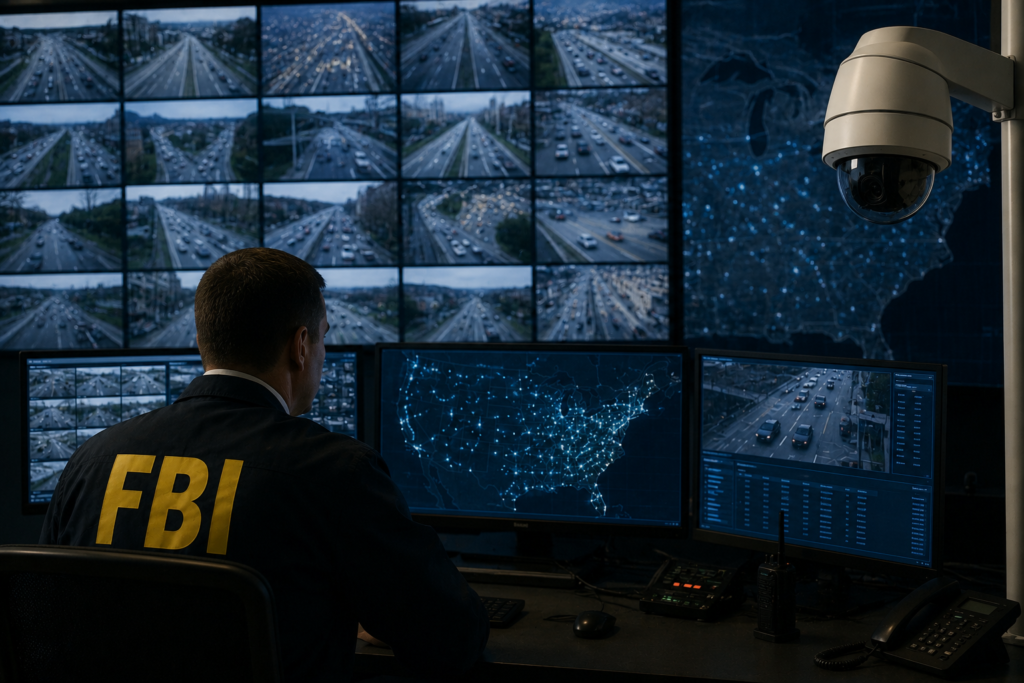
Image Credentials: Image Title: FBI Moves Toward Nationwide License Plate Surveillance Network. Source: (chatgpt.com) Date: May 2026. Attribution: This image was created using AI-generated imagery (chatgpt.com) by Open Chronicle and does not depict a real-world scene.
By Open Chronicle with agencies
The Federal Bureau of Investigation is seeking nationwide access to a vast network of automated license plate reader systems capable of tracking vehicles across the United States in near real time, according to newly published government procurement documents.
The initiative, revealed through a Request for Proposals issued by the FBI’s Directorate of Intelligence on May 14, outlines plans to award contracts to one or more technology vendors capable of providing broad access to vehicle tracking data gathered from cameras installed across roads, highways, and urban areas throughout the country.
Under the proposal, the FBI wants the ability to search and analyze license plate data using vehicle descriptions, time and location filters, geographic mapping tools, and automated notifications tied to specific vehicles or movements.
The agency said the system must be capable of accessing or querying cameras “across the United States and its territories” while providing data “in near real time.”
The proposed system would also allow investigators to search using partial plate numbers, vehicle makes and models, addresses, and previous locations where vehicles were detected. Contractors would additionally be required to provide “heat mapping” tools capable of visualizing camera coverage nationwide.
The project highlights the growing role of mass surveillance technologies in modern law enforcement and intelligence operations, but it is already raising significant privacy and civil liberties concerns.
The FBI stated that the network is necessary to “evaluate and manage threats to personal safety, property, and law enforcement,” arguing that license plate readers help authorities monitor subjects traveling on American roads and highways.
The contract could ultimately be worth up to $36 million over five years and is divided into six regional zones covering the continental United States, Alaska, Hawaii, Puerto Rico, Guam, and other US territories.
Two companies are widely viewed as the leading candidates to participate in the program: Flock Safety and Motorola Solutions.
Flock Safety already operates one of the country’s largest automated license plate reader networks, supplying camera systems to more than 12,000 public safety agencies and local governments. Motorola Solutions also maintains extensive vehicle surveillance infrastructure used by police departments across the United States.
Civil liberties advocates have long warned that such systems can evolve into large-scale mass surveillance platforms capable of monitoring the movements of millions of ordinary citizens without warrants or direct judicial oversight.
Privacy organizations have also raised concerns about data retention, data sharing, and the risk of wrongful identification caused by plate recognition errors.
Recent reports revealed that local police departments used Flock’s systems to assist federal immigration enforcement operations, even though federal agencies did not directly hold contracts for the technology.
The FBI already operates a separate license plate reader information-sharing program with state and local agencies, but the new proposal would dramatically expand federal access to live surveillance infrastructure and commercial vehicle tracking databases.
Flock Safety has publicly stated that data sharing with federal agencies remains “opt-in” and controlled by local law enforcement agencies that own the cameras. The company insists there is “no backdoor” into its systems and that access requires explicit authorization.
However, critics argue that the increasing integration of local, state, and federal surveillance networks creates the potential for nationwide monitoring systems that extend far beyond their original public safety purpose.
The expansion effort also faces potential legal obstacles.
Several states, including California and Virginia, have enacted laws restricting the sharing of license plate reader data with federal agencies or out-of-state law enforcement bodies. The FBI’s proposal specifically requires contractors to identify where surveillance data is stored to ensure compliance with state privacy laws.
The growing use of automated surveillance technologies has become one of the most contentious debates in American law enforcement, balancing national security concerns against fears of expanding government monitoring powers in daily civilian life.