
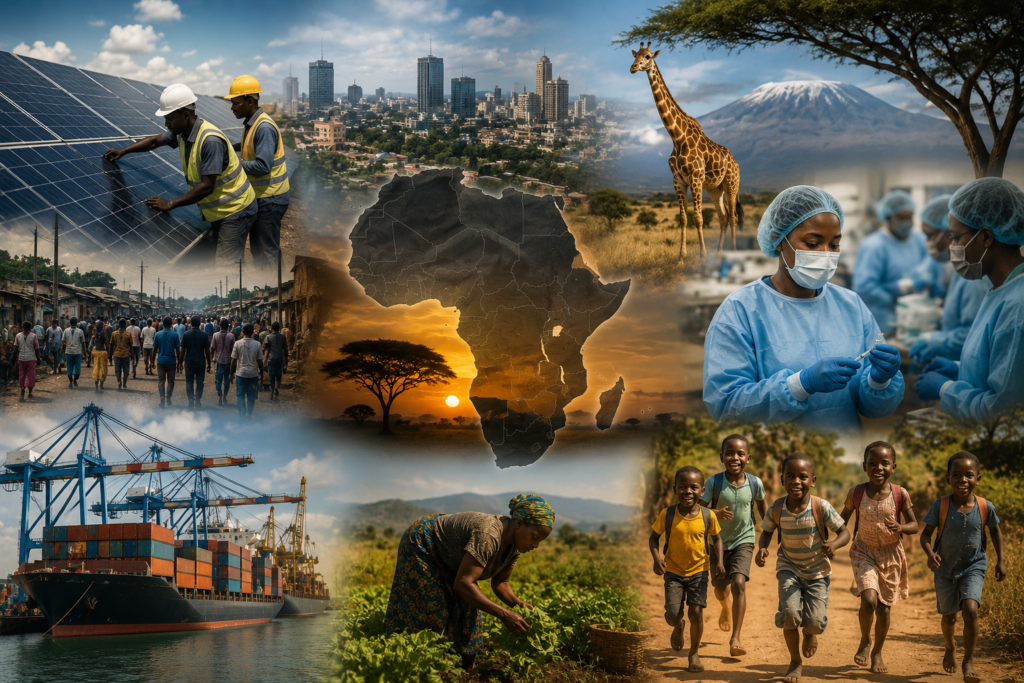
Image Credentials: Image Title: Africa Faces Defining Moment as Health Crises, Economic Expansion and Geopolitical Competition Reshape the Continent. Source: (chatgpt.com) Date: May 2026. Attribution: This image was created using AI-generated imagery (chatgpt.com) by Open Chronicle and does not depict a real-world scene.
By Open Chronicle with agencies
Africa is entering a critical period marked by rapid economic transformation, mounting public health concerns, growing geopolitical competition, and renewed debates over sovereignty, migration, and development across the continent.
From expanding Chinese investment and rising tourism sectors to Ebola fears and anti-migrant unrest in South Africa, developments across Africa this week highlighted both the continent’s growing global importance and the persistent structural challenges many nations continue to face.
Health Security and Ebola Concerns Intensify
One of the most urgent concerns across Africa remains public health security.
The World Health Organization and the Africa Centres for Disease Control and Prevention warned against underestimating the threat posed by the latest Ebola outbreak, which has already caused hundreds of suspected deaths according to WHO assessments.
Fears surrounding the outbreak have already disrupted diplomatic and economic activity, including the postponement of a planned Africa summit in India due to concerns about regional transmission risks.
At the same time, African health authorities and international organizations launched several new initiatives aimed at strengthening medical resilience across the continent.
The WHO and the African Medicines Agency unveiled a landmark framework intended to improve access to quality-assured medicines and healthcare products throughout Africa.
Regional governments in Southern Africa are also committed to deeper health cooperation designed to improve sovereignty over medical supply chains, epidemic response systems, and pharmaceutical production.
Experts increasingly argue that investment in African health research and development could unlock hundreds of billions of dollars in long-term economic gains while reducing dependence on foreign medical systems.
South Africa Faces Multiple Domestic Pressures
South Africa remained at the center of several major developments.
Authorities warned citizens about growing employment scams involving fake “Teacher Assistants Phase 6” recruitment campaigns circulating on Facebook and other social media platforms.
At the same time, anti-migrant protests intensified in parts of the country, with police clashing with displaced migrants as tensions over immigration, unemployment, and public services continued to rise.
South Africa’s healthcare system also came under renewed scrutiny amid warnings about severe shortages of orthopedic surgeons and broader structural weaknesses inside provincial hospitals.
The country’s energy and economic challenges remain significant as well.
Analysts warned that South Africa’s ongoing fuel crisis reflects deeper structural issues beyond taxation or short-term inflation pressures. However, there were also positive economic developments, including South Africa overtaking Spain to become the world’s leading citrus exporter.
Meanwhile, political debate intensified over land reform policies, migration, and the future direction of the country’s economy ahead of the FIFA World Cup 2026, for which South Africa announced a provisional 32-man national squad.
Africa Becomes Central to Global Investment Competition
Economic competition for influence in Africa continued to accelerate as major global powers expanded investment and strategic partnerships across the continent.
China’s role remains especially significant.
Chinese solar exports to Africa surged sharply this year as Beijing deepened its efforts to position itself as a leading supplier of renewable energy infrastructure throughout the continent.
At the same time, Chinese-backed investments in transportation, digital infrastructure, and industrial development continue to reshape several African economies.
The Africa Finance Corporation announced a new $100 million commitment focused on accelerating digital growth across Africa, while discussions over artificial intelligence sovereignty also gained momentum.
Experts noted that Africa’s ambitious $60 billion AI development strategy still relies heavily on foreign technology infrastructure, including advanced Nvidia processors and major international technology companies.
Meanwhile, Japan, India, and European nations all increased efforts to strengthen economic and development partnerships with African governments.
India and Africa continued expanding cooperation in health security, agriculture, and defense, while Japan deepened programs focused on job creation and technology transfer.
Tourism, Infrastructure, and Trade Expand
Several African countries are also benefiting from rising tourism and trade activity.
Kenya’s coastline has emerged as one of East Africa’s fastest-growing tourism hubs, while Zanzibar continues attracting international attention with new hospitality and culinary projects blending African and Asian influences.
Infrastructure remains a major challenge, however.
Industry leaders warned that outdated port systems continue to limit Africa’s ability to achieve stronger economic integration and export growth.
Experts increasingly argue that modern logistics systems, transport networks, and digital infrastructure will be essential if African economies are to fully capitalize on rising global demand and expanding regional trade opportunities.
Security Threats and Geopolitical Tensions Increase
Security concerns also intensified across multiple regions.
In Mali, reports emerged that a Russian-made Shahed drone had been shot down, potentially marking the first known operational use of the Iranian-designed drone system in Africa.
The incident highlighted the growing role of foreign military technologies and geopolitical rivalries across the continent, particularly involving Russia, China, Western nations, and regional powers.
Meanwhile, Ukraine rejected claims of a mass influx of workers arriving from Asia and Africa, while several African governments continued monitoring the broader global migration debate closely.
Africa’s Future at a Crossroads
As Africa Day celebrations approach, political leaders, economists, and civil society groups are increasingly framing the continent’s future as a defining global issue rather than a regional one.
Discussions surrounding economic sovereignty, healthcare independence, technology control, migration, climate resilience, and industrial development are now shaping Africa’s role in the global order.
While the continent continues facing deep structural inequalities and security challenges, many analysts believe Africa is also entering a period of unprecedented strategic importance as global powers compete for influence, investment opportunities, and long-term partnerships.
For millions across the continent, the coming years may determine whether Africa can transform its demographic growth, natural resources, and expanding markets into sustainable prosperity and political stability.