
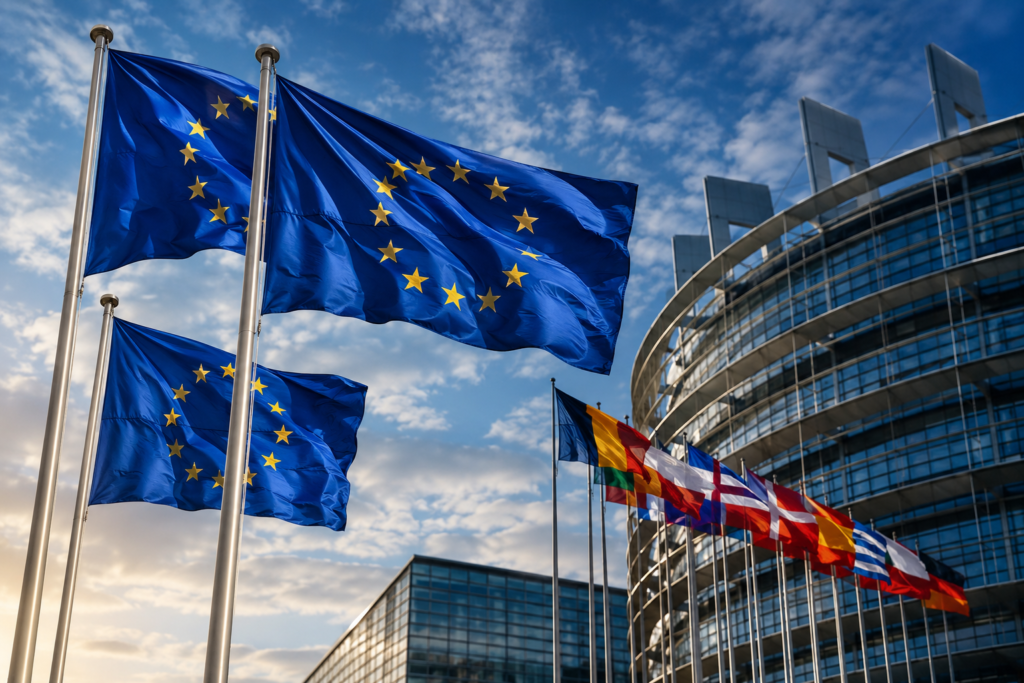
Image Credentials: Image Title: European Union Faces Mounting Pressure Over Ukraine, Iran, Israel and Economic Uncertainty. Source: (chatgpt.com) Date: May 2026. Attribution: This image was created using AI-generated imagery (chatgpt.com) by Open Chronicle and does not depict a real-world scene.
By Open Chronicle with agencies
The European Union is confronting an increasingly complex geopolitical landscape as leaders across the bloc struggle to balance security concerns, economic pressures, energy instability, and growing diplomatic divisions over conflicts stretching from Ukraine and Iran to Gaza and the wider Middle East.
From Brussels to Berlin and Warsaw, European policymakers are attempting to project unity while simultaneously dealing with internal disagreements over sanctions, defense policy, migration, trade, and EU enlargement.
EU Expands Pressure on Iran Over Strait of Hormuz
One of the bloc’s most significant moves this week was the expansion of sanctions targeting Iran over growing tensions surrounding navigation and maritime security in the Strait of Hormuz.
EU officials announced new measures aimed at entities linked to threats against commercial shipping routes in the strategically vital waterway, reflecting growing European concerns about the stability of global energy supplies and maritime trade.
The European Union has increasingly aligned itself with broader Western efforts to pressure Tehran amid ongoing tensions involving the United States, Israel, and Gulf nations.
At the same time, European governments remain divided over how aggressively the bloc should respond militarily or diplomatically if the regional crisis escalates further.
German Foreign Minister Johann Wadephul cast doubt on proposals for a NATO-led maritime mission in the Strait of Hormuz, signaling continued caution among several European governments about deeper military involvement in the region.
Ukraine’s EU Membership Push Gains Momentum
Ukraine’s bid to join the European Union remains a central issue across European diplomacy.
German officials recently floated the possibility of Ukraine becoming an “associate member” of the EU as discussions continue regarding the pace and structure of future enlargement.
Ukrainian Foreign Minister Dmytro Sybiha urged Brussels to formally open all accession negotiation clusters in June, insisting that full EU membership remains Ukraine’s strategic objective.
Poland, Italy, and several Baltic states reiterated strong support for Ukraine’s eventual integration into the bloc, while Hungary and some other governments continue expressing concerns over the political and economic consequences of rapid expansion.
The debate reflects broader tensions within the EU over enlargement policy, particularly as the bloc also faces pressure from Western Balkan nations seeking membership progress.
Hungarian opposition figure Péter Magyar argued that admitting Western Balkan candidates before Ukraine would help preserve the EU’s credibility and stability.
NATO and European Security Under Strain
European defense discussions have intensified amid uncertainty surrounding the United States’ military posture in Europe following President Donald Trump’s decision to send an additional 5,000 US troops to Poland.
NATO foreign ministers meeting in Sweden acknowledged growing confusion over Washington’s rapidly changing deployment strategy and the future balance of military responsibilities inside the alliance.
Several European officials have increasingly argued that Trump’s unpredictability is forcing Europe to become more strategically autonomous.
French and German leaders have both emphasized the need for Europe to strengthen its own defense capabilities independently of the United States.
At the same time, the European Commission commented cautiously on joint Russia-Belarus nuclear exercises, while Baltic leaders condemned what they described as increasingly aggressive Russian disinformation campaigns.
Lithuania announced plans to blacklist nearly 600 individuals linked to Russia’s war effort in Ukraine from entering the Schengen Area.
Growing Pressure on Israel Policy
The EU is also facing mounting internal pressure over its stance toward Israel and the Gaza conflict.
European lawmakers and several member states have demanded stronger action following controversies surrounding the treatment of pro-Palestinian activists by Israeli officials.
Ireland renewed calls for an EU-wide ban on trade involving illegal Israeli settlements, while political anger intensified over comments and actions by Israeli National Security Minister Itamar Ben-Gvir.
However, EU officials stressed that any sanctions or major diplomatic measures against Israel would still require unanimity among all member states, a threshold that remains politically difficult to achieve.
Economic Challenges and Energy Concerns
Economically, Europe continues facing serious uncertainty linked to energy prices, inflation, and slowing growth.
The European Commission recently lowered Romania’s economic growth forecast, while EU finance ministers warned the bloc risks entering a prolonged stagflationary period if fiscal and energy pressures continue worsening.
Fuel prices across several member states continued rising sharply in April, adding to concerns about consumer spending and industrial competitiveness.
At the same time, European officials are debating whether fiscal rules should be temporarily eased to help governments respond to ongoing energy market instability.
The EU also remains deeply concerned about long-term energy security following the collapse of much of its previous energy relationship with Russia.
Europe Searches for Strategic Direction
As Europe navigates simultaneous crises involving Russia, Iran, migration, energy, trade, and defense, questions are increasingly emerging about the bloc’s long-term strategic identity.
Some leaders argue the EU must become a more independent geopolitical power capable of acting without relying heavily on Washington, while others fear internal divisions could weaken Europe’s global influence during an increasingly unstable international period.
With conflicts continuing on Europe’s borders and global alliances shifting rapidly, the European Union now faces one of the most consequential periods in its modern political history.