
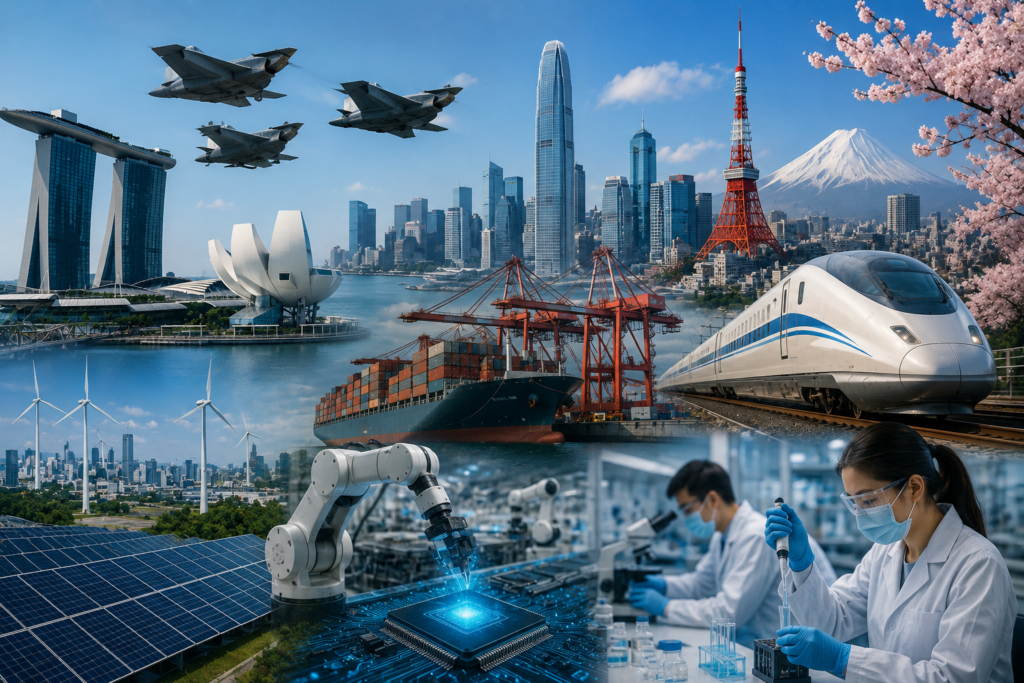
Image Credentials: Image Title: Asia-Pacific Navigates Economic Growth, Security Tensions and Technological Transformation. Source: (chatgpt.com) Date: May 2026. Attribution: This image was created using AI-generated imagery (chatgpt.com) by Open Chronicle and does not depict a real-world scene.
By Open Chronicle with agencies
The Asia-Pacific region is undergoing a period of rapid transformation as governments, businesses and international organizations confront shifting trade dynamics, rising geopolitical tensions and accelerating technological change.
From growing disputes between China and the United States over Taiwan and regional missile deployments to booming investments in artificial intelligence, infrastructure and pharmaceutical manufacturing, the region continues to position itself at the center of the global economy.
China and US Rivalry Shapes Regional Security
Security tensions remained one of the dominant themes across the Asia-Pacific this week.
China issued renewed warnings to the United States over arms sales to Taiwan and increasing military deployments across the region, arguing that expanding missile systems and military alliances threaten regional stability.
Beijing reiterated its opposition to what it described as American interference in Asia-Pacific affairs, particularly following reports that Washington had paused certain military sales to Taiwan amid broader negotiations involving Iran and global strategic priorities.
At the same time, regional governments continue strengthening their defense capabilities.
Interest in “loyal wingman” drone systems has surged across Asia-Pacific militaries, reflecting growing investment in next-generation autonomous combat technology designed to support fighter aircraft operations.
Defense analysts say concerns over China’s military expansion, tensions in the South China Sea and uncertainty surrounding future US regional commitments are accelerating military modernization across several countries.
Economic Growth Continues Despite Global Risks
Despite geopolitical tensions, the Asia-Pacific economy continued showing resilience.
Regional economic growth reached 3.3 percent in 2025 according to recent assessments, with much of the expansion driven by digital infrastructure, manufacturing, trade and technology sectors.
However, trade officials warned that rising global protectionism and supply chain fragmentation remain significant risks for the region’s long-term growth prospects.
China called for deeper regional cooperation during Asia-Pacific trade ministers meetings in Suzhou, emphasizing the need to protect open markets and preserve regional supply chains amid global economic uncertainty.
Meanwhile, the European Union has intensified efforts to deepen trade and diplomatic ties across the Asia-Pacific as Brussels attempts to diversify partnerships and reduce strategic dependence on both Washington and Beijing.
Artificial Intelligence and Data Infrastructure Boom
One of the region’s fastest-growing sectors is artificial intelligence and digital infrastructure.
The AI boom is fueling an estimated $11.6 billion wave of data center investment across Asia-Pacific markets, with cities such as Singapore and Hong Kong competing to become regional technology hubs.
Technology partnerships are expanding rapidly.
OpenAI and Sea announced plans to launch a regional Codex hackathon series beginning in Singapore, while cybersecurity and digital identity companies accelerated new collaborations focused on financial security and authentication systems across the region.
Analysts say Asia-Pacific governments increasingly view technological sovereignty and AI competitiveness as central to future economic influence.
Healthcare and Pharmaceutical Expansion
Healthcare and pharmaceutical manufacturing are also becoming increasingly important across the region.
Industry experts say Asia-Pacific is rapidly reshaping global pharmaceutical manufacturing and supply chain strategies as companies seek alternatives to concentrated production models elsewhere in the world.
Malaysia’s KPJ Selangor achieved a regional milestone with a pioneering spinal surgery procedure, highlighting growing medical innovation capabilities in Southeast Asia.
Meanwhile, AstraZeneca, Roche Diagnostics and other major healthcare companies continue expanding partnerships across Asia-Pacific to accelerate medical research, diagnostics and sustainable healthcare ecosystems.
Vietnam also hosted the Asia Pacific Dental Congress for the first time, reinforcing the country’s growing role in regional healthcare cooperation.
Travel, Hospitality and Consumer Trends Shift
Travel and hospitality industries across Asia-Pacific continue adapting to changing consumer behavior following years of disruption caused by the pandemic and economic uncertainty.
Marriott Bonvoy reported that hotel loyalty in the region is increasingly driven by travel experiences and lifestyle preferences rather than age demographics.
Airports and tourism authorities across the region are investing heavily in modernization, sustainability and digital experiences to attract travelers.
At the same time, environmental concerns are becoming harder to ignore.
Recent reports identified several major Asia-Pacific airports, including Tokyo’s Haneda Airport and Singapore’s Changi Airport, among the world’s highest aviation-related carbon emitters, intensifying pressure for greener aviation policies.
Energy Transition and Industrial Development
Asia-Pacific governments are also accelerating investment in clean energy and industrial modernization.
Hyundai expanded hydrogen economy projects in Hong Kong as part of a broader push into Asia-Pacific energy infrastructure.
Chinese solar exports to developing economies throughout the region have also surged, reflecting the growing importance of renewable energy technologies in regional development plans.
At the same time, concerns over energy security remain significant due to ongoing instability in the Middle East and disruptions linked to global conflicts.
Analysts warn that continued tensions involving Iran and the Strait of Hormuz could expose vulnerabilities in Asia-Pacific energy supply chains and financial systems.
Culture, Innovation and Regional Influence
Beyond economics and geopolitics, the region’s cultural influence continues expanding globally.
Major exhibitions celebrating contemporary Asia-Pacific art opened in London and other international cities, while entertainment, travel retail and digital media sectors continue growing rapidly.
Technology innovation also remains strong.
The Asia-Pacific Informatics Olympiad saw all six Vietnamese student participants win medals, while MedTech Innovator selected its top 20 healthcare startups from more than 680 applicants across the region.
Experts increasingly describe Asia-Pacific not simply as a manufacturing center, but as one of the world’s most important drivers of technological innovation, digital transformation and economic modernization.
A Region at the Center of Global Change
As the balance of global economic and political power continues shifting eastward, the Asia-Pacific region is becoming increasingly central to international trade, security and technological competition.
While tensions involving China, Taiwan, and the United States continue generating uncertainty, regional economies remain among the fastest-growing and most innovative in the world.
For governments and businesses alike, the coming years are likely to determine whether Asia-Pacific can maintain its economic momentum while navigating the growing strategic rivalries shaping the twenty-first century.