
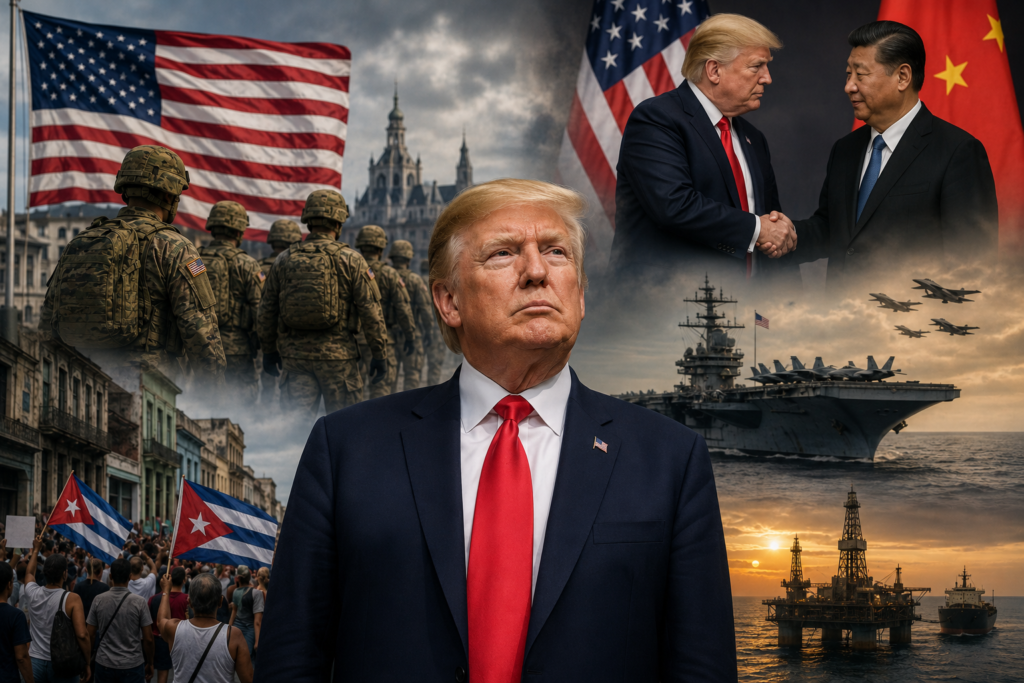
Image Credentials: Image Title: US Faces Mounting Global Pressures as Trump Administration Expands Military and Diplomatic Campaigns. Source: (chatgpt.com) Date: May 2026. Attribution: This image was created using AI-generated imagery (chatgpt.com) by Open Chronicle and does not depict a real-world scene.
By Open Chronicle with agencies
The United States is navigating one of the most turbulent geopolitical periods in recent years as President Donald Trump’s administration simultaneously confronts escalating tensions involving Iran, NATO, Cuba, Taiwan, China, and domestic political divisions at home.
From Europe to the Middle East and the Caribbean, Washington’s rapidly evolving foreign policy has triggered uncertainty among allies, intensified diplomatic friction, and fueled growing debate inside Congress over the future direction of American global leadership.
Troop Deployment to Poland Sparks NATO Confusion
One of the administration’s most significant announcements this week was Trump’s decision to deploy an additional 5,000 US troops to Poland, a move that surprised many NATO allies after earlier indications that Washington intended to reduce parts of its military presence in Europe.
Trump directly linked the deployment to his support for Polish President Karol Nawrocki, praising Warsaw as a loyal ally at a time when relations between Washington and several European governments remain strained.
The sudden shift has left NATO officials and European diplomats scrambling to understand the long-term strategy behind American troop movements on the continent. While Poland welcomed the deployment as a major security guarantee, several alliance members privately expressed confusion over what appeared to be a dramatic reversal in US military planning.
Secretary of State Marco Rubio added to the tensions by openly criticizing NATO members that reportedly restricted American military operations during the recent Iran conflict.
Rubio argued that if allied nations refused to provide operational support during moments of crisis, Washington would inevitably question the practical value of its NATO commitments.
Iran Conflict Continues to Shape US Foreign Policy
The Iran crisis remains at the center of nearly every major diplomatic and military decision emerging from Washington.
Negotiations involving the United States, Iran, and regional mediators have reportedly shown limited progress, with Pakistan playing an increasingly active role in trying to prevent further escalation.
Talks have focused on sanctions relief, Iran’s nuclear activities, and security guarantees related to the Strait of Hormuz, one of the world’s most strategically important maritime trade routes.
Despite ongoing negotiations, tensions remain extremely high.
Trump recently rejected Iran’s proposal to impose transit fees on shipping through Hormuz and insisted that the United States effectively controls the strategic waterway.
Meanwhile, Congress has become increasingly divided over the administration’s military operations against Tehran.
House Republican leaders recently cancelled a planned vote on a resolution intended to limit Trump’s war powers regarding Iran after fears emerged that the measure could unexpectedly pass due to Republican absences.
Several Republican lawmakers have begun expressing concern about the scale and duration of the military campaign, signaling growing unease inside Trump’s own party.
Cuba Relations Deteriorate Further
At the same time, relations between Washington and Havana have sharply deteriorated following the US indictment of former Cuban President Raúl Castro.
The decision triggered demonstrations outside the US Embassy in Havana, where hundreds of Cubans gathered to protest what the Cuban government described as a politically motivated provocation.
The Trump administration has continued increasing pressure on Cuba through sanctions, legal actions, and increasingly aggressive rhetoric, while Cuban officials accuse Washington of attempting to create pretexts for future military confrontation.
The arrival of the USS Nimitz carrier strike group in the Caribbean has further intensified speculation about possible future escalation between the two countries.
Taiwan and China Tensions Add New Strategic Risks
The administration’s handling of Taiwan has also generated international concern.
Reports that Washington temporarily paused a proposed $14 billion arms package for Taiwan triggered immediate criticism from both Beijing and some American lawmakers.
China responded by warning the United States against expanding military deployments in the Asia-Pacific region and reiterated opposition to American support for Taiwan following the recent summit between Trump and Chinese President Xi Jinping.
The dispute reflects the increasingly delicate balance Washington faces as it attempts to manage simultaneous geopolitical crises involving both China and Iran.
Domestic Political Pressure Intensifies
Inside the United States, Trump’s foreign policy decisions are fueling growing political tensions.
Recent polling suggests voter confidence in the economy has declined sharply, while divisions inside the Republican Party are becoming more visible over military intervention, foreign alliances and government spending.
Democrats continue attacking the administration’s handling of foreign policy, while some Republicans have begun warning privately about the political risks of prolonged overseas conflicts.
The administration also faces criticism over immigration policies, intelligence controversies, and disputes involving federal agencies and military funding.
At the same time, Trump continues pushing a nationalist political agenda that combines aggressive foreign policy, pressure on allies, and promises to strengthen American military power globally.
A Global Strategy Under Scrutiny
As Washington manages simultaneous confrontations across Europe, the Middle East, Asia, and Latin America, allies and adversaries alike are closely watching whether the Trump administration can maintain strategic coherence amid rapidly evolving crises.
While supporters argue the administration is projecting strength and reasserting American influence, critics warn that increasingly unpredictable decisions risk destabilizing alliances and escalating already volatile geopolitical conflicts.
With negotiations over Iran still unresolved, NATO tensions growing, and US-China relations remaining fragile, the coming months are expected to test the resilience of both American diplomacy and Washington’s global leadership position.