
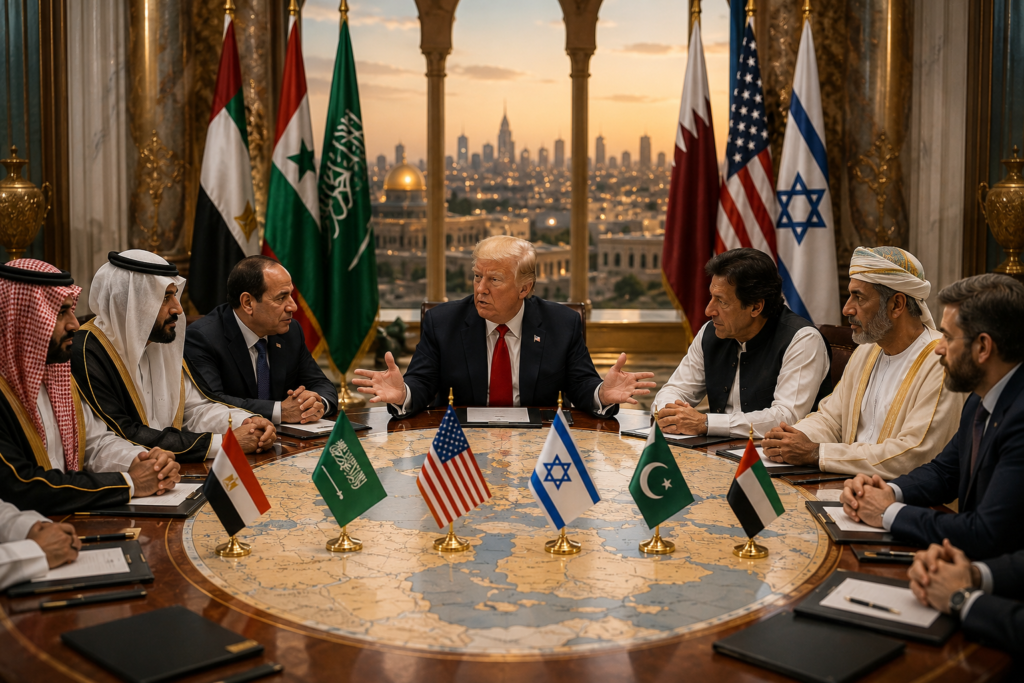
Image Credentials: Image Title: Trump Pushes to Expand Abraham Accords as Iran Negotiations Advance. Source: (chatgpt.com) Date: May 2026. Attribution: This image was created using AI-generated imagery (chatgpt.com) by Open Chronicle and does not depict a real-world scene.
By Open Chronicle with agencies
U.S. President Donald Trump has intensified efforts to expand the Abraham Accords as negotiations with Iran continue to move forward, linking a potential regional peace arrangement to a broader diplomatic realignment across the Middle East and South Asia.
In a series of public remarks and social media posts on Monday, Trump argued that several Muslim-majority nations should join the normalization agreements with Israel as part of a wider regional settlement connected to ongoing talks with Tehran.
“After all the work done by the United States to pull this very complex puzzle together, it should be mandatory,” Trump wrote, referring to countries such as Saudi Arabia, Qatar, Pakistan, Egypt, Jordan, and Turkey joining the accords.
The comments came as U.S. officials described negotiations with Iran as constructive but still incomplete. Trump maintained that any future agreement with Tehran must be “great and meaningful,” warning that there would otherwise be “no deal at all.”
Abraham Accords Return to Center Stage
Originally launched during Trump’s first presidency in 2020, the Abraham Accords normalized diplomatic relations between Israel and several Arab states, including the United Arab Emirates and Bahrain. The agreements were presented at the time as a historic breakthrough in Middle Eastern diplomacy.
Now, amid discussions surrounding a possible ceasefire framework and maritime security arrangement involving Iran, Trump is attempting to revive and dramatically expand the initiative.
According to officials familiar with the talks, Washington sees the accords as a way to reshape regional alliances while reducing the likelihood of future conflicts involving Iran, Israel, and Gulf states.
Trump reportedly held conversations over the weekend with leaders from several Middle Eastern and South Asian nations, including Saudi Arabia, Qatar, Pakistan, and Bahrain. He later suggested that even Iran itself could eventually become part of a broader regional framework if negotiations succeed.
Pakistan Faces Diplomatic Pressure
Among the countries now facing increased diplomatic attention is Pakistan, which has emerged as a key intermediary in the U.S.-Iran negotiations. Islamabad has reportedly helped facilitate indirect communications between Washington and Tehran during recent ceasefire discussions tied to tensions in the Strait of Hormuz.
However, Trump’s push to include Pakistan in the Abraham Accords has created a delicate political situation for the Pakistani government. Domestic opposition to formal recognition of Israel remains strong, while Islamabad also seeks to preserve strategic ties with Gulf nations, Iran, China, and the United States simultaneously.
Analysts say Pakistan now finds itself balancing mediation efforts with mounting geopolitical expectations from Washington.
Trump notably praised Pakistan’s military leadership in recent statements, mentioning Army Chief Asim Munir while largely avoiding references to Prime Minister Shehbaz Sharif, a move that drew attention across South Asian political circles.
Tensions With Netanyahu
The evolving diplomacy has also exposed growing friction between Washington and Israeli Prime Minister Benjamin Netanyahu’s government.
Multiple reports on Monday suggested Netanyahu privately acknowledged to aides that he currently holds limited influence over Trump’s approach toward Iran. Israeli officials remain deeply skeptical of any agreement that could ease pressure on Tehran without permanently dismantling its nuclear capabilities and regional influence.
Critics inside Israel and among Republican hawks in Washington have accused Trump of offering excessive concessions in pursuit of a diplomatic breakthrough.
Trump dismissed such criticism, insisting that any future arrangement would be “the exact opposite” of the 2015 nuclear deal negotiated during the Obama administration.
Regional Realignment Underway
The broader diplomatic effort reflects rapidly shifting alliances across the Middle East. Gulf states have increasingly prioritized economic stability, energy security, and regional de-escalation after years of military tensions and disruptions in maritime trade.
The reopening of the Strait of Hormuz remains central to ongoing negotiations, as the waterway handles a major portion of global oil and gas shipments. Energy markets have reacted cautiously to signs of progress between Washington and Tehran, though major disagreements remain unresolved.
Secretary of State Marco Rubio said talks are “moving in the right direction” but warned that the administration would not accept what he described as a weak agreement.
Meanwhile, Trump continued to frame the diplomatic push as part of a larger geopolitical vision.
“We’re trying to bring stability to a region that has suffered for generations,” he said Monday. “If countries want peace and prosperity, they should be part of it.”