
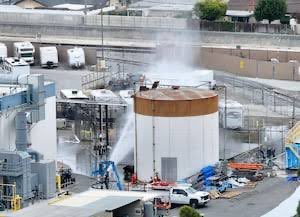
Image: from QC TLK NEWS X @QCTLKNews
By Open Chronicle with agencies
Southern California authorities announced Monday that the immediate threat of a catastrophic explosion at a chemical storage facility in Orange County has been eliminated, bringing cautious relief to tens of thousands of residents forced from their homes during a days-long emergency.
Officials confirmed that pressure inside a damaged 7,000-gallon storage tank containing methyl methacrylate, a highly flammable chemical used in plastics and resins manufacturing, has decreased after a crack formed in the structure over the weekend. The tank, located at the GKN Aerospace facility in Garden Grove, had shown dangerous signs of overheating and swelling, raising fears of a devastating boiling liquid expanding vapor explosion, commonly known as a BLEVE.
“We are happy to report that the threat of a BLEVE is now off the table,” interim Orange County Fire Chief TJ McGovern said during an emergency briefing. “That threat has been eliminated.”
The incident began last week when fire officials detected what was initially described as a vapor release at the aerospace plant. Further inspections revealed rising temperatures inside one of the chemical tanks, eventually reaching at least 100 degrees Fahrenheit, the maximum reading displayed on monitoring equipment. Firefighters responded by continuously cooling the structure with sprinklers and hose lines while emergency crews assessed the risk of rupture.
Authorities later identified a crack in the tank during a visual inspection Saturday night. By Monday morning, officials said internal temperatures had dropped to approximately 93 degrees, significantly reducing the danger of a major blast.
Orange County CA Fire Authority Interim Chief TJ McGovern provides an update on efforts to prevent a chemical tank explosion.
He says the threat of a BLEVE (Boiling Liquid Expanding Vapor Explosion) has been eliminated, but the incident is not under control yet. pic.twitter.com/NmNNfigfyO
— The Post Millennial (@TPostMillennial) May 25, 2026
Despite the improved conditions, evacuation orders affecting roughly 50,000 residents remained in place across parts of northern Orange County, including areas near Anaheim and La Palma. Emergency shelters operated by the American Red Cross continued to host displaced families, many of whom described the ordeal as traumatic and exhausting.
Lydia Green, an Anaheim resident staying at a shelter in La Palma, said the uncertainty had become overwhelming.
“I’m feeling nervous, scared, devastated,” she told local media. “We’ve been sleeping in our car. It feels like living in a nightmare.”
Officials stressed that while the immediate explosion scenario has been avoided, the situation remains unstable enough to require continued caution. Nearby tanks containing additional methyl methacrylate also remain a concern, particularly if heat or structural failure were to spread.
Orange County Fire incident commander Craig Covey warned earlier in the crisis that a full-scale explosion could have caused severe structural damage within a half-mile radius and potentially released toxic vapors into surrounding communities and waterways.
Environmental monitoring teams from the Environmental Protection Agency have established at least 20 air-quality checkpoints around the evacuation zone. Authorities said there is currently no evidence of toxic chemicals leaking into the atmosphere.
California Governor Gavin Newsom declared a state of emergency over the weekend and requested federal assistance from President Donald Trump to support local response operations. Federal agencies, including FEMA, have since deployed personnel and atmospheric hazard modeling teams to assist authorities.
The incident has also reignited concerns about the placement of industrial chemical facilities near densely populated residential neighborhoods. Several evacuees questioned why hazardous storage sites operate so close to homes, schools, and major public attractions such as Disneyland, located only a few miles away.
GKN Aerospace stated that crews continue to work around the clock to stabilize the affected tanks and prevent any further deterioration.
Emergency officials said residents will not be allowed to return home until the site is fully secured.
“We have to get them back,” McGovern said, “but we will not do that until it is safe.”