
Image Credentials: Image Title: Texas Primaries Reshape Key US Senate and House Battles Ahead of Midterms. Source: (chatgpt.com) Date: May 2026. Attribution: This image was created using AI-generated imagery (chatgpt.com) by Open Chronicle and does not depict a real-world scene.
By Open Chronicle with agencies
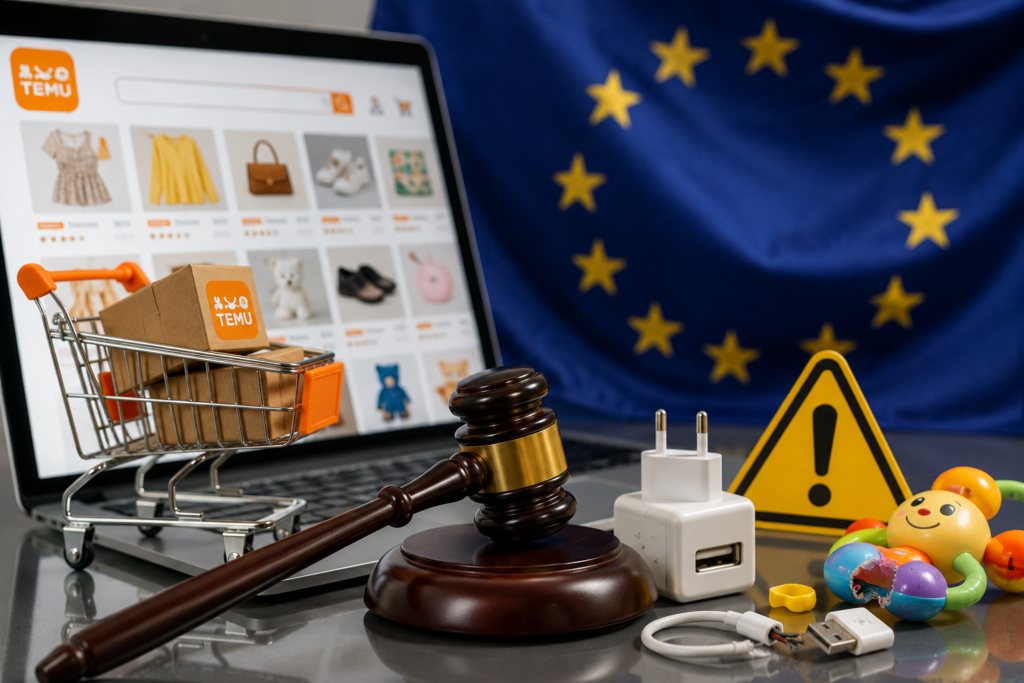
The European Commission has imposed a $232 million fine on Chinese-owned online retailer Temu after an investigation found the platform had failed to adequately prevent the sale of illegal and potentially dangerous products across the European Union.
According to the Commission, the penalty was issued under the EU’s Digital Services Act (DSA), which requires major online platforms to assess and mitigate systemic risks linked to illegal goods and harmful content.
In a statement, the Commission said Temu “failed to diligently identify, analyze, and assess the systemic risks of illegal products being offered on its platform and the resulting harm to consumers in the European Union.”
Investigators carried out mystery shopping exercises as part of the probe and discovered what officials described as alarming safety failures. The Commission reported that a large number of chargers sold on the platform failed basic electrical safety tests, while several baby toys posed medium to high safety risks.
Authorities said some toys contained chemicals exceeding legal safety limits, while others presented suffocation hazards because of detachable parts.
Under the Digital Services Act, platforms classified as Very Large Online Platforms must actively evaluate risks associated with their services and implement effective safeguards. Brussels argued that Temu’s risk assessments lacked specificity, solid evidence, and a comprehensive understanding of the dangers posed to European consumers.
Henna Virkkunen, the Commission’s executive vice president for Tech Sovereignty, Security and Democracy, said the company’s approach was inadequate.
“Risk assessments are not box-ticking exercises; they are the backbone of the DSA,” Virkkunen said. “Temu’s risk assessment underestimates concrete risks, lacks specificity, is not grounded in solid evidence, and is not comprehensive.”
She added that regulators and consumers were being left “in the dark about the true scale of potential harm posed by illegal products sold on Temu.”
Temu has rejected the findings and described the fine as disproportionate. A spokesperson for the company told the BBC that the investigation reflected the state of the platform in 2024 and did not represent current systems and safeguards.
“We disagree with the European Commission’s decision and consider the fine to be disproportionate,” the company said, adding that it was reviewing legal options.
The Commission has given Temu until August 28 to submit a formal action plan detailing how it intends to address the identified problems. The European Board for Digital Services will then review the proposed measures before the Commission adopts a final compliance decision.
Consumer protection groups welcomed the move. Which? praised the penalty and urged the United Kingdom to follow a similar path.
Sue Davies, head of consumer protection policy at Which?, described the fine as “a strong example of the tough action needed to hold online marketplaces to account for dangerous products on their platforms.”
The case marks only the second major financial penalty issued under the Digital Services Act. In December, the European Union fined X $140 million for allegedly misleading users through its blue checkmark verification system.
The latest action against Temu reflects growing European scrutiny of major digital platforms, particularly concerning product safety, disinformation, and consumer protection in online marketplaces.