
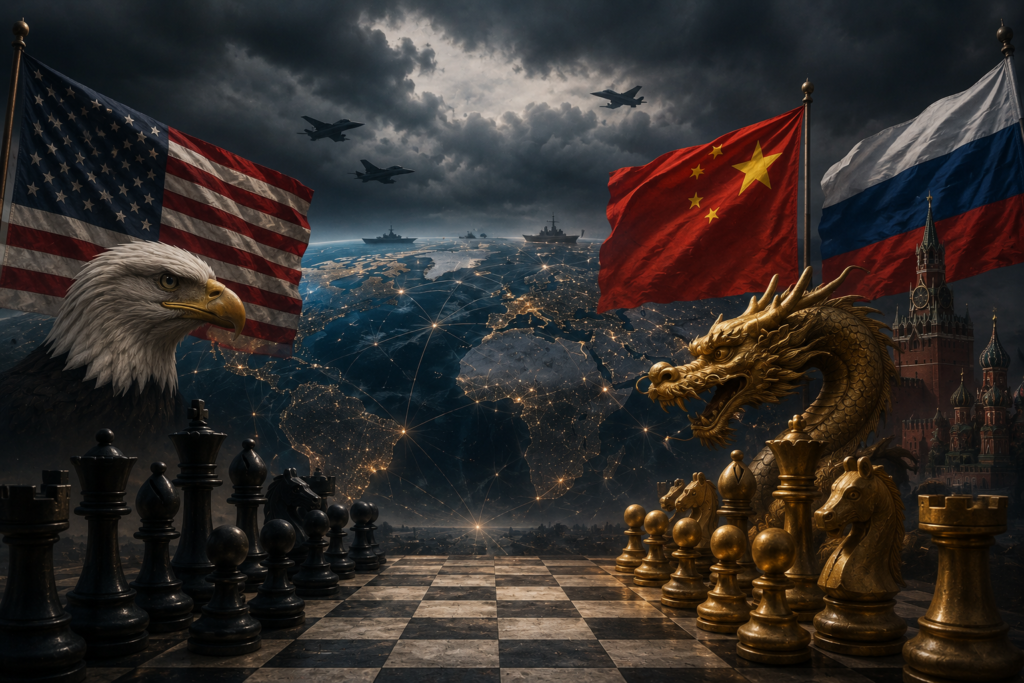
Image Credentials: Image Title: The Return of Great Power Competition. Source: (chatgpt.com) Date: May 2026. Attribution: This image was created using AI-generated imagery (chatgpt.com) by Open Chronicle and does not depict a real-world scene.
By Jordan Price | Senior Editor
For much of the three decades that followed the collapse of the Soviet Union in 1991, many policymakers and scholars believed that major power rivalry had become a relic of history. The United States emerged from the Cold War as the world’s sole superpower, globalization accelerated at an unprecedented pace, and international institutions appeared increasingly capable of managing disputes between states.
Today, that era has come to an end.
From Eastern Europe and the Middle East to the Indo-Pacific, competition among major powers has re-emerged as the defining feature of international politics. The United States, China, and Russia are engaged in a strategic contest that is reshaping diplomacy, military planning, economic policy, and technological development across the globe.
The return of great power competition marks one of the most significant geopolitical transformations of the 21st century.
The Unipolar Moment
Following the dissolution of the Soviet Union, the United States entered what political scientist Charles Krauthammer famously described as the “unipolar moment.”
American military power was unmatched. The U.S. economy accounted for roughly a quarter of global output. NATO expanded eastward. Liberal democracy appeared ascendant, and many believed economic integration would reduce the likelihood of major interstate conflict.
This optimism was reflected in the influential argument of political scientist Francis Fukuyama, who suggested that liberal democracy represented the endpoint of ideological evolution.
Yet history proved more complicated.
While globalization deepened economic interdependence, it did not eliminate geopolitical competition. Instead, new centers of power gradually emerged.
China’s Rise and the New Balance of Power
No development has transformed global geopolitics more profoundly than the rise of China.
Since launching economic reforms in 1978 under Deng Xiaoping, China has experienced one of the fastest and largest economic expansions in human history. According to World Bank data, hundreds of millions of Chinese citizens were lifted out of poverty, while the country evolved into the world’s manufacturing powerhouse.
Today, China is the world’s second-largest economy and, by some measures of purchasing power, the largest.
Its influence extends far beyond economics.
China has invested heavily in military modernization, expanded its naval capabilities, strengthened its presence in the South China Sea, and launched the Belt and Road Initiative, a vast infrastructure and connectivity program spanning Asia, Africa, Europe, and Latin America.
For many American strategists, China’s rise represents the most significant challenge to U.S. global leadership since the Cold War.
The strategic rivalry between Washington and Beijing increasingly shapes global trade, technology, security alliances, and diplomatic relations.
Russia’s Revisionist Strategy
While China’s rise is primarily economic and technological, Russia’s challenge to the international order has been largely geopolitical and military.
Following the collapse of the Soviet Union, Russia experienced economic turmoil and a dramatic reduction in international influence. Under President Vladimir Putin, however, Moscow pursued a strategy aimed at restoring its status as a major power.
This approach became increasingly visible through military interventions in Georgia in 2008, Crimea in 2014, Syria in 2015, and the full-scale invasion of Ukraine in 2022.
The war in Ukraine fundamentally altered Europe’s security environment.
NATO expanded further with the accession of Finland and Sweden. European defense spending increased substantially. Military deterrence once again became a central concern across the continent.
For many analysts, the conflict demonstrated that conventional interstate warfare remains a defining feature of international relations despite decades of assumptions about its decline.
The Indo-Pacific as the Strategic Center
Increasingly, the focus of great power competition is shifting toward the Indo-Pacific.
The region contains some of the world’s most important trade routes, major manufacturing hubs, and critical technological supply chains.
Taiwan occupies a particularly important position.
Beyond its political significance, Taiwan produces a substantial share of the world’s advanced semiconductors, components essential to everything from smartphones and automobiles to artificial intelligence systems and military equipment.
As tensions between China and Taiwan persist, concerns about regional stability have intensified. The United States has strengthened partnerships with Japan, South Korea, Australia, and the Philippines while expanding strategic cooperation through frameworks such as AUKUS and the Quad.
Many defense planners now regard the Indo-Pacific as the most consequential geopolitical theater of the coming decades.
Technology as a Strategic Battlefield
Unlike previous eras of great power rivalry, today’s competition extends deeply into technology.
Artificial intelligence, quantum computing, cyber capabilities, space systems, and advanced semiconductors have become instruments of national power.
Governments increasingly view technological leadership not merely as an economic objective but as a strategic necessity.
The semiconductor industry offers a clear example. The United States has imposed export restrictions on advanced chip technologies to China, while Beijing has invested billions of dollars to reduce dependence on foreign suppliers.
Competition over technology now resembles earlier contests over industrial capacity, energy resources, and military superiority.
The nations that dominate emerging technologies may shape the balance of power for decades to come.
Economics as a Tool of Geopolitics
Economic interdependence was once seen as a force for stability.
Today, it is increasingly viewed through the lens of national security.
Sanctions, export controls, investment restrictions, and supply-chain diversification have become central instruments of statecraft.
The United States and its allies have imposed extensive sanctions on Russia. Meanwhile, concerns about economic dependence on China have encouraged efforts to “de-risk” supply chains in strategic sectors.
This trend reflects a broader shift toward economic security, where trade and investment decisions are increasingly influenced by geopolitical considerations.
The result is a gradual fragmentation of aspects of the global economy into competing spheres of influence.
A Multipolar World Emerging
The return of great power competition is occurring alongside the rise of influential middle powers.
Countries such as India, Türkiye, Saudi Arabia, Brazil, Indonesia, and the United Arab Emirates are pursuing more independent foreign policies and seeking greater influence in international affairs.
Rather than aligning exclusively with one major power, many states are adopting flexible strategies that maximize their autonomy.
This trend contributes to the emergence of a more complex and multipolar international system.
Unlike the Cold War, which was dominated by two superpowers, today’s world features multiple centers of economic, military and diplomatic influence.
The Risks of the New Era
Great power competition does not inevitably lead to conflict.
Historically, however, periods of major power rivalry have often been associated with heightened instability.
Military miscalculations, cyberattacks, arms races, and proxy conflicts all carry the potential to escalate tensions.
The challenge facing policymakers is to manage competition without allowing it to evolve into confrontation.
This requires credible deterrence, diplomatic engagement, and mechanisms for crisis management.
History demonstrates that great powers can compete intensely while avoiding catastrophic conflict, but doing so requires discipline, communication and strategic restraint.
A Defining Challenge of the Century
The return of great power competition represents more than a temporary shift in international politics. It reflects a profound transformation in the global balance of power.
The post-Cold War era was characterized by relative American dominance and optimism about globalization. The emerging era is defined by strategic rivalry, technological competition, and a more contested international order.
Whether this transition leads to stability or confrontation will depend on decisions made in Washington, Beijing, Moscow, and other capitals around the world.
What is increasingly clear is that the geopolitical assumptions that shaped the early decades of the 21st century no longer apply. A new era has arrived, one in which power, geography, and strategy once again occupy the center of global affairs.