
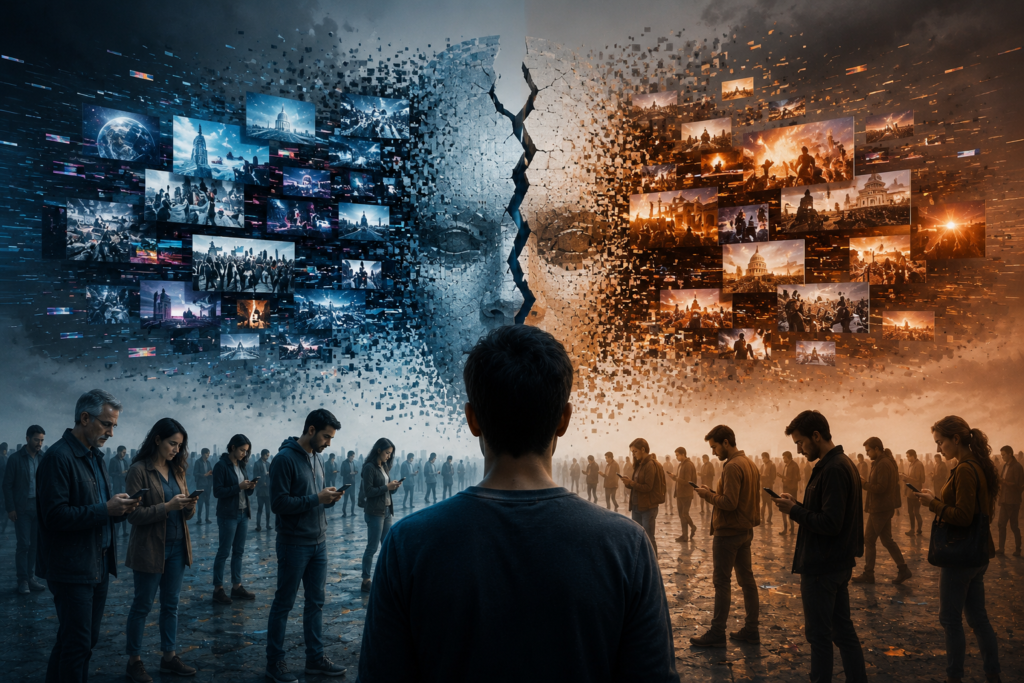
Image Credentials: Image Title: The Slow Death of Shared Reality in the Digital Age. Source: (chatgpt.com) Date: May 2026. Attribution: This image was created using AI-generated imagery (chatgpt.com) by Open Chronicle and does not depict a real-world scene.
By Open Chronicle Culture & Ideas
For most of modern history, societies were held together not only by institutions and laws, but by something less tangible, a broadly shared understanding of reality. Citizens disagreed about politics, religion, and ideology, yet they generally operated from a common set of facts, consumed through a relatively limited number of newspapers, radio stations, and television networks. Today, that shared foundation is increasingly fractured.
The digital age has delivered unprecedented access to information, but it has also transformed how reality itself is experienced. In many ways, the 21st century’s information revolution has produced a paradox. The more connected humanity becomes, the less certain it seems about what is true.
From Mass Media to Fragmented Worlds
Throughout much of the 20th century, information flowed through centralized institutions. Newspapers, broadcasters, and public agencies acted as gatekeepers that filtered information before it reached the public. These systems were far from perfect and often reflected political, economic, and cultural biases, but they created a common informational environment.
The rise of the internet fundamentally altered this arrangement. Information no longer needs institutional approval to reach a global audience. Social media platforms accelerated this transformation, allowing individuals to become publishers and broadcasters themselves.
Initially celebrated as a democratization of knowledge, this shift gradually produced an unforeseen consequence: the fragmentation of public reality.
Instead of millions of citizens consuming similar information, algorithms increasingly personalize content according to individual preferences, behaviors, and beliefs. Two people living in the same city could now inhabit entirely different informational worlds.
The Algorithmic Divide
The business model of major digital platforms is built around engagement. Algorithms are designed to maximize attention, often by promoting content that provokes strong emotional reactions.
Research from institutions including the Massachusetts Institute of Technology has shown that false information can spread significantly faster online than verified reporting. Sensational claims, conspiracy theories, and emotionally charged narratives frequently outperform nuanced analysis because they generate stronger engagement.
The result is not merely misinformation. It is the emergence of competing realities.
Political scientists increasingly describe this phenomenon as epistemic fragmentation, a condition in which groups no longer agree on the basic facts necessary for democratic debate. When citizens cannot agree on what is happening, meaningful discussion about what should be done becomes increasingly difficult.
The Crisis of Trust
Underlying the fragmentation of reality is a broader crisis of trust.
Public confidence in governments, media organizations, corporations, and other institutions has declined across many democratic societies during the past two decades. Surveys conducted by organizations such as the Edelman Trust Barometer consistently show significant skepticism toward traditional sources of authority.
This distrust creates fertile ground for alternative narratives.
When official institutions are viewed as unreliable, individuals often seek information from peer networks, influencers, or ideologically aligned communities. While some of these sources provide valuable perspectives, others operate without standards of verification or accountability.
The consequence is a feedback loop. Distrust encourages fragmentation, and fragmentation further erodes trust.
Artificial Intelligence and the Next Information Revolution
The emergence of artificial intelligence may intensify these challenges.
Generative AI systems can now produce convincing text, audio, and video at unprecedented scale. Deepfake technology makes it increasingly difficult to distinguish authentic content from fabricated material. What once required sophisticated state resources can now be accomplished with widely available software.
The concern extends beyond individual falsehoods.
The greater risk may be what scholars call the “liar’s dividend.” In a world where fabricated media is common, genuine evidence can also be dismissed as fake. The result is a society in which certainty becomes elusive, and trust becomes increasingly difficult to maintain.
As information ecosystems become saturated with synthetic content, establishing a shared understanding of events may become even more challenging.
Why Shared Reality Matters
A shared reality does not require unanimous agreement. Democratic societies have always contained competing interests, values and worldviews.
What they require is a common factual foundation.
Courts depend on evidence. Science depends on verification. Journalism depends on facts. Elections depend on citizens making informed choices based on broadly accepted realities.
Without these foundations, public discourse becomes less about persuasion and more about tribal affirmation. Political opponents are no longer viewed as people with different interpretations of reality, but as inhabitants of entirely separate realities.
History suggests that societies function best when disagreement occurs within a common framework of facts. When that framework erodes, polarization deepens, and institutional stability weakens.
Rebuilding Common Ground
The decline of shared reality is not inevitable, nor is it irreversible.
Media literacy education can help citizens better evaluate information sources. Greater transparency from technology companies may provide insight into how content is prioritized and distributed. Stronger support for independent journalism can preserve institutions dedicated to verification and accountability.
At the individual level, rebuilding shared reality may require a renewed commitment to intellectual humility, the recognition that no person, ideology, or algorithm possesses a monopoly on truth.
The challenge facing modern societies is not merely technological. It is cultural, philosophical, and civic.
The digital age has transformed humanity’s relationship with information. The question now is whether democratic societies can adapt quickly enough to preserve the shared foundations that make collective decision-making possible.
The future of public discourse may depend not on how much information we can access, but on whether we can still agree on what is real.