
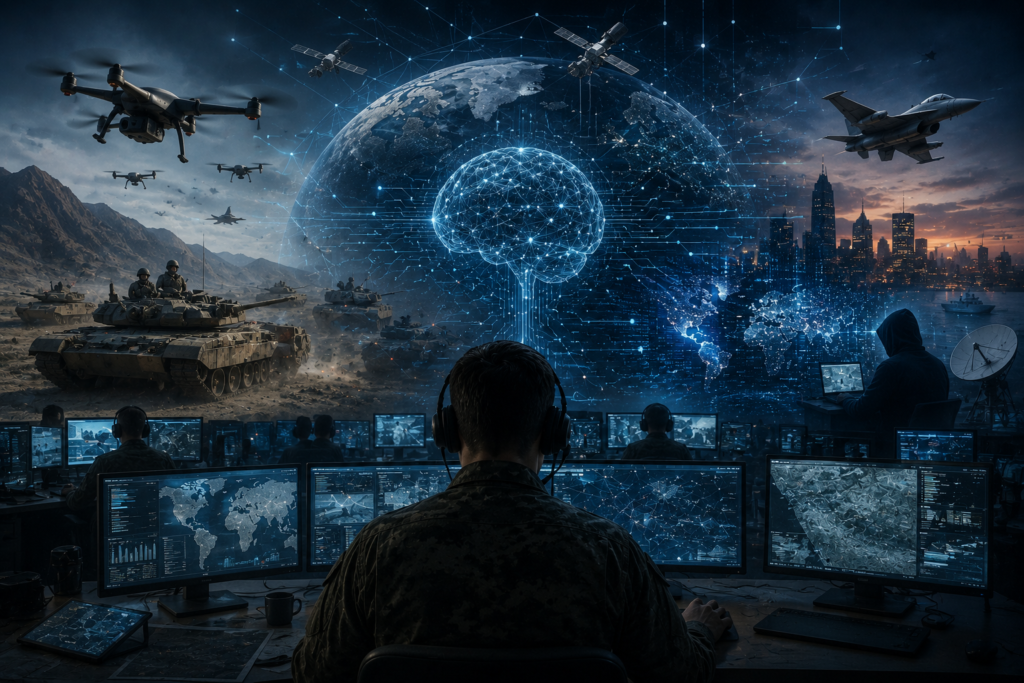
Image Credentials: Image Title: Artificial Intelligence and the Future of National Security. Source: (chatgpt.com) Date: May 2026. Attribution: This image was created using AI-generated imagery (chatgpt.com) by Open Chronicle and does not depict a real-world scene.
By Daniel Ford | Staff Writer
Artificial intelligence has emerged as one of the most transformative technologies of the 21st century. Once largely confined to research laboratories and science fiction, AI now influences economies, military operations, intelligence gathering, cybersecurity, and diplomatic competition. Governments increasingly view artificial intelligence not merely as a technological innovation but as a strategic asset capable of shaping the future balance of power.
As nations invest billions of dollars into AI development, a new reality is taking shape: artificial intelligence is becoming a central pillar of national security.
The implications extend far beyond military applications. AI is transforming how states collect information, defend critical infrastructure, project power, and compete in an increasingly complex geopolitical environment.
The Emergence of AI as a Strategic Technology
Historically, technological revolutions have reshaped international politics. The Industrial Revolution transformed military logistics and production. Nuclear technology altered the foundations of deterrence. The internet changed communication and intelligence gathering.
Artificial intelligence represents the latest stage in this evolution.
Machine learning systems can process enormous quantities of data, identify patterns beyond human perception, and generate predictions at unprecedented speed. Governments increasingly recognize that such capabilities can provide strategic advantages across multiple domains.
The growing importance of AI has led policymakers in Washington, Beijing, Brussels, and other capitals to treat technological leadership as a national security priority rather than solely an economic objective.
The AI Race Between Major Powers
The strategic competition between the United States and China increasingly revolves around technological dominance.
The United States remains a global leader in advanced AI research, supported by major technology companies, world-class universities, and significant government investment. American firms have played a central role in developing large language models, cloud infrastructure, and advanced semiconductor technologies.
China, meanwhile, has made artificial intelligence a cornerstone of its long-term national strategy. Through initiatives such as the New Generation Artificial Intelligence Development Plan, Beijing aims to achieve global leadership in AI while integrating the technology across civilian and military sectors.
The competition extends beyond algorithms.
Advanced semiconductors, data centers, cloud computing infrastructure, and specialized AI chips have become strategic resources. Export controls and technology restrictions imposed by the United States reflect growing concerns that AI superiority could influence future military and economic power.
Increasingly, artificial intelligence is viewed as a critical component of great power competition.
Intelligence in the Age of Algorithms
One of the most immediate impacts of AI is occurring within intelligence agencies.
Modern intelligence organizations face an overwhelming volume of information generated by satellites, social media, communications networks, and open-source platforms. Artificial intelligence allows analysts to process this data at scales previously impossible.
Machine learning systems can identify unusual activities, detect emerging threats, and analyze patterns across millions of documents or images in seconds.
The war in Ukraine has demonstrated the growing importance of open-source intelligence. Satellite imagery, geolocation tools, and AI-assisted analysis have enabled governments, journalists, and independent researchers to track military movements with remarkable accuracy.
As AI capabilities advance, intelligence agencies may become increasingly dependent on automated systems for surveillance, threat assessment, and strategic forecasting.
The Transformation of Military Operations
Artificial intelligence is also reshaping warfare.
Modern militaries already employ AI in logistics, reconnaissance, target identification, and battlefield analysis. Autonomous and semi-autonomous systems are becoming more sophisticated, while drone technology has transformed the nature of conflict.
Military planners increasingly envision future battlefields where human decision-makers are supported by AI systems capable of processing information faster than any individual or command structure.
The United States Department of Defense, China’s People’s Liberation Army, and numerous NATO members are investing heavily in AI-enabled military capabilities.
However, the integration of AI into military operations raises significant questions regarding accountability, ethics, and strategic stability.
The prospect of autonomous weapons capable of selecting and engaging targets without direct human intervention remains one of the most controversial issues in contemporary security debates.
Cybersecurity and Digital Defense
Artificial intelligence is becoming both a weapon and a shield in cyberspace.
Cybersecurity systems increasingly rely on AI to detect malware, identify network intrusions, and respond to attacks in real time. Given the growing sophistication of cyber threats, automated defense mechanisms are often necessary to protect critical infrastructure.
At the same time, malicious actors are using AI to enhance cyber operations.
Artificial intelligence can generate highly convincing phishing campaigns, automate vulnerability discovery, and accelerate cyberattacks. Deepfake technologies further complicate the landscape by enabling the creation of realistic but fabricated audio and video content.
This dual-use nature of AI creates a continuous cycle of competition between offensive and defensive capabilities.
Critical Infrastructure and National Resilience
Modern societies depend on interconnected systems that manage energy, transportation, finance, healthcare, and communications.
Artificial intelligence offers opportunities to improve efficiency and resilience across these sectors. Predictive maintenance, automated monitoring, and advanced risk analysis can strengthen infrastructure security.
Yet increased reliance on AI also introduces new vulnerabilities.
A failure in a critical AI system, whether caused by technical malfunction, cyberattack, or manipulation of training data, could have significant consequences for national security.
As governments integrate AI into essential services, ensuring reliability and resilience becomes an increasingly important challenge.
The Challenge of Strategic Stability
One of the most significant concerns surrounding artificial intelligence involves its impact on strategic stability.
Throughout the nuclear age, deterrence relied partly on predictable decision-making and clear communication between rival powers.
Artificial intelligence may complicate this framework.
AI systems can accelerate decision cycles, reducing the time available for human judgment during crises. In situations involving military escalation, automated systems may create risks of miscalculation or unintended consequences.
Scholars and policymakers have warned that excessive reliance on AI in command-and-control structures could increase instability rather than enhance security.
The challenge is not merely technological but strategic: how to harness AI’s advantages without undermining mechanisms that help prevent conflict.
Ethics, Governance, and International Cooperation
The rapid development of artificial intelligence has sparked growing calls for international governance frameworks.
Organizations, including the United Nations, the European Union, and various academic institutions, have advocated principles for the responsible development and deployment of AI technologies.
Key concerns include transparency, accountability, privacy, human oversight, and compliance with international humanitarian law.
While major powers compete intensely in the AI domain, they may also share an interest in establishing rules that reduce the risks associated with autonomous systems and algorithmic decision-making.
History suggests that technological competition and international regulation are not mutually exclusive. Nuclear arms control agreements during the Cold War demonstrate that rivals can cooperate when shared risks become sufficiently significant.
The Future Security Landscape
Artificial intelligence is unlikely to replace traditional elements of national power such as geography, economic strength, military capability, or political leadership.
Instead, it will increasingly amplify them.
States that successfully integrate AI into their economies, institutions, and security architectures may gain significant advantages in productivity, intelligence gathering, military effectiveness, and strategic influence.
At the same time, AI introduces new vulnerabilities, ethical dilemmas, and geopolitical tensions that governments are only beginning to understand.
The future of national security will not be determined solely by who possesses the most advanced algorithms. It will depend on how societies balance innovation with resilience, competition with cooperation, and technological progress with democratic accountability.
Artificial intelligence is rapidly becoming one of the defining strategic factors of the modern era. The decisions made today regarding its development and governance may shape the international security environment for decades to come.