
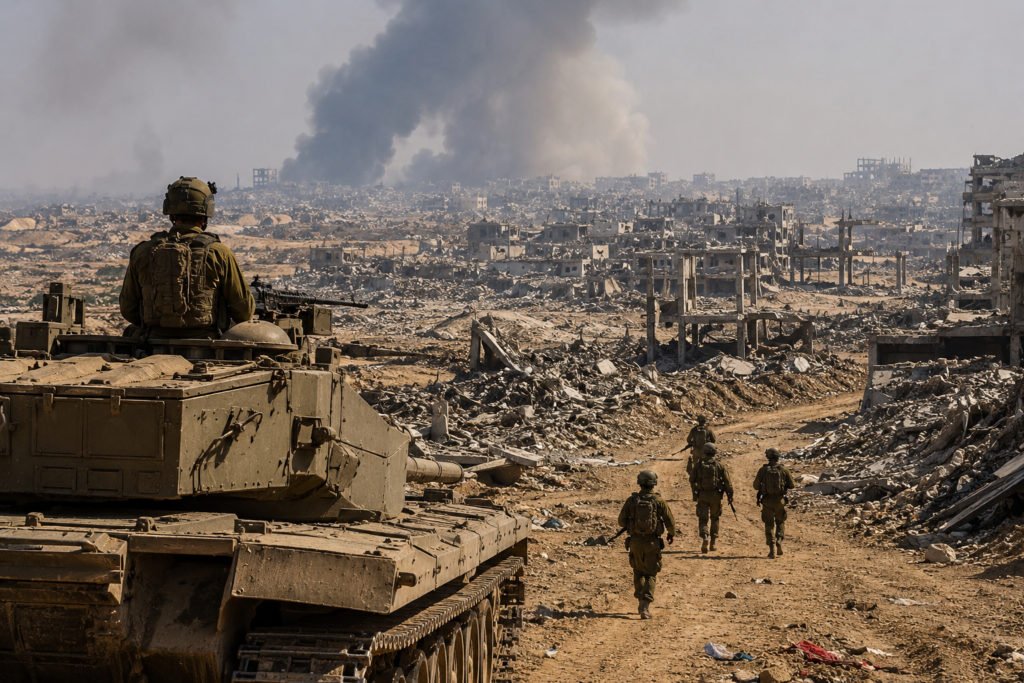
Image Credentials: Image Title: Netanyahu Orders Expansion of Israeli Military Control to 70% of Gaza. Source: (chatgpt.com) Date: May 2026. Attribution: This image was created using AI-generated imagery (chatgpt.com) by Open Chronicle and does not depict a real-world scene.
By Open Chronicle with agencies
Israeli Prime Minister Benjamin Netanyahu has instructed the Israeli military to expand its control over the Gaza Strip, setting an initial objective of bringing 70% of the territory under Israeli control as fighting continues despite an internationally backed truce.
Speaking at a conference in an Israeli settlement in the occupied West Bank, Netanyahu outlined a gradual approach to increasing Israeli-held territory in Gaza.
“We were at fifty, we moved to sixty,” Netanyahu said. “My directive is to move to, let’s go step by step. First of all, seventy. Let’s start with that. We’re pressing them from all sides. We’ll deal with the remnants.”
The remarks come amid growing international scrutiny of Israel’s military campaign in Gaza, where humanitarian organizations and several governments have accused Israel of actions amounting to collective punishment and possible violations of international law. Israel strongly rejects allegations of genocide, maintaining that its operations are directed against Hamas and other militant groups.
Expanding Buffer Zones
Israel currently controls an estimated 64% of Gaza, according to military maps and independent analysts. Under a U.S.-brokered ceasefire agreement reached in October, Israeli forces were expected to withdraw to a designated “Yellow Line,” which would have left Israel in control of approximately 53% of the territory.
However, reports indicate that Israeli forces have expanded beyond that line, with military maps issued earlier this year showing a significantly larger restricted zone across Gaza.
Israeli officials describe these areas as security buffer zones intended to prevent future attacks similar to the Hamas-led assault on southern Israel on October 7, 2023, which triggered the current war.
Palestinians and human rights advocates argue that the expansion of these zones is part of a broader strategy aimed at permanently reducing Palestinian access to land and encouraging displacement from the territory.
Renewed Military Operations
Netanyahu’s directive coincides with an escalation of Israeli military operations targeting Hamas leadership.
Israeli forces announced earlier this week that they had killed the commander of Hamas’ military wing, just days after eliminating his predecessor. Israel says the strikes are part of ongoing efforts to dismantle Hamas’ command structure and military capabilities.
Meanwhile, Gaza health authorities reported that an Israeli strike on Wednesday night killed at least ten people, including five children, and injured eighteen others. Israel said the attack targeted two Hamas leaders.
The strike occurred during Eid al-Adha celebrations, one of the most important holidays in the Islamic calendar.
Civilians Caught in the Conflict
Residents described scenes of fear and destruction as attacks continued across the territory.
Etidal Al-Za’im said she and her family were gathered inside a tent celebrating the holiday when a nearby strike caused debris to collapse onto their shelter.
“We came out to the sound of a bang,” she said. “We sat for an hour before we could come out through the rubble and find a way out of the tent.”
Another resident, identified as Abu Azam, described a pervasive sense of insecurity.
“A person in Gaza has no safety at all,” he said. “He could be hit in the street, he could be hit in the house, he could be hit in the hospital, he could be hit on his way to the market.”
Stalled Negotiations
Despite ongoing diplomatic efforts, negotiations between Israel and Hamas remain deadlocked.
The United States has proposed a framework that would involve the withdrawal of Israeli troops and the disarmament of Hamas, but neither side has agreed to the necessary conditions for implementation.
According to Gaza health officials, more than 900 people have been killed in Israeli strikes since the ceasefire came into effect. Israel, meanwhile, says four of its soldiers have been killed in militant attacks during the same period.
As military operations intensify and political negotiations remain stalled, concerns continue to grow over the humanitarian situation in Gaza and the prospects for a lasting resolution to the conflict.