
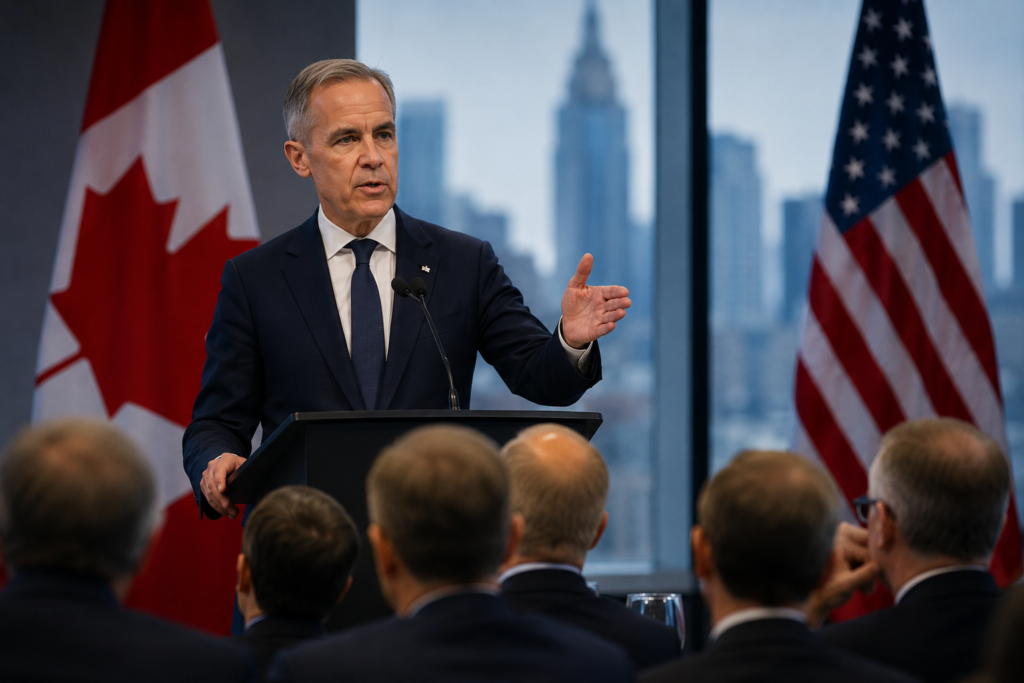
Image Credentials: Image Title: Carney Tells U.S. Business Leaders That a Strong Canada Can Help ‘Make America Great Again’. Source: (chatgpt.com) Date: May 2026. Attribution: This image was created using AI-generated imagery (chatgpt.com) by Open Chronicle and does not depict a real-world scene.
By Open Chronicle with agencies
Canadian Prime Minister Mark Carney has argued that a stronger, more independent Canada would ultimately benefit the United States, telling a gathering of influential American business leaders that deeper cooperation between the two neighbors remains essential despite growing economic and geopolitical challenges.
Speaking before the Economic Club of New York on Thursday, Carney outlined his vision for a renewed North American partnership as Canada, the United States, and Mexico prepare to negotiate a new trade agreement that will shape the future of regional commerce.
His remarks come at a time of heightened uncertainty in global markets, shifting trade policies, and increasing competition among major economic powers.
A New Vision for Canada-U.S. Relations
Carney told the audience that Canada’s efforts to strengthen its economy and expand its global influence should not be viewed as a move away from the United States.
Instead, he argued that a more resilient Canada would become a stronger partner for its southern neighbor.
“Canada Strong will help make America great again,” Carney said, echoing a phrase closely associated with U.S. President Donald Trump while framing it within a broader vision of mutual economic growth.
According to Carney, the two countries remain deeply interconnected through trade, energy, manufacturing, and supply chains. He emphasized that both nations benefit when their economies grow together.
Responding to a Changing World
The Canadian leader said recent shifts in global politics and trade have forced Ottawa to rethink its economic strategy.
He pointed to what he described as “tectonic shifts” in tariffs and international trade policies, as well as a world that has become increasingly divided and unpredictable.
Those developments, he argued, require Canada to strengthen its domestic economy, invest in critical industries, and ensure greater self-reliance in key sectors.
At the same time, Carney stressed that Canada is not seeking isolation or economic separation from the United States.
Rather, he called for a “true partnership” based on shared interests and mutual benefits.
Energy and Resources at the Center of Cooperation
A major focus of Carney’s speech was Canada’s role as a supplier of strategic resources.
He highlighted Canada’s vast reserves of oil, natural gas, electricity, industrial metals, and critical minerals, resources that remain essential to North American energy security and industrial production.
Carney suggested that greater cooperation in these sectors would strengthen both economies while improving competitiveness against global rivals.
“That is mutual strength,” he told attendees. “The examples are legion where we should work together and compete with the world together.”
Canada has increasingly promoted itself as a reliable supplier of energy and critical materials needed for advanced manufacturing, clean technologies, and defense industries.
Diversifying Beyond the American Market
While emphasizing the importance of Canada-U.S. relations, Carney also made clear that Ottawa intends to expand its economic partnerships elsewhere.
He noted that Canada is actively pursuing deeper trade and investment ties with the European Union, Asian economies, and countries across South America.
The strategy reflects a broader effort to reduce dependence on any single market and increase Canada’s resilience against economic disruptions.
For decades, the United States has been Canada’s dominant trading partner, accounting for the vast majority of Canadian exports. However, policymakers in Ottawa have increasingly sought to diversify trade relationships amid changing global conditions.
Trade Talks on the Horizon
Carney’s address comes as North America approaches a critical period of trade negotiations.
Canada, the United States, and Mexico are expected to begin discussions over a new trade framework that could reshape economic relations across the continent.
Issues such as tariffs, energy exports, supply chains, manufacturing competitiveness, and critical mineral production are likely to feature prominently in the negotiations.
Business leaders on both sides of the border are watching closely, as the outcome could influence investment decisions and economic growth for years to come.
Balancing Independence and Partnership
Carney’s message reflected a delicate balancing act: promoting Canadian independence while reaffirming the importance of cooperation with the United States.
His remarks suggest that Ottawa sees economic diversification and stronger domestic capabilities not as alternatives to North American integration, but as foundations for a more balanced and durable partnership.
As global competition intensifies and geopolitical tensions continue to reshape international trade, Canada appears determined to strengthen its position while maintaining close ties with its largest ally and trading partner.
Whether that vision can be translated into concrete policy outcomes will likely become clearer as negotiations over the future of North American trade begin in the months ahead.