
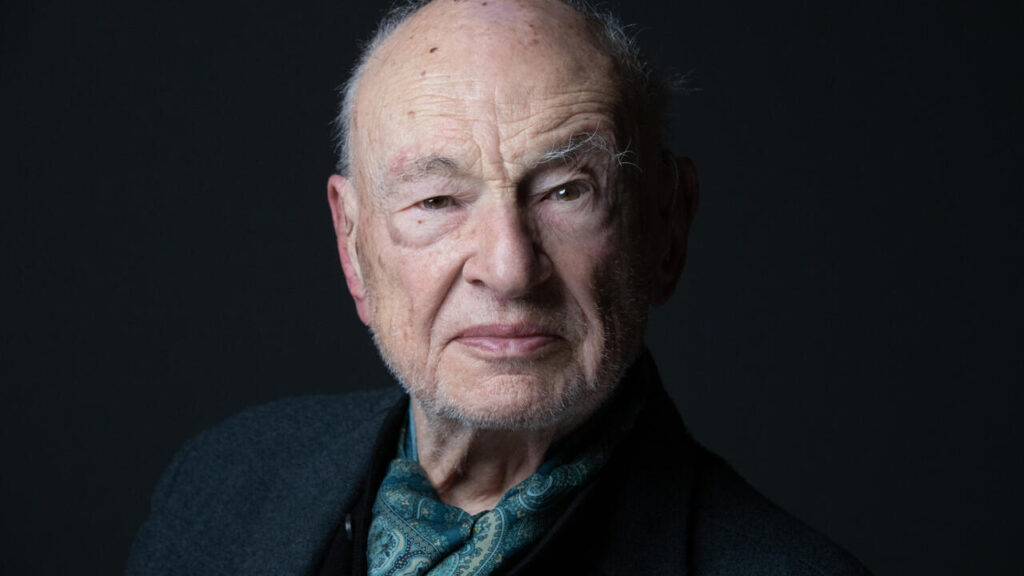
Image: from FRANCE 24 – France X @F24ActuFrance
By Open Chronicle with agencies
French philosopher, sociologist, and public intellectual Edgar Morin, one of the most influential thinkers of the modern era, has died at the age of 104. His death was confirmed by his wife, the Franco-Moroccan sociologist Sabah Abouessalam Morin.
For more than eight decades, Morin shaped debates on humanity, democracy, education, science, ecology, and global society. His work, translated into dozens of languages, inspired generations of scholars, educators, and political leaders across the world.
Widely regarded as the leading advocate of “complex thought,” Morin challenged simplistic explanations of reality and argued that understanding the modern world required connecting knowledge across disciplines.
A Life Shaped by History
Born Edgar Nahoum in Paris on July 8, 1921, he came from a secular Sephardic Jewish family whose roots traced back to Thessaloniki, Greece.
A defining moment of his childhood was the death of his mother when he was only ten years old, an event he would later describe as his personal “Hiroshima.” The loss profoundly influenced his reflections on human suffering, memory, and existence.
During the Second World War, Morin joined the French Resistance against Nazi occupation and adopted the pseudonym “Morin,” a name he would retain for the rest of his life. He also became involved with the French Communist Party, believing socialism could help rebuild a devastated Europe.
However, disillusionment with Stalinism and authoritarianism eventually led him to break with the party. His 1959 book Self-Criticism documented both his political journey and his rejection of ideological dogmatism.
This experience would become central to his intellectual outlook, reinforcing his lifelong belief that freedom, democracy, and critical thinking must always prevail over rigid political systems.
The Architect of Complex Thought
Morin’s most enduring intellectual contribution was the development of the concept of “complex thought.”
He argued that modern society often fragments knowledge into isolated disciplines, making it difficult to understand the interconnected nature of reality. For Morin, human beings, societies, ecosystems, and political systems could not be properly understood through reductionist approaches.
His monumental multi-volume work The Method became the cornerstone of this philosophy. In it, he sought to reconnect science, philosophy, sociology, biology, psychology, and history into a unified framework for understanding human existence.
Among his most influential books were Introduction to Complex Thought, The Well-Made Head, Lessons of a Century of Life, The Seven Complex Lessons in Education for the Future, and Lessons of History, published when he was already over one hundred years old.
His ideas gained particular influence in educational theory, where he advocated teaching students how to think critically, connect knowledge, and confront uncertainty rather than simply memorize information.
A Global Intellectual Voice
Morin’s influence extended far beyond France.
He received honorary doctorates from dozens of universities across Europe, Latin America, and other regions, becoming a prominent figure in international academic circles.
Outside philosophy and sociology, he also left a mark on documentary filmmaking. Alongside filmmaker Jean Rouch, he co-created the groundbreaking 1961 documentary Chronique d’un été (Chronicle of a Summer), considered one of the foundational works of cinéma vérité.
The film explored everyday life in postwar France through spontaneous conversations about happiness, social class, race, and colonialism, helping transform documentary storytelling worldwide.
Even after turning one hundred, Morin remained active in public debates, regularly commenting on climate change, war, democracy, globalization, and technological transformation.
A Special Relationship with Portugal
Morin maintained a particularly close relationship with Portugal for more than six decades.
He first visited the country in the 1960s and developed lasting friendships with several leading Portuguese intellectuals, including António Alçada Baptista, Helena Vaz da Silva, and former President and Prime Minister Mário Soares.
During Portugal’s democratic transition following the Carnation Revolution of 1974, Morin publicly supported Soares and the defense of democratic freedoms at a time when political tensions threatened the country’s future direction.
Recalling that period during a visit to Lisbon in 2023, Morin said that freedom and social justice must go hand in hand.
“People need bread, but they also need freedom,” he remarked, reflecting a principle that guided much of his political and philosophical thinking.
His final visit to Portugal came in 2023 for the conference The Atlantic: The New Charter of Humanism, where he emphasized that humanity should focus on improving life on Earth before dreaming of colonizing other planets.
A Voice Against Intolerance and Environmental Crisis
Throughout his later years, Morin increasingly focused on global challenges such as environmental degradation, nationalism, social fragmentation, and the risks posed by technological acceleration.
He warned repeatedly that humanity faced interconnected crises requiring unprecedented levels of cooperation and collective awareness.
While critical of nationalism and authoritarianism, he also cautioned against simplistic solutions to complex global problems. His writings consistently emphasized dialogue, pluralism, and the need for a shared human consciousness.
In one of his final public reflections, Morin expressed concern about humanity’s inability to fully grasp the dangers posed by climate change and geopolitical instability. Yet he remained hopeful.
Despite acknowledging the seriousness of the challenges ahead, he refused fatalism and continued advocating for human creativity, solidarity, and resilience.
An Enduring Legacy
Edgar Morin leaves behind an intellectual legacy that spans more than a century of history and thought.
A resistance fighter, philosopher, sociologist, filmmaker, and public intellectual, he dedicated his life to understanding the complexity of the human condition and defending the values of freedom, democracy, and human dignity.
His death marks the end of an extraordinary chapter in modern intellectual history. Yet the questions he raised about humanity, knowledge, uncertainty, and coexistence remain as relevant today as ever.
As the world confronts increasingly interconnected crises, Morin’s central message continues to resonate: understanding reality requires embracing complexity rather than seeking simple answers.