
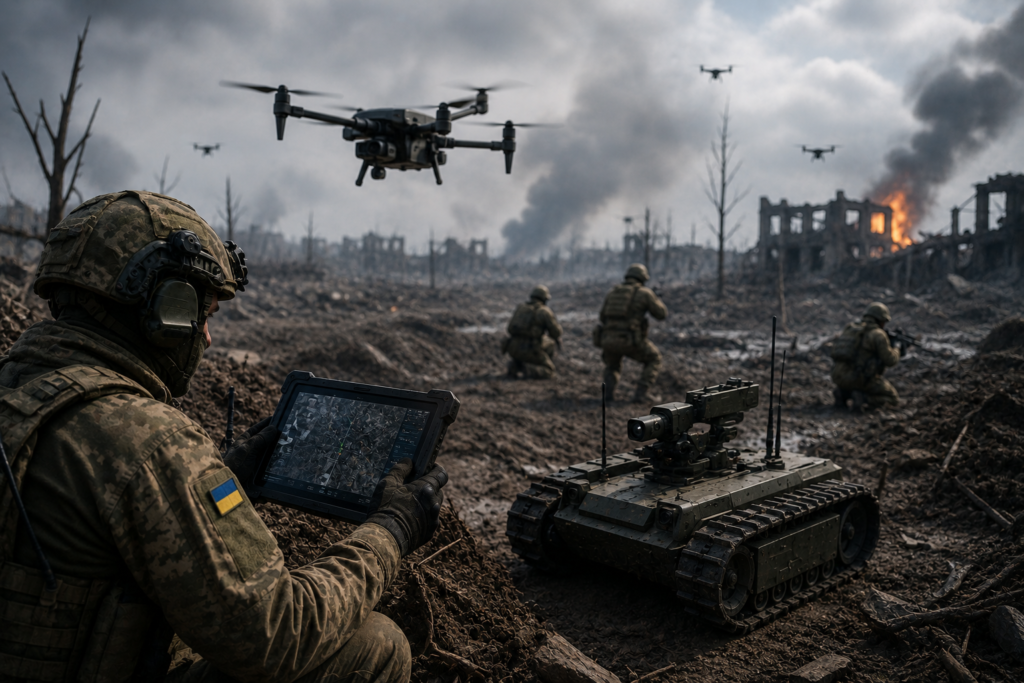
Image Credentials: Image Title: “Robots Don’t Bleed”: How Drones and AI Are Transforming Warfare in Ukraine. Source: (chatgpt.com) Date: May 2026. Attribution: This image was created using AI-generated imagery (chatgpt.com) by Open Chronicle and does not depict a real-world scene.
By Maximus Carter | Open Chronicle Research
The war in Ukraine has become one of the most technologically advanced conflicts in modern history, reshaping traditional concepts of warfare and accelerating the integration of robotics, artificial intelligence, satellite communications, and data-driven military operations.
According to international affairs analyst Américo Martins (CNN), who recently reported from the front lines, a simple phrase captures the new reality of the battlefield: “Robots don’t bleed.”
The statement reflects a growing military doctrine embraced by both Ukraine and Russia, where machines increasingly perform tasks once carried out by soldiers, reducing human exposure to some of the war’s most dangerous environments.
The Rise of Ground Robots
The robots deployed in Ukraine are not humanoid machines resembling science fiction characters. Instead, they are compact, remotely operated ground vehicles designed for combat support and logistics.
Often described as small unmanned armored vehicles, these systems can transport ammunition, food, and medical supplies to forward positions while also evacuating wounded personnel from active combat zones.
Some models are equipped with machine guns or explosive payloads, allowing them to engage enemy positions directly.
Their growing presence reflects a broader trend in military thinking: replacing soldiers with machines whenever possible in high-risk environments.
For commanders, the logic is straightforward. Equipment can be repaired or replaced. Human lives cannot.
Drones Redefine the Battlefield
Unmanned aerial vehicles have become perhaps the most influential weapon system of the conflict.
In the early stages of Russia’s full-scale invasion, Ukrainian forces successfully used inexpensive drones carrying improvised explosives to attack advancing Russian armored columns moving toward Kyiv.
These early successes demonstrated the vulnerability of traditional military formations to low-cost aerial systems.
Russia responded by expanding electronic warfare operations aimed at disrupting drone communications and navigation systems.
Ukraine, however, adapted quickly.
Rather than relying exclusively on radio signals, Ukrainian engineers developed fiber-optic-controlled drones connected to operators through cables extending up to 20 kilometers. Because communication occurs through physical connections rather than wireless transmissions, electronic jamming becomes largely ineffective.
This innovation illustrates the rapid cycle of adaptation that has characterized the conflict, where technological advantages often trigger immediate countermeasures and further innovation.
The Emergence of the “Kill Zone”
One of the most significant consequences of widespread drone deployment has been the transformation of the front line itself.
Military analysts increasingly describe a broad area extending roughly 20 kilometers on either side of the contact line as a “kill zone,” a region under near-constant surveillance by reconnaissance drones.
Within this zone, any movement can be detected and targeted within minutes, dramatically increasing the dangers faced by troops.
As a result, traditional battlefield concepts are rapidly becoming obsolete.
Trench systems, once considered essential defensive positions and frequently compared to those of the First World War during the early years of the conflict, have lost much of their effectiveness.
Persistent aerial surveillance means fixed positions can be identified and attacked with unprecedented speed and precision.
Soldiers deployed in advanced positions often remain confined for extended periods under constant threat from artillery, drones, and missile strikes.
In this environment, robotic supply vehicles have become critical for sustaining frontline units.
Artificial Intelligence Joins the Fight
Beyond drones and robots, artificial intelligence is increasingly influencing military decision-making.
The Ukraine conflict generates enormous quantities of digital information every day. Combat footage, satellite imagery, drone recordings, communications intercepts, and battlefield reports create vast datasets that can be analyzed in near real time.
Ukrainian military planners have invested heavily in teams dedicated to processing this information.
Machine learning systems help identify behavioral patterns, track troop movements, predict logistical routes, and optimize drone targeting strategies.
Artificial intelligence allows commanders to transform massive volumes of battlefield data into actionable intelligence more quickly than traditional analytical methods.
The result is a battlefield where information superiority can be nearly as important as firepower itself.
A Glimpse Into Future Warfare
Military experts increasingly view Ukraine as a testing ground for the future of warfare.
The conflict demonstrates how relatively inexpensive technologies can challenge conventional military doctrines built around tanks, artillery, and large troop formations.
It also highlights the growing importance of software, data analysis, electronic warfare, and autonomous systems in determining battlefield outcomes.
Yet despite its technological sophistication, the war remains exceptionally brutal.
Advanced algorithms, satellite networks, and robotic systems have not eliminated human suffering. Instead, they have altered the methods through which violence is delivered and managed.
As nations around the world study the lessons emerging from Ukraine, one conclusion appears increasingly clear: future conflicts are likely to be fought by a combination of soldiers, machines, and artificial intelligence operating together in ways that were difficult to imagine only a decade ago.
The war has become both a devastating human tragedy and a powerful demonstration of how rapidly technology is transforming the nature of armed conflict.