
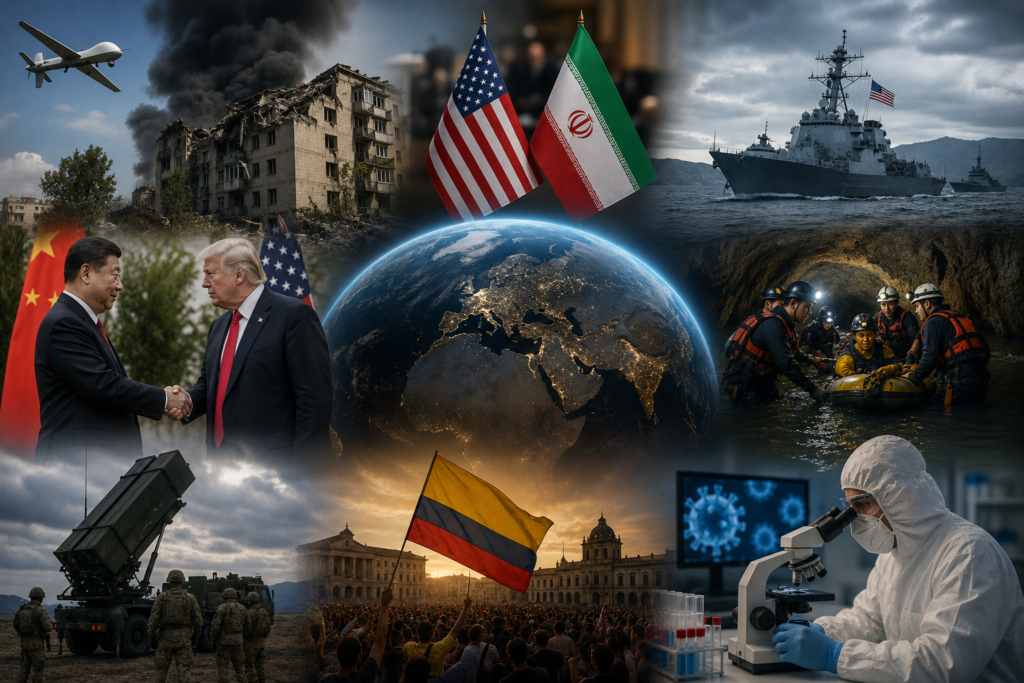
Image Credentials: Image Title: Global News Brief: Key Events and Developments for May 30, 2026. Source: (chatgpt.com) Date: May 2026. Attribution: This image was created using AI-generated imagery (chatgpt.com) by Open Chronicle and does not depict a real-world scene.
By Open Chronicle with agencies
A series of major developments across Europe, the Middle East, Asia, and Africa highlighted growing geopolitical tensions, security concerns, and humanitarian challenges on May 30, as governments grappled with regional conflicts, public health emergencies, and shifting diplomatic alliances.
NATO Faces New Security Challenges After Drone Incident
Security concerns intensified in Eastern Europe after Romania reported that a Russian drone involved in attacks against Ukraine crashed into a residential building, causing casualties and reigniting debate over NATO’s response to repeated airspace violations.
The incident came as Ukrainian officials announced successful overnight drone strikes against Russian military and energy infrastructure, including missile systems, a tanker, and strategic facilities in southern Russia.
Meanwhile, Russia recalled its ambassador to Armenia for consultations amid growing tensions over Yerevan’s deepening integration with the European Union, signaling another strain in Moscow’s relationships across the former Soviet space.
Middle East Remains on Edge
Despite ongoing diplomatic efforts, tensions continued to simmer across the Middle East.
US Defense Secretary Pete Hegseth confirmed that the American naval blockade targeting Iran remains in force while negotiations over a broader peace arrangement continue. The US Navy also issued warnings to commercial shipping regarding potential mine threats in the Strait of Hormuz, one of the world’s most important maritime trade routes.
Iran rejected new American sanctions efforts linked to the Strait, while reports indicated that the United Arab Emirates conducted dozens of strikes against Iranian targets during the recent conflict.
Turkish Foreign Minister Hakan Fidan described a potential US-Iran agreement as “closer than ever,” although significant disagreements remain over nuclear issues, maritime security, and regional influence.
In Lebanon, military and political leaders held discussions concerning security arrangements with Israel, while reports suggested Israeli and Lebanese military officials participated in talks facilitated by the Pentagon.
China, Indo-Pacific Security, and AUKUS Expansion
At the Shangri-La Dialogue in Singapore, senior US officials continued to emphasize concerns about China’s military modernization.
Defense Secretary Hegseth warned that Beijing’s military buildup remains a major strategic challenge, while new satellite imagery reportedly revealed additional Chinese military infrastructure projects.
The AUKUS security partnership announced plans to accelerate the development of advanced unmanned undersea vehicles, with deployment expected by 2027. Officials described the initiative as a key component of future deterrence efforts in the Indo-Pacific region.
The Pentagon also highlighted improving relations between Washington and Beijing following recent diplomatic engagements, though US officials continued to urge regional allies, including Japan, to strengthen defense capabilities.
Ebola Outbreak Draws International Attention
The escalating Ebola outbreak in the Democratic Republic of the Congo continued to attract global concern.
World Health Organization Director-General Tedros Adhanom Ghebreyesus arrived in the outbreak’s epicenter in Ituri Province to coordinate international response efforts as cases continue to rise.
Neighboring countries remain on alert, although Congolese authorities ruled out widespread school closures for the time being.
China issued new travel advisories urging its citizens to avoid non-essential travel to affected regions, while health agencies around the world continued monitoring the situation closely.
Humanitarian and Political Developments
In Laos, rescue teams successfully pulled four more people from a flooded cave system after nearly a week of intensive operations. Two individuals remain missing as search efforts continue.
Elsewhere, Afghanistan suffered another tragedy when a truck carrying returning refugees overturned, killing at least 18 people, including children.
In South America, Colombia prepared for a crucial presidential election amid concerns about continuing political violence, while Bolivia faced growing unrest that government officials blamed on supporters of former leadership figures.
Europe Confronts Multiple Challenges
The European Union announced it would release €16.4 billion in previously frozen funds for Hungary following reforms that addressed concerns related to governance and rule-of-law standards.
Meanwhile, Munich Airport experienced a temporary ground stop after reports of a drone sighting disrupted air traffic operations for approximately one hour.
European leaders also continued debating future trade relations with China, with the European Commission signaling a tougher stance toward Beijing amid growing concerns about economic dependence and market imbalances.
Space, Technology, and Science
NASA leadership reignited debate over the classification of Pluto after comments suggesting the former planet deserves reconsideration within the Solar System’s official structure.
In the technology sector, Meta reportedly advanced plans for AI-powered wearable devices, including workplace-focused smart accessories, as competition intensifies in the artificial intelligence hardware market.
A World Defined by Strategic Competition
From escalating tensions in Eastern Europe and the Middle East to concerns about China’s military rise and global health emergencies in Africa, the developments of May 30 underscored the increasingly interconnected nature of international affairs.
Diplomatic negotiations continue across multiple fronts, but the day’s events highlighted how geopolitical competition, technological transformation, and humanitarian crises are shaping the global landscape simultaneously.