
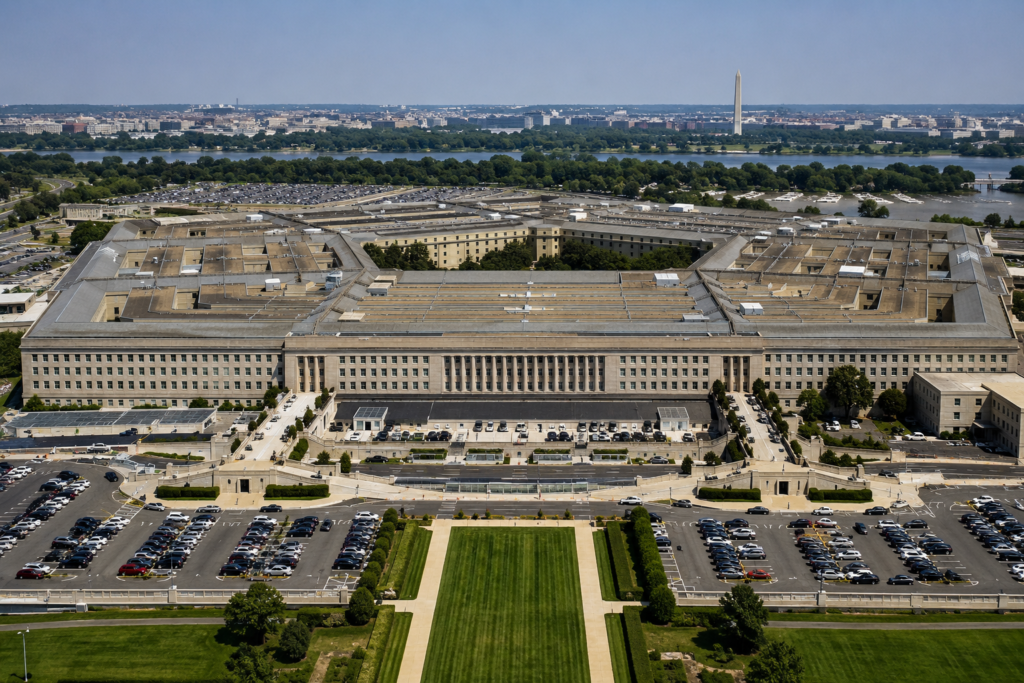
Image Credentials: Image Title: Pentagon Revises Religious Affiliation List Following Backlash Over Faith Classification Changes. Source: (chatgpt.com) Date: June 2026. Attribution: This image was created using AI-generated imagery (chatgpt.com) by Open Chronicle and does not depict a real-world scene.
By Open Chronicle with agencies
The Pentagon has once again revised its list of religious affiliation options available to U.S. service members after facing criticism over how certain faith groups were categorized in a recent update.
The controversy emerged after the Department of Defense introduced a significantly shortened list of religious identification codes, reducing the number of available affiliations from roughly 200 to just 31. Defense officials said the move was intended to simplify the system and make it more practical for military chaplains and personnel administrators.
However, the revised list quickly drew criticism from lawmakers and religious leaders, particularly because it grouped numerous denominations under a broad “Christian” label while excluding the Church of Jesus Christ of Latter-day Saints from that category.
Effort to Simplify Religious Codes
Defense Secretary Pete Hegseth had previously defended the decision to reduce the number of faith codes available to military personnel.
According to Pentagon officials, the larger system had become difficult to manage, with the overwhelming majority of service members using only a small number of the available codes.
Hegseth argued that a streamlined list would help military chaplains better understand and respond to the spiritual needs of service members while maintaining administrative efficiency.
Pentagon spokesman Sean Parnell initially shared the revised list last week, emphasizing that the department was not making judgments about the legitimacy of any religious tradition but merely attempting to simplify an overly complex classification system.
Criticism from Lawmakers
The updated list immediately sparked concern among several members of Congress, particularly representatives from Utah, where the Church of Jesus Christ of Latter-day Saints has a significant presence.
Senator Mike Lee, Representative Mike Kennedy, and Senator John Curtis publicly criticized the categorization, arguing that the federal government should avoid making distinctions that could be interpreted as theological judgments.
Lee described the omission of the Latter-day Saint faith from the Christian category as inappropriate and inconsistent with principles of religious neutrality.
He argued that government institutions should not become involved in doctrinal debates between religious groups and emphasized that thousands of active-duty military personnel identify with the faith.
Pentagon Issues New Revision
In response to the backlash, the Pentagon released a new version of the religious affiliation list on Monday.
The updated system removes the broad “Christian” label entirely. Instead, individual Christian denominations are listed separately without being grouped under a single category.
Pentagon officials stated that the earlier version contained what they described as “redundant and unnecessary labeling” and that the latest revision was intended to address those concerns.
In a public statement, the department reiterated that its role is not to determine theological classifications but to ensure that the sincerely held beliefs of military personnel are respected and accommodated whenever possible.
“The Pentagon’s job is not to adjudicate theological debates, but instead to ensure sincerely held faith is respected and encouraged in our ranks,” the statement said.
New Religious Categories
Under the revised system, service members can select from approximately 20 different Christian denominations and traditions. Additional options remain available for Jewish, Muslim, Hindu, Sikh, Buddhist, Baháʼí, and agnostic personnel.
The changes also include broader categories such as “No Religion” and “Other Religion.”
However, some previously available affiliations have been removed entirely, including options for Unitarian Universalists, Wiccans, pagans, and humanists. Those individuals would now need to select either “Other Religion” or another available category that best reflects their beliefs.
Debate Reflects Broader Questions
The dispute highlights ongoing debates within the U.S. military about how best to balance administrative efficiency with religious diversity among service members.
Supporters of the streamlined system argue that reducing hundreds of rarely used categories makes the process more practical for chaplain services and personnel management. Critics, however, warn that oversimplification may leave some religious communities feeling overlooked or misrepresented.
Following the latest revision, Senator Mike Lee thanked Defense Secretary Hegseth for addressing the issue and correcting what he viewed as a significant oversight.
The Pentagon has indicated that the revised list is part of a broader effort to modernize and simplify personnel systems while continuing to respect the religious freedom of all members of the armed forces.