
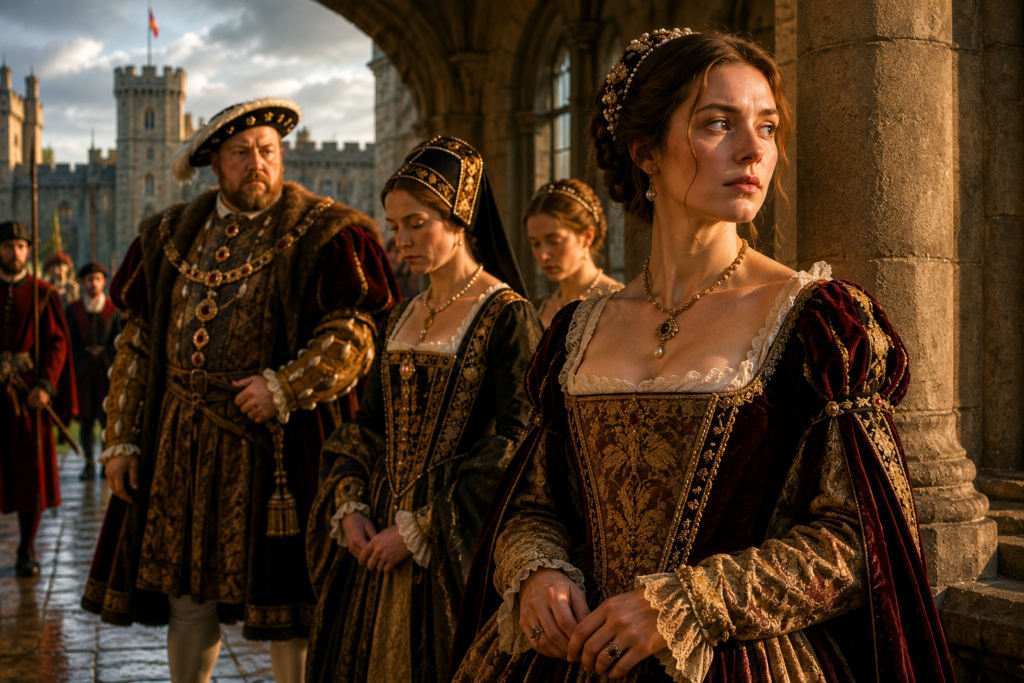
Image Credentials: Image Title: The Truth About Tudor England’s ‘Most Hated Woman’. Source: (chatgpt.com) Date: June 2026. Attribution: This image was created using AI-generated imagery (chatgpt.com) by Open Chronicle and does not depict a real-world scene.
By Isabella Harper | Open Chronicle Staff Writer
For nearly five centuries, Jane Boleyn has occupied a unique place in English history. Cast as a scheming courtier, a spy, and even a traitor to her own family, she has often been remembered as the woman who helped send her husband, George Boleyn, and her sister-in-law, Queen Anne Boleyn, to their deaths.
Her name later became entangled in another royal catastrophe, the downfall of Catherine Howard, Henry VIII’s fifth wife. By the time Jane herself climbed the scaffold at the Tower of London in February 1542, her reputation had already been stained by allegations of betrayal and intrigue.
Yet modern historians are increasingly asking whether Jane Boleyn truly deserves her infamous legacy, or whether she became a convenient scapegoat in one of history’s most ruthless royal courts.
A Life at the Heart of Tudor Power
Born Jane Parker around 1505, she entered royal service while still a child. Her father was a respected court official, and Jane quickly became part of the sophisticated world surrounding King Henry VIII.
Her marriage to George Boleyn, the talented and ambitious brother of Anne Boleyn, elevated her status considerably. At the time, the Boleyn family was rising rapidly through the ranks of English society.
Few could have predicted how dramatically their fortunes would change.
When Anne captured Henry VIII’s attention and eventually became queen in 1533, the Boleyn family reached the height of its influence. Jane found herself at the centre of Tudor politics, surrounded by wealth, prestige, and unprecedented access to royal power.
But life at Henry VIII’s court came with constant danger.
Loyalties shifted overnight, friendships could become liabilities, and royal favour was often fleeting. A careless remark or political miscalculation could prove fatal.
The Fall of the Boleyns
The defining tragedy of Jane’s life arrived in 1536.
Anne Boleyn, once the most powerful woman in England, was arrested on charges of adultery, treason, and incest. Among those accused alongside her was her own brother, George Boleyn.
The allegations shocked contemporaries and continue to provoke debate among historians today. Many scholars believe the charges were fabricated to remove Anne from power and allow Henry VIII to marry Jane Seymour.
Yet almost immediately after Anne and George were executed, rumours began circulating that Jane had played a role in their downfall.
According to later accounts, she supposedly provided information that supported accusations against her husband and sister-in-law. The image of Jane as the wife who betrayed her own family became deeply embedded in historical memory.
The evidence, however, tells a far less certain story.
Contemporary records offer little proof that Jane actively contributed to the prosecution. Historians have found no clear indication that her testimony was decisive or even particularly damaging. In fact, surviving documents suggest she attempted to intervene on George’s behalf.
Despite this, her continued presence at court after the executions fuelled suspicion. While other members of the Boleyn family fell from favour, Jane remained in royal service.
For many observers, survival itself became evidence of guilt.
Catherine Howard and a Fatal Secret
Jane’s second encounter with a royal scandal would ultimately cost her life.
After returning to court, she entered the household of Catherine Howard, the young woman who became Henry VIII’s fifth wife in 1540. Catherine was barely out of her teens, while the king was aging, increasingly ill, and notoriously suspicious.
Within a short time, Catherine began a secret relationship with the courtier Thomas Culpeper.
Historical records indicate that Jane was aware of meetings between the pair and may have helped facilitate some of them. Whether she acted out of loyalty to the queen, obedience to her position, or personal sympathy remains impossible to determine.
What is certain is that when the affair was uncovered, Henry VIII reacted with characteristic fury.
Culpeper was executed first. Catherine Howard was condemned soon after. Jane, accused of assisting the relationship, was also charged with treason.
On 13 February 1542, both women were executed at the Tower of London.
Jane was approximately thirty-six years old.
The Making of a Villain
Following her death, Jane’s reputation deteriorated further.
As generations of historians revisited the Tudor period, she was frequently portrayed as manipulative, jealous, and morally corrupt. Victorian writers viewed her through a rigid moral lens, presenting her as a woman whose ambition had led her into scandal.
Later interpretations were often equally unforgiving.
Some twentieth-century historians influenced by Freudian theories described her as sexually obsessed or psychologically unstable. Popular novels, plays, and television dramas frequently cast her as a schemer lurking behind the downfall of queens and courtiers.
These portrayals, however, often relied more on speculation than evidence.
The problem facing historians is simple: very little survives that reveals Jane’s personal thoughts or motivations. Unlike many famous Tudor figures, she left behind no substantial collection of letters, diaries, or writings.
The silence of the historical record allowed myths to flourish.
A New Historical Reassessment
In recent decades, scholars have increasingly challenged the traditional narrative.
Historians such as Tracy Borman and Julia Fox argue that Jane was unfairly blamed for events largely beyond her control. Rather than being a mastermind of Tudor conspiracies, they suggest she was a woman attempting to navigate an extraordinarily dangerous political environment.
Fox, whose biography of Jane remains one of the most influential modern studies, argues that later generations needed someone to blame for the destruction of Anne Boleyn.
By placing responsibility on Jane, it became easier to avoid confronting the role played by Henry VIII himself.
The king ordered the investigations, approved the prosecutions, and sanctioned the executions. Yet public memory often focused on Jane instead.
This tendency was reinforced during the reign of Elizabeth I, Anne Boleyn’s daughter. Efforts to rehabilitate Anne’s reputation naturally encouraged the creation of villains who could be portrayed as enemies of the fallen queen.
Jane fit the role perfectly.
Survival in a Tyrant’s Court
Perhaps the most revealing way to view Jane Boleyn is not as a villain but as a survivor.
For more than two decades, she remained active at one of Europe’s most dangerous courts, serving multiple queens under a monarch whose reign was marked by executions, political purges, and constant instability.
Her ambition was undeniable. Yet ambition alone was hardly unusual in Tudor England. What made Jane controversial was that she pursued influence in a society that often judged ambitious women far more harshly than ambitious men.
Ultimately, her story reflects the brutal realities of power under Henry VIII.
Whether she was guilty of poor judgment, political opportunism, or simply misplaced loyalty, Jane Boleyn became one of many casualties of a system dominated by fear and absolute authority.
Far from being the clear-cut villain portrayed by centuries of tradition, she emerges today as a far more complicated figure, a woman caught between survival and loyalty, navigating a court where even the slightest misstep could lead to the executioner’s axe.
In that sense, Jane Boleyn’s story is not merely about betrayal. It is about the human cost of living under tyranny, and the way history often transforms its victims into its villains.