
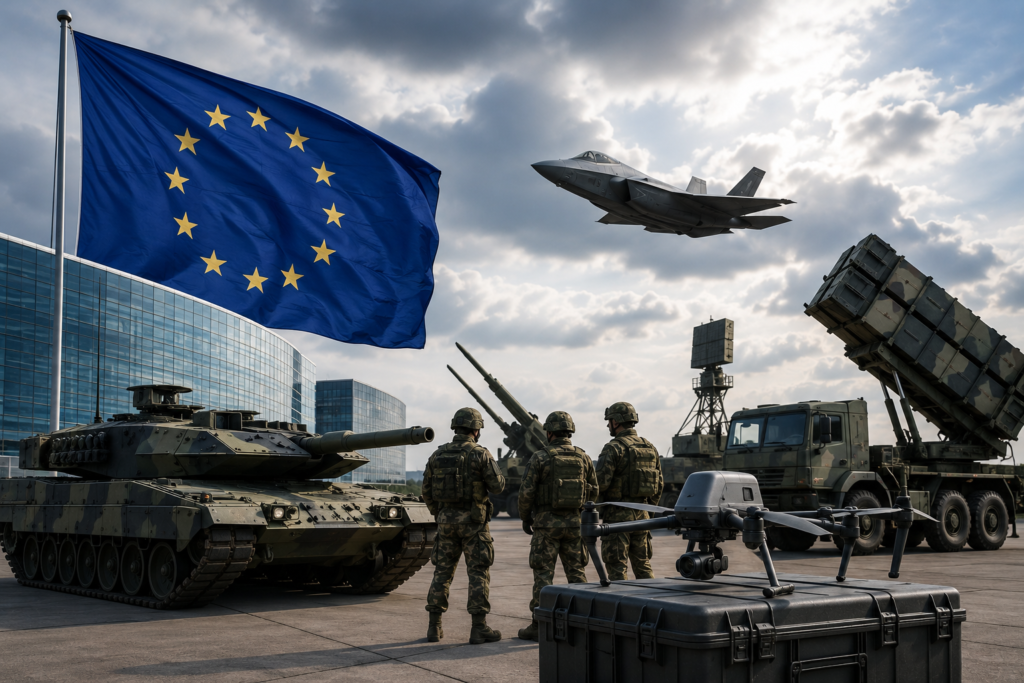
Image Credentials: Image Title: EU Prepares SAFE II as Brussels Rethinks Defense Financing Strategy. Source: (chatgpt.com) Date: June 2026. Attribution: This image was created using AI-generated imagery (chatgpt.com) by Open Chronicle and does not depict a real-world scene.
By Open Chronicle with agencies
The European Union is already preparing the next phase of its landmark common defense financing initiative, with policymakers exploring a new mechanism known as SAFE II that could move beyond low-interest loans and introduce direct grants for member states. The debate comes as security threats on the bloc’s eastern flank intensify and governments seek more flexible ways to fund a rapidly expanding military buildup.
Launched in 2025, the Security Action for Europe (SAFE) programme marked the first major use of jointly issued European debt dedicated to defense. The initiative allows EU countries to access favorable financing for military investments while benefiting from exemptions under the bloc’s fiscal rules through a national escape clause.
One year later, European officials believe the changing security environment is forcing a reassessment of the model. Hybrid threats, including repeated drone incursions and electronic warfare incidents linked to the conflict in Ukraine, have increased demand for defense funding and accelerated discussions over a successor programme.
According to EU officials involved in the debate, the central political question is no longer whether SAFE should evolve, but how. While the first version focused on loans, several countries on NATO’s eastern flank argue that additional borrowing is no longer sustainable and are pushing for a grant-based system.
States such as Estonia and Latvia, among the strongest advocates for increased defense spending, have already approached the limits imposed by existing EU fiscal rules despite the flexibility built into the SAFE framework. Their experience has strengthened calls for a mechanism that would provide direct financial support rather than increasing national debt burdens.
Strong demand for additional funding
Interest in the first SAFE programme has already exceeded expectations. Initial consultations with member states suggested demand for up to €188 billion in financing, nearly €40 billion above the €150 billion initially allocated.
European institutions are currently assessing how much of the original funding envelope will remain unused after several governments, including Italy and Romania, revised their borrowing plans. Current estimates suggest that between €8 billion and €18 billion could remain available once all loan agreements are finalized later this summer.
Countries such as Poland and Lithuania are expected to seek additional funding rounds, making the outcome of SAFE I a crucial factor in shaping any future SAFE II proposal.
The issue has gained further urgency following a series of recent drone incidents affecting Eastern European countries. Several suspected Ukrainian drones, reportedly diverted into EU airspace by Russian GPS spoofing operations, have triggered political and security concerns. In Latvia, criticism over the government’s handling of one such incident contributed to the collapse of the ruling coalition, while in Lithuania, a drone incursion forced senior leaders to seek shelter.
Building a stronger European defense industry
Beyond military readiness, SAFE was designed to strengthen Europe’s defense industrial base by creating stable, long-term demand for domestic manufacturers. EU officials stress that the objective is not only to fill immediate capability gaps, but also to reduce dependence on external suppliers and support industrial growth across the bloc.
However, national governments continue to guard their defense budgets closely, often prioritizing domestic companies over wider European coordination. Officials acknowledge that this approach risks creating a fragmented industrial landscape, particularly in fast-evolving sectors such as drones and counter-drone technologies, where interoperability and scale are increasingly essential.
The challenge is compounded by the rapid pace of battlefield innovation in Ukraine. European officials admit that Ukrainian manufacturers have developed significant technological advantages through combat experience, particularly in drone warfare, and warn that Europe may ultimately become a customer of Ukraine’s defense industry rather than its primary supplier.
Ukraine’s growing role in Europe’s defense future
The war in Ukraine is also reshaping the EU’s broader defense strategy. Of the latest €90 billion EU financial package for Kyiv, around two-thirds is expected to be spent on military procurement. While Brussels encourages purchases from European producers, officials recognize that EU industry cannot yet meet all of Ukraine’s operational requirements.
Critical shortages remain in areas such as advanced missile defense systems, where Ukraine continues to rely heavily on U.S.-built Patriot batteries. Although alternatives such as the Franco-German SAMP/T system exist, production volumes remain insufficient to match Kyiv’s needs.
As a result, much of the funding is likely to be invested directly in Ukraine’s own defense sector, especially in drone technology and other battle-tested capabilities. European policymakers increasingly see partnerships with Ukrainian firms as an opportunity to integrate that expertise into European production lines, although some capitals fear that such cooperation could weaken their own national defense champions.
Preparing for the wars of tomorrow
The debate over SAFE II is unfolding against a backdrop of profound strategic uncertainty. The gradual reduction of U.S. military commitments to Europe, the evolving nature of the war in Ukraine, and instability around key global trade routes such as the Strait of Hormuz are all forcing European governments to rethink long-term defense planning.
One of the greatest concerns is Washington’s stated intention to reduce not only its conventional troop presence but also its strategic enablers, including logistics, aerial refueling, and intelligence capabilities that underpin NATO operations.
European Defense Commissioner Andrius Kubilius recently warned that replacing U.S. military assets on the continent could ultimately cost the European Union as much as €500 billion, a gap that member states would struggle to fill individually.
As officials shape the future of SAFE II, one question continues to dominate the debate: what kind of conflict should Europe be preparing for? The battlefield in Ukraine has changed dramatically since 2022, and military planners acknowledge that the nature of warfare in 2030 could look very different from today.
For Brussels, the challenge is not only financing defense, but ensuring that Europe develops the industrial capacity, technological innovation, and strategic autonomy needed to respond to an increasingly unpredictable security landscape.