
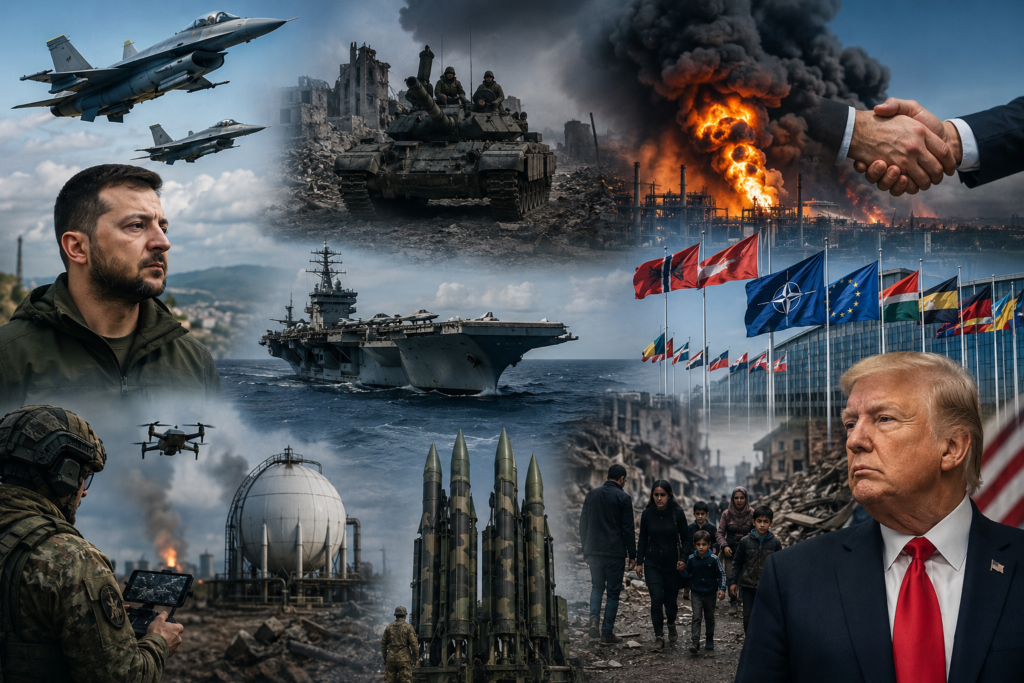
Image Credentials: Image Title: Global News Brief: Key Events and Developments for June 18, 2026. Source: (chatgpt.com) Date: June 2026. Attribution: This image was created using AI-generated imagery (chatgpt.com) by Open Chronicle and does not depict a real-world scene.
By Open Chronicle with agencies
A series of major geopolitical, military, and diplomatic developments unfolded across the globe on June 18, highlighting growing tensions in Eastern Europe, uncertainty in the Middle East, and significant shifts in international security policy.
US to Review Military Presence in Europe
US Defense Secretary Pete Hegseth announced that Washington will conduct a comprehensive review of its military footprint across Europe. The move comes amid renewed debates within NATO over burden-sharing and long-term security responsibilities.
Hegseth urged European allies to increase defence spending and strengthen their own military capabilities, suggesting that the United States may adjust troop deployments depending on the outcome of the review.
Ukraine Launches Major Drone Attack on Moscow
Ukraine carried out one of its largest drone attacks against Russia since the start of the war, targeting Moscow and surrounding regions.
Russian authorities reported that drones struck the Moscow oil refinery in Kapotnya for the second time in two days, triggering a major fire and sending thick smoke over parts of the capital. Airport operations were severely disrupted, with hundreds of flights delayed or cancelled after temporary closures at several Moscow airports.
Ukrainian President Volodymyr Zelensky described the strikes as a response to continued Russian attacks on Ukrainian cities and infrastructure.
US-Iran Peace Deal Takes Effect
The recently signed US-Iran peace agreement officially entered into force, marking a significant diplomatic breakthrough after months of conflict.
The accord provides for the gradual reopening of the Strait of Hormuz, the restoration of commercial shipping routes, and the launch of negotiations aimed at achieving a long-term settlement regarding Iran’s nuclear programme.
Pakistan, which played a key mediating role, formally endorsed the agreement after Prime Minister Shehbaz Sharif signed the Islamabad Memorandum of Understanding.
Despite the agreement, tensions remain high. Israeli air strikes continued in parts of Lebanon, raising concerns about the durability of regional stability.
Israel Cuts Contact with EU Foreign Policy Chief
A diplomatic dispute erupted between Israel and the European Union after reports emerged that EU foreign policy chief Kaja Kallas compared Israeli policies to apartheid.
Israeli Foreign Minister Gideon Saar announced the suspension of official contacts with Kallas, deepening existing tensions between Brussels and Jerusalem over the conflict in Gaza and developments in the occupied territories.
Ukraine Strengthens Air Defence Capabilities
Belgium confirmed that seven F-16 fighter jets will be delivered to Ukraine during 2026 as part of broader military assistance efforts.
President Zelensky also revealed that discussions are advancing on a joint Ukraine-European missile defence initiative, describing it as an important step in strengthening regional security.
Germany separately pledged an additional $400 million package to support Ukraine’s air defence systems.
Poland Detains Suspect in Killing of Russian Dissident Artist
Polish authorities arrested a suspect in the murder of Russian artist and Kremlin critic Semyon Skrepetsky, who was shot dead earlier this week in eastern Poland.
Prime Minister Donald Tusk confirmed the arrest, stating that the suspect was carrying a Georgian passport. Investigators continue to examine possible motives and potential links to political or criminal networks.
Security Crisis in Niger
Gunfire and explosions were reported in Niger’s capital, Niamey, as government forces responded to an apparent armed attack near strategic locations, including the city’s airport.
Authorities have not yet released full details, but the incident highlights ongoing security challenges facing the West African nation following years of instability and militant activity.
Libya Moves Toward Elections
Libya’s rival political factions reached a roadmap agreement aimed at holding presidential and parliamentary elections by early 2027.
The breakthrough is being viewed as a significant step toward ending years of political fragmentation and competing administrations that have divided the country since the fall of Muammar Gaddafi.
Rising Tensions in Asia-Pacific
Taiwan renewed calls for additional US military support as concerns over Chinese military activity continue to grow.
Meanwhile, China expressed strong opposition to US-Japan nuclear deterrence cooperation and voiced concern over expanding security arrangements involving Washington and its regional allies.
Interpol also warned that cybercrime across Asia and the South Pacific is increasing rapidly, posing growing challenges for governments and businesses throughout the region.
Humanitarian Concerns Continue
The United Nations warned that acute hunger is expected to worsen in 13 global hotspots, while El Niño-related weather disruptions threaten food production in vulnerable regions.
In Gaza, local authorities reported that basic municipal services are nearing collapse amid ongoing conflict and infrastructure damage. Humanitarian organisations continue to warn of worsening conditions for civilians.
World Cup Headlines
The 2026 FIFA World Cup continued to generate major headlines.
Argentina’s Lionel Messi remained a central figure after his historic hat-trick against Algeria, while Ghana celebrated a dramatic late victory over Panama. England’s opening win against Croatia and Austria’s successful return to the tournament after nearly three decades were also among the most discussed results of the opening round.
Outlook
June 18 demonstrated how interconnected today’s global challenges have become. From the evolving US-Iran agreement and the war in Ukraine to NATO’s future posture and instability across multiple regions, international leaders face a complex landscape marked by both diplomatic openings and persistent security risks.
As negotiations continue in Europe and the Middle East, attention will remain focused on whether recent agreements can translate into lasting stability.