
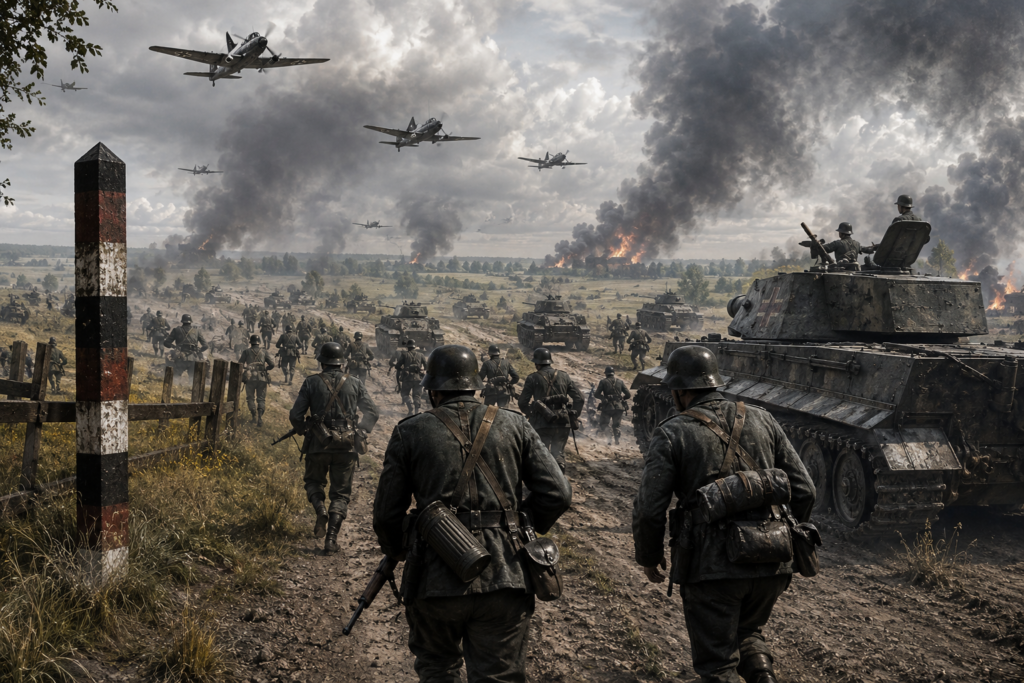
Image Credentials: Image Title: Operation Barbarossa Begins. Source: (chatgpt.com) Date: June 2026. Attribution: This image was created using AI-generated imagery (chatgpt.com) by Open Chronicle and does not depict a real-world scene.
By Open Chronicle with agencies
June 22, 1941
On this day in 1941, Nazi Germany and its allies launched Operation Barbarossa, the largest military invasion in history, opening the Eastern Front of World War II and dramatically altering the course of the conflict.
In the early hours of June 22, more than three million Axis troops crossed the Soviet frontier along a vast front stretching from the Baltic Sea in the north to the Black Sea in the south. The invasion shattered the German Soviet Nonaggression Pact signed less than two years earlier and caught many Soviet forces unprepared despite numerous warnings of an impending attack.
Named after the medieval Holy Roman Emperor Frederick Barbarossa, the operation reflected Adolf Hitler’s long-standing ambition to conquer Soviet territory, destroy communism, and secure what Nazi ideology called Lebensraum, or living space, for the German people. The campaign also sought control of the Soviet Union’s vast agricultural lands, industrial resources, and oil reserves.
The invasion was organized into three major army groups. Army Group North advanced toward Leningrad, Army Group Centre drove toward Moscow, and Army Group South targeted Ukraine and the resource-rich regions of southern Soviet territory. Supported by thousands of tanks, aircraft, and artillery pieces, German forces achieved rapid advances during the opening weeks of the campaign.
The Soviet Union suffered devastating losses in the early stages of the invasion. Entire armies were encircled, hundreds of thousands of soldiers were captured, and vast areas of territory fell under Axis control. Yet despite these setbacks, Soviet resistance stiffened as the war progressed. The immense size of the country, harsh weather conditions, logistical difficulties, and determined Soviet defence gradually slowed the German advance.
By the end of 1941, German forces had reached the outskirts of Moscow but failed to capture the Soviet capital. The failure marked the beginning of a prolonged and brutal conflict that would become the deadliest theatre of the Second World War. Battles such as Stalingrad and Kursk would eventually turn the tide against Nazi Germany.
Operation Barbarossa transformed the war into a global struggle of unprecedented scale. The Eastern Front became the central battleground of World War II, claiming tens of millions of military and civilian lives. Historians widely regard the invasion as one of the most consequential military decisions in modern history and a critical factor in the eventual defeat of Nazi Germany.