
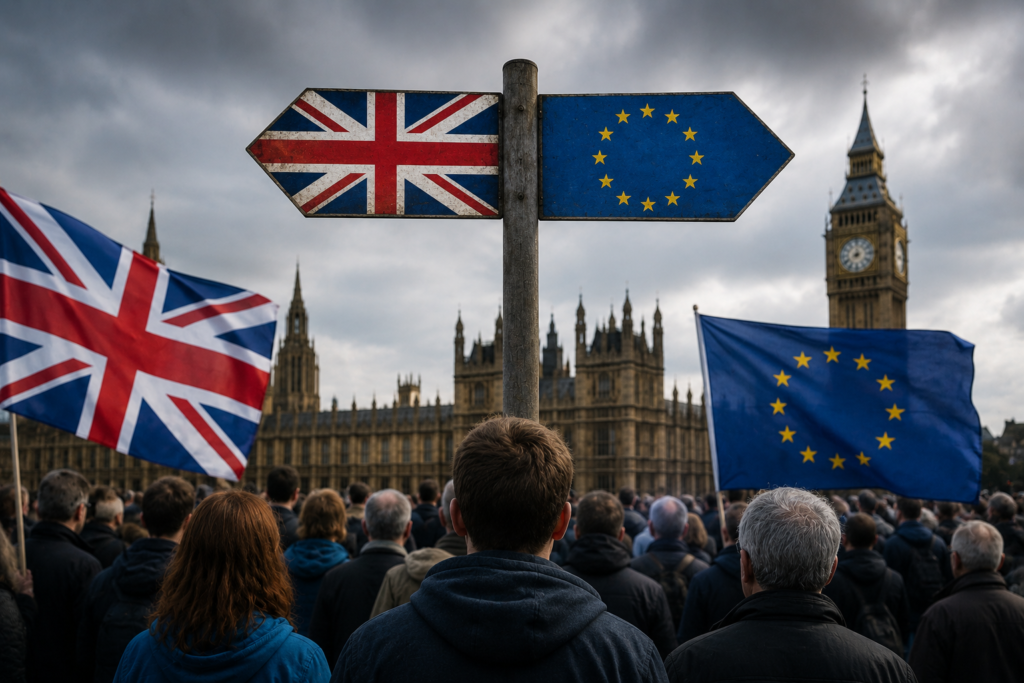
Image Credentials: Image Title: Brexit at 10: Majority of Britons Would Vote to Rejoin the European Union, Poll Suggests. Source: (chatgpt.com) Date: June 2026. Attribution: This image was created using AI-generated imagery (chatgpt.com) by Open Chronicle and does not depict a real-world scene.
By Open Chronicle with agencies
Ten years after the referendum that transformed British politics and reshaped the country’s relationship with Europe, a new poll suggests that a majority of Britons would now support rejoining the European Union.
The findings come as the United Kingdom marks the tenth anniversary of the historic Brexit vote on June 23, 2016, when 52 percent of voters backed leaving the EU. Since then, the country has experienced years of political instability, economic debate, and leadership upheaval, culminating in the resignation of Prime Minister Keir Starmer, the sixth British leader to leave office since the referendum.
According to a survey conducted by the pro-Brexit research and campaigning group Best for Britain, 53 percent of respondents now say they would vote for the UK to return to the European Union, while only 37 percent strongly support remaining outside the bloc.
The shift appears to reflect changing attitudes among former Leave supporters. The poll found that nearly a quarter of those who voted to leave in 2016 have since changed their position, contributing to growing support for closer ties with Brussels.
A Gradual Reconnection with Europe
While Britain remains outside the European Union, recent years have seen a gradual rebuilding of relations between London and Brussels.
One of the most notable developments is the UK’s planned return to the Erasmus+ student exchange programme in 2027, restoring opportunities for educational exchanges across Europe.
British researchers have also regained access to major European scientific initiatives, including the Copernicus Earth observation programme and Horizon Europe, the EU’s flagship research and innovation funding framework.
These moves have been interpreted by many observers as evidence that practical cooperation between the UK and the EU is expanding despite Brexit.
Political Reality Complicates Rejoin Ambitions
Despite growing public support for stronger European ties, the political landscape remains far from straightforward.
Polling indicates that Nigel Farage’s Reform Party has emerged as the leading force in national voting intentions, with approximately 24 percent support. Labour and the Conservative Party are currently tied at around 19 percent, reflecting continued fragmentation within British politics.
Many Reform supporters remain firmly committed to Brexit. According to the same survey, 55 percent of Reform voters favour not only remaining outside the European Union but also loosening ties with Brussels even further.
This creates a paradox for advocates of closer European integration. Although public opinion appears increasingly favourable toward Europe, electoral dynamics could produce a government less interested in reversing Brexit.
Uncertainty After Starmer’s Departure
The resignation of Keir Starmer has added another layer of uncertainty to Britain’s future relationship with the European Union.
With Labour preparing to choose a new leader and questions surrounding the country’s political direction growing, analysts caution that predicting the next phase of Brexit remains difficult.
Anand Menon, Director of the research institute UK in a Changing Europe, argues that several factors will determine the future course of relations between Britain and the EU.
“I think it depends on what happens geopolitically, whether the current reset is successful, and who the next Prime Minister is,” Menon said.
Brexit’s Legacy Still Shapes Britain
A decade after the referendum, Brexit continues to influence nearly every aspect of British politics, from trade and immigration to education, science, and foreign policy.
While opinion polls indicate that many Britons have become more receptive to European integration, the country’s political future remains uncertain. The next general election, combined with the leadership transition following Starmer’s resignation, could determine whether Britain continues its cautious rapprochement with Europe or moves further away from the bloc it left in 2020.
For now, the Brexit debate remains unresolved, even ten years after one of the most consequential votes in modern British history.