
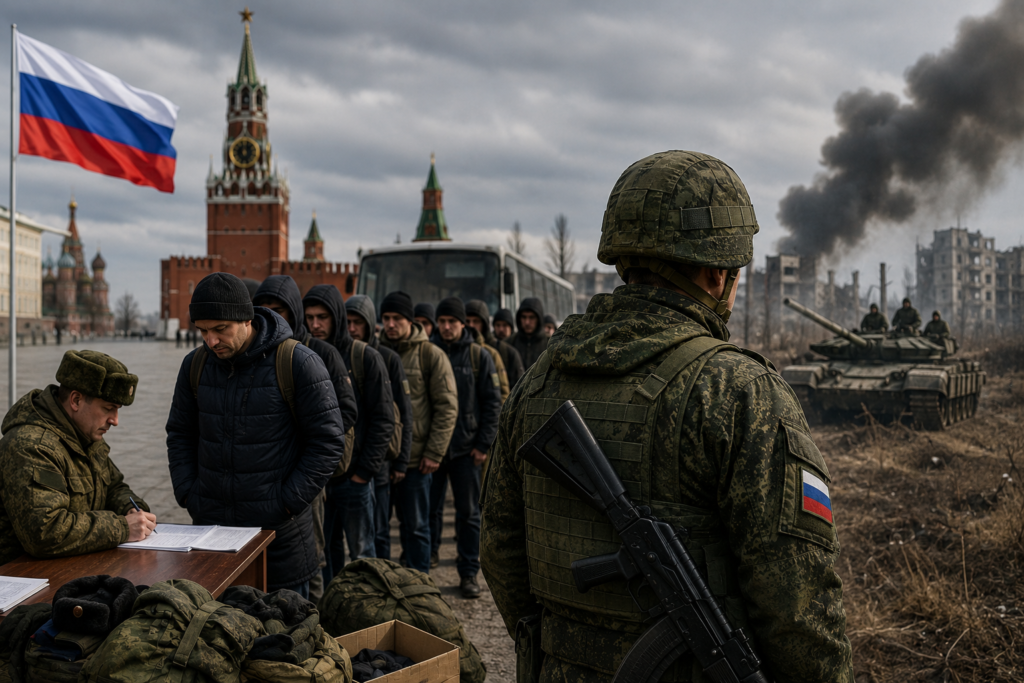
Image Credentials: Image Title: Russian Military Recruitment Declines Despite Increased Financial Incentives. Source: (chatgpt.com) Date: June 2026. Attribution: This image was created using AI-generated imagery (chatgpt.com) by Open Chronicle and does not depict a real-world scene.
By Open Chronicle with agencies
Russia is facing growing difficulties in replenishing its military ranks as recruitment figures continue to decline across the country, according to a report published by independent Russian outlet Verstka.
The findings suggest that despite increasingly generous financial incentives and aggressive recruitment campaigns, authorities are struggling to attract enough new contract soldiers to sustain military operations amid the ongoing war in Ukraine.
Recruitment falls across multiple regions
According to Verstka, the number of Russians signing military contracts has dropped significantly in 2026.
In Moscow, one of the country’s most important recruitment centers, the decline has been particularly noticeable. The city reportedly sent 1,708 contract soldiers to the front in April and 1,378 in May, approximately 1,000 fewer recruits than during the same period in 2025.
Sources cited by the publication described a shrinking pool of willing volunteers.
“People are joining in small numbers, and motivated recruits are even fewer,” a source within Moscow’s city administration reportedly told the outlet.
The trend appears to extend far beyond the capital. Military and administrative sources from several regions indicated that recruitment targets are becoming increasingly difficult to meet despite quotas remaining unchanged.
A military source in Siberia described the current situation as the lowest level of recruitment seen in years.
Authorities increase incentives
In response to falling enlistment numbers, regional governments have expanded financial rewards for both recruits and those who successfully refer candidates to military service.
Data cited by Verstka from investigative outlet Important Stories indicates that monthly spending on recruiter bonuses more than doubled in 2026, increasing from 358 million rubles to 802 million rubles.
Authorities have also broadened the categories of potential recruits. Recruitment campaigns are increasingly targeting older individuals, foreign nationals, people with criminal records, and applicants with certain health limitations.
Some advertisements reportedly promote military service as support work, logistics assignments, or humanitarian activities, although recruits ultimately sign standard Ministry of Defense contracts.
Another source claimed that authorities are increasingly offering military service contracts to detainees and criminal suspects in exchange for reduced legal penalties.
Independent estimates confirm slowdown
Independent analysts have also observed the decline.
Researcher Janis Kluge of the German Institute for International and Security Affairs estimated that between 800 and 1,000 individuals signed military contracts each day during the first quarter of 2026. That figure represents a reduction of roughly 20 percent compared with the previous year.
The decline comes despite substantial financial packages designed to attract volunteers.
Growing strain on military units
Military personnel interviewed by Verstka described increasing pressure on operational units, with some formations reportedly operating well below their authorized manpower levels.
One serviceman claimed that certain units were functioning at only 30 to 40 percent of their intended strength. Others reported that newly recruited personnel often arrive with limited training and little combat experience.
The recruitment challenges coincide with assessments suggesting that Russia’s territorial advances in Ukraine have slowed compared with previous phases of the conflict.
Organizations including the Institute for the Study of War and the Ukrainian monitoring project DeepState have previously reported a reduction in the pace of Russian offensive operations during 2026.
Debate over future mobilization
The report indicates that discussions within Russian political and military circles are intensifying regarding possible solutions to manpower shortages.
Among the options reportedly being considered are expanded recruitment efforts, greater use of reserve personnel, and the possibility of a new mobilization campaign after Russia’s parliamentary elections scheduled for September.
Independent outlet Meduza recently reported that some security officials had advocated postponing the elections due to economic difficulties, declining public approval ratings, and security concerns following Ukrainian drone attacks on Russian territory.
However, officials cited by Verstka stressed that no final decision regarding a new mobilization has been made.
Several sources dismissed reports of an imminent nationwide draft expansion, arguing that the political and economic costs of another large-scale mobilization could prove significant for the Kremlin.
As the conflict in Ukraine continues into another year, the ability of Russia to maintain troop numbers may become an increasingly important factor shaping both military operations and domestic political calculations.