
Image: from NewsTongue X @NewsTongueX
By Open Chronicle with agencies
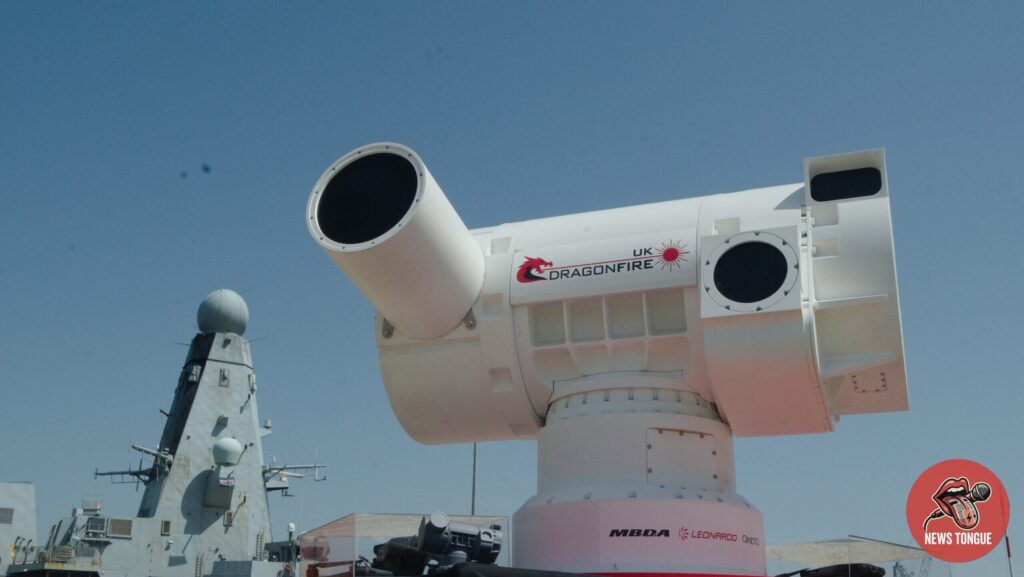
The United Kingdom is moving closer to becoming the first European NATO member to deploy an operational laser-directed energy weapon at sea, as industry partners work to reduce the size of the DragonFire laser system ahead of its planned installation on a Royal Navy Type 45 destroyer.
Developed through a collaboration between British defense companies QinetiQ, MBDA UK, and Leonardo UK, DragonFire represents one of the most advanced laser weapon programs currently under development in Europe. The system is expected to enter operational service aboard a Type 45 air defense destroyer by the end of 2027.
According to project officials, current efforts are focused on refining the technology, improving maintainability, and reducing the overall size of the laser infrastructure while preserving performance.
Check out a test-fire of MBDA's Dragonfire laser system taking down a drone.#MBDA #dragonfire #laser #counterUAS pic.twitter.com/PWK3koeW0E
— Defense News (@defense_news) June 23, 2026
Miniaturization efforts underway
Speaking during a NATO Industrial Advisory Group industry event, QinetiQ Royal Navy account lead James Anderson said engineers are examining ways to shrink the system’s footprint while enhancing long-term support capabilities.
The work includes improvements to beam generation technologies and the broader architecture required to sustain laser operations at sea.
While industry representatives acknowledge that reducing size remains an important objective, immediate priorities remain focused on ensuring DragonFire can withstand the demanding conditions of naval deployment.
Graeme McNaught, campaign manager for electro-optical, infrared, and laser directed energy systems at Leonardo, said the current focus is on successfully integrating the weapon aboard a Type 45 destroyer within the ambitious deployment timeline.
Engineers are also concentrating on protecting the system from harsh maritime environments, including saltwater exposure, heavy seas, and continuous operational demands.
A low-cost answer to drone threats
DragonFire has been designed primarily to counter small aerial threats, particularly Class 1 and Class 2 drones. Operating within line of sight, the system uses a highly concentrated laser beam capable of engaging targets with extreme precision.
One of its most attractive features is its exceptionally low operating cost. Each shot is estimated to cost less than £10, significantly cheaper than conventional surface to air missiles often used against relatively inexpensive drones.
The growing use of unmanned systems in modern warfare has highlighted the economic challenge faced by many navies, where costly interceptor missiles are frequently used to destroy low cost aerial threats.
According to Anderson, laser technology could fundamentally change that equation.
“If you look at the UK’s ability to take out swarms of drones and the economic balance of war, where we’re currently using some fairly exquisite missiles, we’ve got to do something about that,” he said.
Strengthening layered naval defense
Defense planners emphasize that DragonFire is not intended to replace traditional missile systems. Instead, it will become part of a broader layered defense architecture.
The laser system can engage selected threats while preserving missile inventories for more complex or higher-priority targets. This approach could significantly extend the endurance of deployed warships by reducing their reliance on finite stocks of conventional munitions.
McNaught noted that greater use of directed energy weapons would allow vessels to remain on patrol for longer periods without requiring replenishment of expensive missile inventories.
Future potential
Although laser weapons have been tested extensively in recent years, military adoption remains limited. Industry officials believe wider acceptance will depend on proving their effectiveness in real operational environments.
Questions remain about performance during severe weather conditions, including rain, fog, sea spray, and atmospheric disturbances, factors that can affect laser propagation and effectiveness.
Despite those challenges, defense experts view DragonFire as a major step toward the future of naval warfare.
As drone threats continue to evolve and military budgets face increasing pressure, laser weapons offer the possibility of highly precise, low-cost defensive capabilities that could transform how modern navies protect their fleets.
If the current schedule is maintained, the Royal Navy could become the first European NATO force to demonstrate operational laser weapon deployment at sea, marking a significant milestone in the evolution of directed energy warfare.