
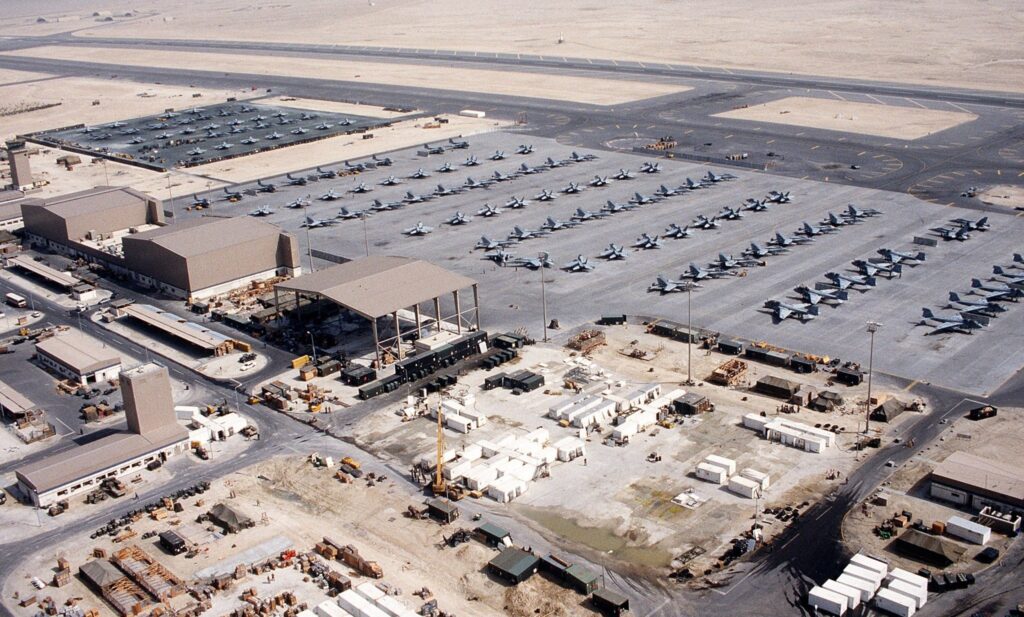
Image: from Brics Times X @Brics_Timesx
By Open Chronicle News Desk with Agencies
DUBAI, United Arab Emirates, June 27, 2026, Bahrain accused Iran of launching multiple drones toward its territory on Saturday, while a commercial tanker was struck in the Strait of Hormuz, marking another dangerous escalation in the confrontation between Tehran and Washington despite ongoing diplomatic negotiations.
The attacks followed overnight U.S. airstrikes against Iranian missile, drone, and coastal radar facilities. Washington said the operation was carried out in response to an Iranian drone strike on a commercial container ship attempting to leave the Strait of Hormuz earlier in the week.
The Pentagon says no one was killed at NSA Bahrain and that operations were not significantly affected.
That may be true, but buildings are not irrelevant. Command headquarters matter. Satellite terminals and Warehouses matter. Water systems and emergency facilities matter. A… pic.twitter.com/cZHUtbcM72
— The Tectonic (@thetect0nic) June 27, 2026
Bahrain’s Foreign Ministry condemned what it described as “several Iranian drones” targeting the kingdom, calling the attack “a flagrant threat to the security of citizens and residents.” No casualties or significant damage were immediately reported.
Bahrain hosts the headquarters of the U.S. Navy’s Fifth Fleet and has emerged as one of Iran’s strongest regional critics. The attack came shortly after Gulf Cooperation Council foreign ministers met with U.S. Secretary of State Marco Rubio, calling for an end to attacks in the Gulf and for freedom of navigation through the Strait of Hormuz.
Earlier on Saturday, Iran’s Islamic Revolutionary Guard Corps announced that it had targeted several positions belonging to what it described as the “U.S. terrorist army” in the region, though it did not specify the locations involved.
Meanwhile, the U.S. Central Command confirmed that American forces had struck Iranian missile depots, drone facilities, and coastal radar installations during overnight operations.
Vice President JD Vance, who is leading U.S. negotiations with Tehran, urged Iranian leaders to return to diplomatic discussions.
“If there are disagreements regarding the ceasefire, Iran should pick up the phone,” Vance said, warning that “violence will be met with violence.”
The latest confrontation unfolded as both countries continue negotiations under a 60-day interim agreement designed to address maritime security, Iran’s nuclear programme, and broader regional stability, including efforts to end fighting involving Hezbollah in Lebanon.
At sea, the British military’s United Kingdom Maritime Trade Operations (UKMTO) reported that a tanker had been struck while transiting the Strait of Hormuz. All crew members were reported safe, and no environmental damage was recorded.
Although no group immediately claimed responsibility, suspicion quickly fell on Iran amid the broader escalation.
Shortly after the incident, the Joint Maritime Information Center, operating under U.S. Navy oversight, announced the expansion of a protected maritime corridor along Oman’s coastline to facilitate both inbound and outbound commercial shipping.
The move could become another point of friction with Tehran, which has recently insisted that vessels crossing the Strait of Hormuz comply with Iranian instructions and has warned that transit fees could be imposed.
Iranian parliamentary national security committee chairman Ebrahim Azizi reiterated Tehran’s position on Friday, declaring that “the Strait of Hormuz is governed by Iran” and urging ships to “respect the rules.”
The United States and Gulf Arab nations have rejected those claims, maintaining that the strait remains an international waterway governed by international maritime law.
Maritime security officials continue to warn that the threat level in the area remains high. The Joint Maritime Information Center advised commercial shipping that naval mine threats remain substantial and warned vessels to expect continued multinational naval clearance operations throughout the region.
The International Maritime Organization has also suspended its evacuation and vessel guidance initiative until stronger security guarantees can be established. Approximately 115 ships have successfully exited the Gulf in recent days despite the growing risks.
The latest incidents underscore how quickly the security situation around one of the world’s most strategically important maritime chokepoints can deteriorate, threatening global energy supplies and complicating already fragile diplomatic efforts between Washington and Tehran.