
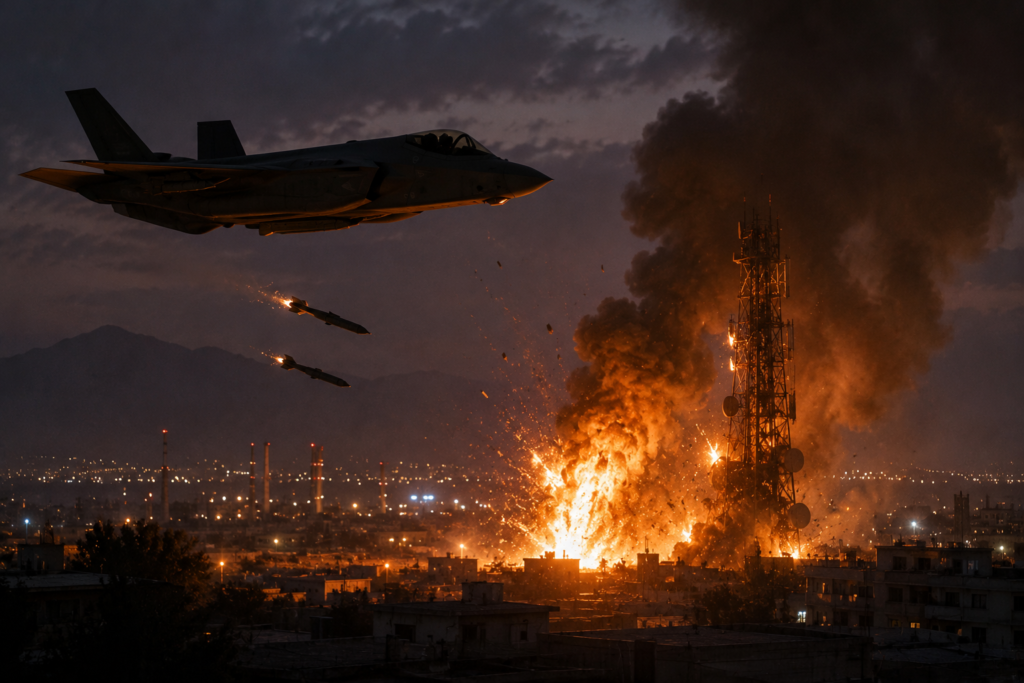
Image Credentials: Image Title: US Strikes Iran Again as Tit for Tat Attacks Dramatically Reignite Gulf Tensions. Source: (chatgpt.com) Date: June 2026. Attribution: This image was created using AI-generated imagery (chatgpt.com) by Open Chronicle and does not depict a real-world scene.
By Open Chronicle News Desk with Agencies
The United States carried out a new wave of military strikes against Iran on Saturday, targeting surveillance and military infrastructure after Washington accused Tehran of launching another drone attack against a commercial vessel in the Strait of Hormuz, marking a sharp escalation in hostilities despite an existing ceasefire framework.
According to U.S. Central Command (CENTCOM), American forces launched precision strikes against multiple Iranian military facilities following what it described as continued Iranian aggression against international shipping.
“CENTCOM forces launched strikes today in direct response to continued Iranian aggression against commercial shipping,” the command said in a statement.
The U.S. military said the latest operation followed Friday’s strikes, which had been conducted after Iran allegedly attacked the cargo vessel M/V Ever Lovely. Washington said Tehran was allowed to comply with the ceasefire agreement, but instead launched another one-way attack drone that struck the tanker M/T Kiku on Saturday morning.
💢 CENTCOM says the U.S. struck Iran for the second consecutive day.
According yo the statement, Iran was given a chance to honor the ceasefire after yesterday’s strikes — instead launched a drone that hit a Panama-flagged tanker carrying 2M+ barrels of crude near the Strait of… https://t.co/ho29c9Ebfv pic.twitter.com/VI4w1MXgXY
— Rabia İclal Turan (@iclalturan) June 27, 2026
The renewed exchange of attacks threatens to unravel fragile diplomatic efforts aimed at reducing tensions in the Gulf region.
Iranian state broadcaster IRIB, citing a military source, reported that explosions heard near the southern coastal city of Sirik were caused by several projectiles striking a telecommunications tower. Iranian authorities did not immediately report casualties or provide further details about the extent of the damage.
Tehran defended its own military actions, describing them as defensive operations against U.S.-linked targets in response to what it called repeated American violations of the memorandum of understanding governing the ceasefire.
Iranian officials accused Washington of breaching the agreement through both its military operations inside Iran and what they described as coordinated actions involving Lebanon.
Mohsen Rezaei, military adviser to Supreme Leader Mojtaba Khamenei, said the United States had violated both Article 1 and Article 5 of the memorandum of understanding.
Writing on X, Rezaei warned that “the response to any violation of any article of the Memorandum of Understanding will be swift and crushing.”
Iran’s Foreign Ministry also condemned the latest U.S. strikes, arguing that the attacks represented a serious breach of the ceasefire framework and justified Iran’s military response.
The latest confrontation comes amid increasing instability across the Strait of Hormuz, one of the world’s most strategically important maritime corridors, through which roughly one-fifth of global oil shipments transit.
Commercial shipping has become increasingly vulnerable in recent days following multiple drone attacks and strikes on merchant vessels navigating the narrow waterway.
International maritime agencies have already elevated security warnings, while several shipping companies continue to reassess routes through the Gulf as naval forces from multiple countries expand their presence in the region.
The renewed military exchanges also cast fresh uncertainty over ongoing diplomatic negotiations between Washington and Tehran, which had been seeking to establish a broader agreement covering maritime security, regional stability, and Iran’s nuclear programme.
With both sides now accusing each other of violating the ceasefire, fears are growing that the conflict could once again spiral into a wider regional confrontation involving additional state and non-state actors across the Middle East.