
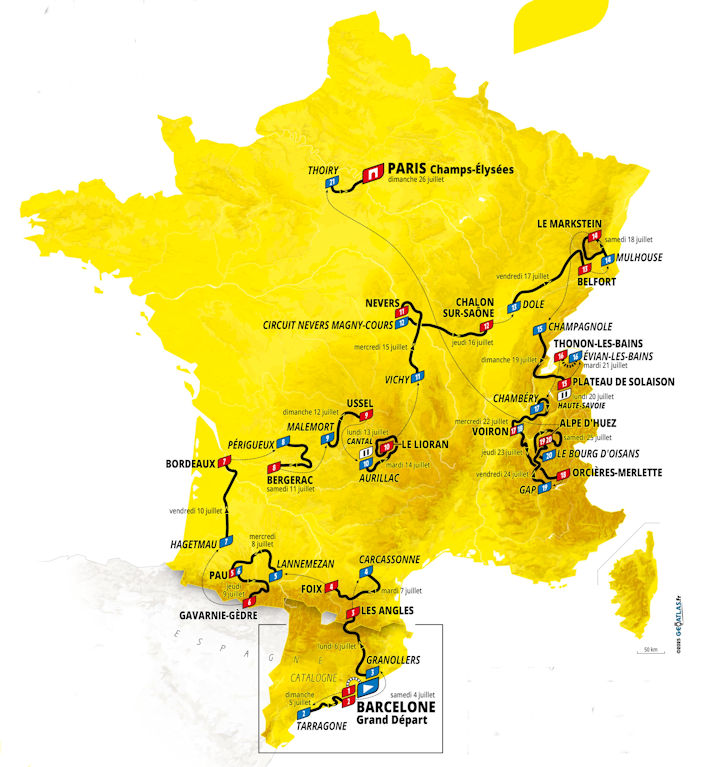
Image: Tour de France 2026: route – source:letour.fr
By Open Chronicle News Desk with Agencies
The 2026 Tour de France promises to be one of the most demanding editions in recent history, featuring 3,321.2 kilometres of racing and an astonishing 54,450 metres of elevation gain across three weeks.
Beginning in Barcelona on 4 July and concluding on the Champs-Élysées in Paris on 26 July, the 113th edition of cycling’s greatest race combines a challenging Grand Départ, early Pyrenean battles, demanding mountain stages in the Massif Central, Vosges and Alps, and an unforgettable finale featuring two consecutive summit finishes at Alpe d’Huez before the traditional Paris procession.
Defending champion Tadej Pogačar starts as the man to beat, with Jonas Vingegaard and rising French talent Paul Seixas among the principal contenders.
Grand Départ: Barcelona sets the tone
The Tour begins in spectacular fashion with an innovative team time trial through Barcelona.
Unlike traditional team time trials, riders receive individual finishing times, meaning general classification contenders can attack even their own teammates during the closing climbs in pursuit of valuable seconds.
The route concludes with two punchy ascents that favour explosive climbers and puncheurs, immediately creating gaps in the overall standings.
Stage 2 – Montjuïc returns
The second stage covers 168.5 kilometres from Tarragona to Barcelona.
The finale centres on the iconic Montjuïc circuit, where riders complete three laps featuring six climbs over the final 30 kilometres.
The race finishes atop a short but demanding uphill ramp after gradients of:
- 1.6 kilometres at 9.3%
- Final 700 metres at 7%
The explosive finish is perfectly suited to puncheurs and aggressive general classification riders.
Stage 3 – Into the Pyrenees
The first major mountain test arrives immediately.
Crossing from Spain into France, Stage 3 features almost 4,000 metres of climbing before finishing uphill at the Pla del Mir ski resort.
The demanding route ensures the race enters the high mountains before the opening week has even concluded.
Week One: Pyrenean spectacle
Stage 4 heads towards Foix, a finish town renowned for rewarding successful breakaways.
Previous winners include Luis León Sánchez, Warren Barguil and Hugo Houle, suggesting another aggressive race is likely.
Stage 5 offers the sprinters an opportunity between Lannemezan and Pau, before the race returns to the mountains.
Stage 6 – Historic first visit to Cirque de Gavarnie
One of the highlights of the opening week comes with the Tour’s first-ever finish at Cirque de Gavarnie.
Before reaching the spectacular UNESCO World Heritage site, riders must conquer two legendary Pyrenean climbs:
- Col d’Aspin
- Col du Tourmalet
The stage is expected to produce the first major battle among the favourites.
Sprint opportunities
The opening week concludes with several chances for the fast men.
- Stage 7 finishes in Bordeaux, making the race’s 83rd visit to France’s fifth-largest city.
- Stage 8 remains entirely within the Dordogne, finishing in Bergerac.
- Stage 9 travels from Malemort to Ussel over rolling terrain likely to favour attackers rather than pure sprinters.
Week Two: Bastille Day fireworks
Following the first rest day, the Tour resumes on Bastille Day with one of the race’s toughest stages.
Stage 10 – Return to Le Lioran
The riders face the demanding roads of the Massif Central.
The finale recreates the memorable finish from the 2024 Tour, including:
- Puy Mary Pas de Peyrol
- Col du Pertus
The stage concludes in Le Lioran, where Jonas Vingegaard narrowly defeated Tadej Pogačar in a thrilling sprint two years earlier.
Sprint stages
Stages 11 and 12 provide welcome relief for the sprinters.
- Vichy to Nevers
- Circuit de Magny-Cours to Chalon-sur-Saône
Both feature relatively gentle terrain.
Vosges mountains
Stage 13 crosses rolling countryside between Dole and Belfort, acting as preparation for another mountainous weekend.
Stage 14 introduces the Vosges, finishing at Le Markstein after approximately 3,800 metres of climbing.
Plateau de Solaison
The second week concludes with perhaps its hardest challenge.
Stage 15 features:
- Nearly 4,000 metres of elevation gain
- Finish at Plateau de Solaison
- Final climb measuring 11.3 kilometres
- Average gradient of 9%
The relentless ascent is likely to produce substantial time gaps before the final rest day.
Week Three: Time trial before Alpine showdown
The final week begins with an important individual time trial between Thonon-les-Bains and Évian-les-Bains, on the southern shores of Lake Geneva.
The stage offers another opportunity for specialists to gain valuable seconds before the decisive Alpine battles.
Stage 17 provides the last realistic sprint finish of the race.
Alpine finale
The Tour’s final mountain block begins with Stage 18.
Orcières-Merlette
The first Alpine finish climbs steadily for:
- 7.1 kilometres
- Average gradient of 6.7%
Although less severe than the following stages, it offers another opportunity for climbers to attack.
Stage 19 – Alpe d’Huez
One of cycling’s most famous climbs returns.
The stage covers just 127.9 kilometres, yet includes approximately 3,500 metres of climbing.
The legendary ascent of Alpe d’Huez features:
- 13.8 kilometres
- Average gradient of 8.1%
- 21 iconic hairpin bends
Its compact distance encourages aggressive racing from the very first climb.
Stage 20 – Alpe d’Huez from the opposite side
The organisers introduce one of the race’s most original finales.
Instead of finishing via the traditional ascent, riders approach Alpe d’Huez from the Col de Sarenne, creating an entirely different challenge.
Before reaching the finish, they must conquer:
- Col de la Croix de Fer
- Col du Télégraphe
- Col du Galibier
The stage contains a staggering 5,450 metres of elevation gain, making it arguably the hardest day of the entire Tour.
The back-to-back mountain finishes ensure the yellow jersey battle remains alive until the penultimate stage.
Return to Paris
Stage 21 concludes in Paris, restoring the now familiar finish on the Champs-Élysées.
Once again, organisers have retained the steep cobbled climbs of Montmartre, introduced to make the traditional final stage more selective and exciting.
While sprinters will still aim for victory beneath the Arc de Triomphe, the addition of Montmartre could once again encourage late attacks before the final sprint.
A Tour built for climbers
The 2026 route places a clear emphasis on climbing.
With more than 54,000 metres of elevation gain, summit finishes in the Pyrenees, Massif Central, Vosges and Alps, and two consecutive finishes at Alpe d’Huez, this edition offers little respite for the general classification contenders.
Combined with an opening team time trial using individual times and a decisive final-week individual time trial, the route rewards complete riders capable of excelling in every discipline.
As the world’s best cyclists prepare to battle from Barcelona to Paris, the 2026 Tour de France promises three weeks of relentless racing and one of the most spectacular mountain editions in modern history.