
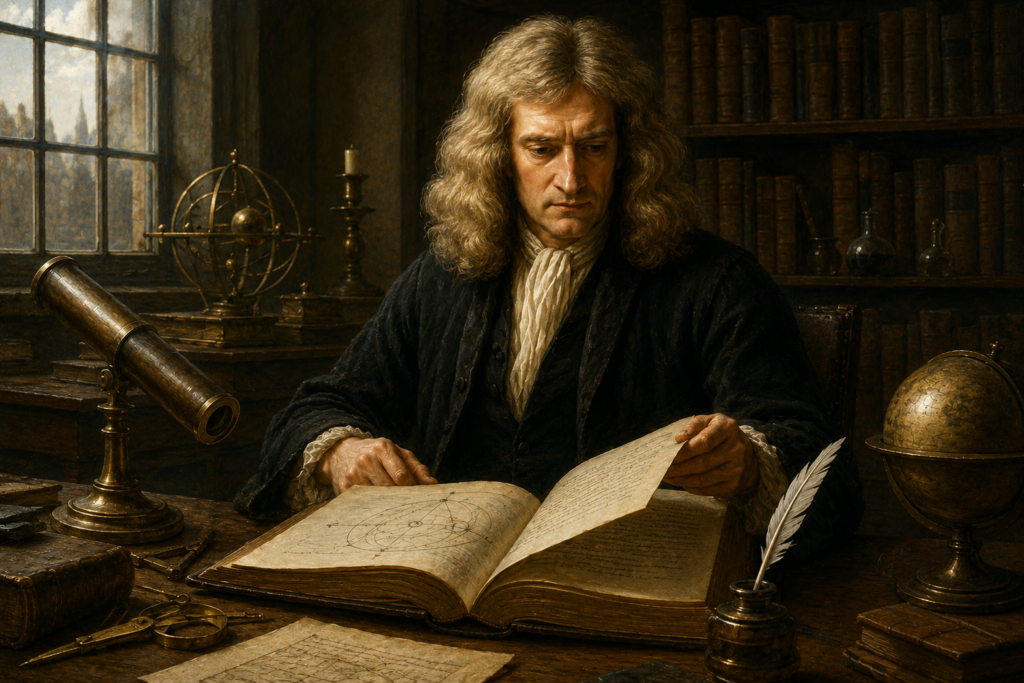
Image Credentials: Image Title: Today in History, July 5: Newton’s Principia Mathematica Is Published. Source: (chatgpt.com) Date: June 2026. Attribution: This image was created using AI-generated imagery (chatgpt.com) by Open Chronicle and does not depict a real-world scene.
By Open Chronicle
July 5, 1687
On this day in 1687, Isaac Newton’s Philosophiæ Naturalis Principia Mathematica, commonly known as the Principia, was published by the Royal Society in London. The work became one of the most important scientific books ever written and transformed humanity’s understanding of motion, gravity, and the structure of the universe.
Newton’s Principia set out the mathematical foundations of classical mechanics. In it, he formulated his three laws of motion, explaining how objects move and how forces act upon them. These principles provided a unified framework for understanding everything from falling bodies on Earth to the movement of planets in the heavens.
The book also introduced Newton’s law of universal gravitation. Newton argued that every object in the universe attracts every other object with a force related to their masses and the distance between them. This revolutionary idea explained why apples fall to the ground, why the Moon orbits Earth, and why planets follow curved paths around the Sun.
The publication of the Principia was closely connected to the work of Edmond Halley, the astronomer later famous for Halley’s Comet. Halley encouraged Newton to develop and publish his ideas, helped guide the manuscript through the Royal Society, and personally supported its printing when financial difficulties arose.
The Principia appeared at a time when European science was undergoing dramatic change. Earlier thinkers such as Copernicus, Galileo, and Kepler had challenged older views of the cosmos. Newton brought many of these discoveries together into a powerful mathematical system that could explain celestial and terrestrial motion under the same physical laws.
Its impact was enormous. For more than two centuries, Newtonian physics shaped astronomy, engineering, navigation, mechanics, and the scientific method itself. The Principia showed that nature could be described through precise mathematical laws, becoming a model for modern science.
Although later developments, including Einstein’s theory of relativity, would expand and refine our understanding of gravity and motion, Newton’s work remains foundational. The Principia stands as a monument to human reason and one of the defining achievements of the Scientific Revolution.