
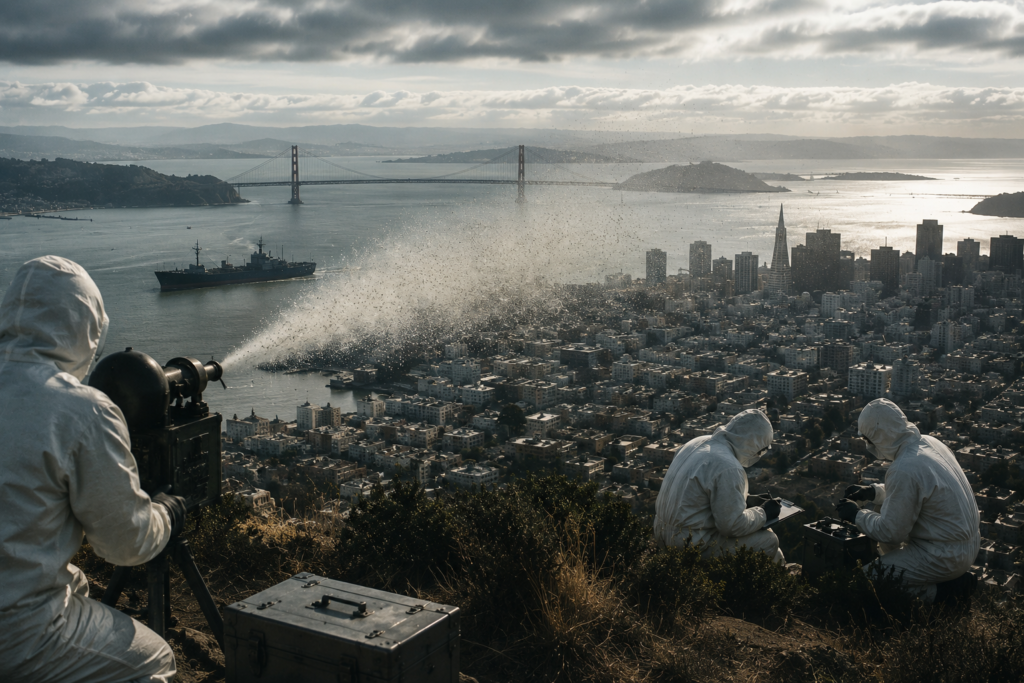
Image Credentials: Image Title: Parlamento deverá chumbar perda de nacionalidade por crimes graves após desacordo entre Chega e PSD/CDS. Source: (chatgpt.com) Date: June 2026. Attribution: This image was created using AI-generated imagery (chatgpt.com) by Open Chronicle and does not depict a real-world scene.Inside Operation Sea-Spray: The Secret U.S. Biological Test Over San Francisco
By Open Chronicle
In September 1950, the United States Navy carried out one of the most controversial military experiments ever conducted on American soil. Known as Operation Sea-Spray, the classified operation involved releasing large quantities of bacteria over the city of San Francisco to study how a biological weapon might spread through an urban population.
For decades, residents remained unaware that they had unknowingly participated in a Cold War military experiment. The operation has since become one of the most frequently cited examples in debates over government secrecy, biological warfare research, and ethical standards in military testing.
A Cold War experiment
Operation Sea-Spray took place between 20 and 27 September 1950, at the height of growing Cold War tensions. American military planners were increasingly concerned that adversaries could launch biological attacks against major U.S. cities.
To understand how airborne biological agents would disperse, the U.S. Navy deployed a minesweeper several miles off the California coast. Using specialized aerosol generators, researchers released massive clouds of two microorganisms that were believed at the time to be relatively harmless.
The organisms used were Serratia marcescens, a red pigmented bacterium, and Bacillus globigii, now classified as Bacillus atrophaeus, which served as a stand-in for anthrax spores during military research.
The objective was not to infect the population intentionally, but to evaluate atmospheric dispersion, wind patterns, and the vulnerability of American cities to biological attacks.
Millions unknowingly exposed
Military scientists later concluded that the released bacteria spread across virtually the entire San Francisco metropolitan area.
According to declassified reports, more than 800,000 residents were exposed during the tests. Monitoring stations positioned throughout the city collected air samples to measure how efficiently the microorganisms dispersed through neighborhoods, buildings, and transportation corridors.
Researchers considered the experiment a technical success because it demonstrated that a biological aerosol released offshore could rapidly contaminate a densely populated urban environment.
Unexpected health consequences
Although military officials initially maintained that the bacteria posed no danger to healthy individuals, questions emerged almost immediately.
Shortly after the experiment, physicians at Stanford Hospital reported an unusual outbreak of urinary tract infections caused by Serratia marcescens. One patient, Edward Nevin, died after the infection spread to his heart.
Nevin’s family later sued the federal government, arguing that his illness resulted directly from Operation Sea-Spray. Although the lawsuit was ultimately unsuccessful because definitive proof could not be established, the case intensified public scrutiny after the operation became public decades later.
Subsequent medical research also revealed that Serratia marcescens can act as an opportunistic pathogen capable of causing infections in vulnerable patients, contradicting earlier assumptions that it was essentially harmless.
Declassification and public reaction
Operation Sea-Spray remained secret until the 1970s, when congressional investigations into military research programs uncovered documents detailing numerous biological testing projects conducted across the United States.
The revelations showed that San Francisco was only one of many locations where biological simulants had been released during the Cold War. Similar experiments occurred in New York City, Washington, D.C., Minneapolis, St. Louis, and other metropolitan areas.
The disclosures fueled criticism from civil liberties advocates, medical ethicists, and members of Congress, who argued that citizens had been exposed without informed consent.
Legacy of Operation Sea-Spray
Today, Operation Sea-Spray is widely studied as a landmark example of Cold War biological weapons research and government secrecy.
Military planners viewed the experiment as essential for understanding national defense against biological attacks. Critics, however, argue that it highlighted serious ethical failures by exposing civilians to biological agents without their knowledge or permission.
The operation has since become an important case study in discussions about military ethics, public health policy, classified research, and the balance between national security and individual rights.
More than seventy years later, Operation Sea-Spray remains one of the most controversial biological testing programs ever conducted in the United States, serving as a reminder of how Cold War fears often pushed governments to undertake extraordinary, and sometimes deeply contested, measures.