
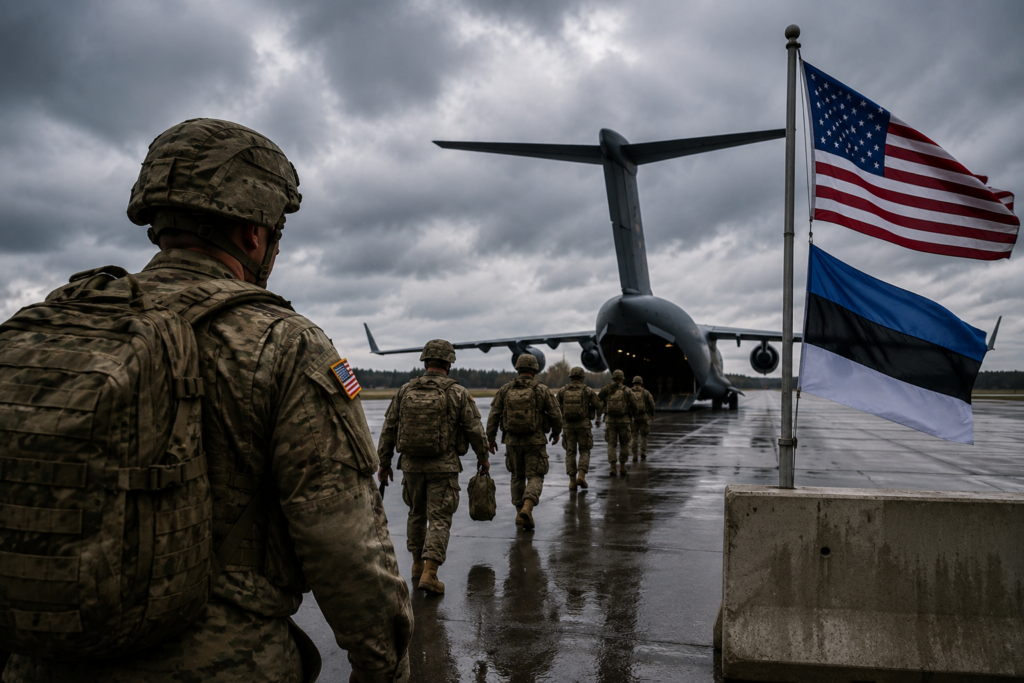
Image Credentials: Image Title: Opinion: Estonia Cannot Be Treated as a Temporary Outpost While Ukraine Holds NATO’s Front Line. Source: (chatgpt.com) Date: June 2026. Attribution: This image was created using AI-generated imagery (chatgpt.com) by Open Chronicle and does not depict a real-world scene.

By Open Chronicle
The reported reduction of the United States military presence in Estonia has reignited debate over NATO’s long-term deterrence posture on its eastern flank, raising concerns among security analysts about alliance credibility at a time of continued confrontation with Russia.
According to reports, the number of U.S. troops stationed in Estonia has fallen from between 500 and 700 personnel to fewer than 100 following the latest force rotation. While Estonian officials have expressed hope that additional American forces could return later this year, no firm timetable or troop commitment has been publicly confirmed.
Questions Over Forward Deterrence
The apparent drawdown has prompted criticism from observers who argue that forward military deployments should provide predictable deterrence rather than temporary reassurance.
Estonia occupies one of NATO’s most strategically sensitive positions, bordering Russia and serving as part of the Alliance’s northeastern defensive line alongside Latvia, Lithuania, Poland and Finland.
Security analysts have long argued that consistent troop deployments help reduce the risk of miscalculation by demonstrating that any aggression against NATO territory would immediately involve Allied forces.
The uncertainty surrounding future American rotations has therefore fueled questions about whether temporary deployments are sufficient to maintain credible deterrence.
Ukraine Remains Europe’s Front Line
The debate comes as Ukraine continues to bear the overwhelming burden of resisting Russia’s full-scale invasion.
Since 2022, Ukrainian forces have inflicted heavy losses on Russian military formations while conducting increasingly sophisticated long-range strikes against logistics hubs, ammunition depots, airfields and energy infrastructure deep inside Russian-controlled territory.
Supporters of continued military assistance argue that Ukraine’s resistance has significantly reduced Russia’s capacity to threaten other European states, effectively serving as the first line of defence for NATO’s eastern members.
From this perspective, continued investment in Ukraine’s military capabilities is viewed not simply as support for Kyiv, but as a broader investment in European security.
Calls for Long-Term Military Planning
The reported troop reduction has also renewed calls for NATO members to accelerate long-term defence planning rather than relying on periodic force reviews.
Many defence specialists argue that permanent infrastructure, expanded industrial production and sustained force commitments provide stronger deterrence than rotational deployments whose future remains uncertain.
They also point to ongoing efforts to expand European defence manufacturing, including licensed production of advanced missile systems, air defence technologies and precision weapons, as essential for strengthening the continent’s security architecture.
A Broader Strategic Debate
The issue reflects a wider discussion across the Alliance about the future balance between American and European defence responsibilities.
While the United States remains NATO’s largest military contributor, several European governments have significantly increased defence spending since Russia invaded Ukraine.
The challenge now facing the Alliance is how to transform those investments into long-term military capabilities capable of sustaining deterrence across NATO’s eastern frontier.
For many observers, the question is no longer whether Russia represents a lasting security challenge, but whether NATO’s posture will evolve quickly enough to meet it.
Continue Exploring Strategic Analysis
This article is part of The Grand Strategy Institute, Open Chronicle's research centre dedicated to geopolitics, international security, military strategy, intelligence, technology and the evolving balance of global power.
Return to The Grand Strategy Institute →The Grand Strategy Institute
Continue Exploring Strategic Analysis
Return to The Grand Strategy Institute for strategic assessments, long-form analysis and research examining geopolitics, military affairs, international security, emerging technologies and the changing international order.
← Back to The Grand Strategy Institute