
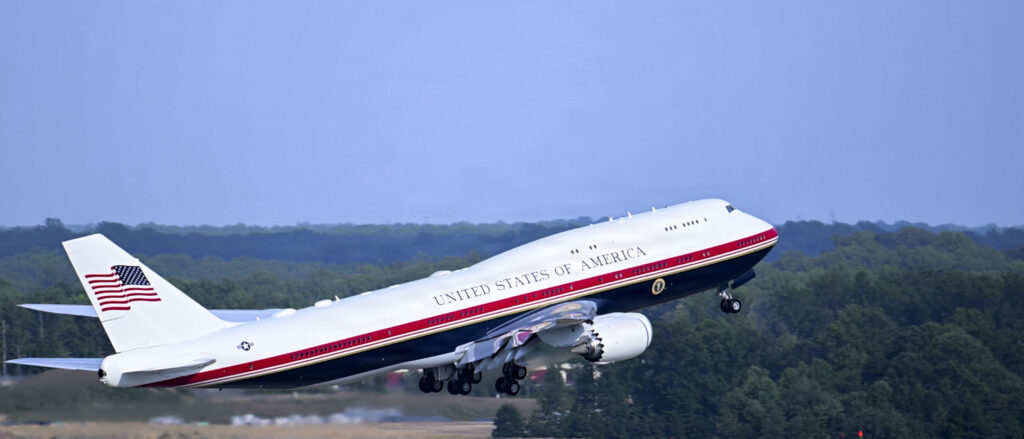
Image: from OSINTdefender X @sentdefender
By Open Chronicle with Agencies
U.S. President Donald Trump has appeared to acknowledge that heightened security concerns linked to the escalating confrontation with Iran played a key role in his last-minute decision to abandon the new presidential aircraft and instead return from the NATO Summit in Türkiye aboard the older Air Force One.
The unexpected switch came after Trump had arrived in Ankara on the recently introduced Boeing 747-8, a luxury aircraft donated by Qatar and valued at approximately $400 million. Initially, the president said the newer aircraft would fly ahead to the United Kingdom so American service members stationed at RAF Mildenhall could tour it, while he would return aboard the previous presidential jet “for old time’s sake.”
However, comments made during the flight suggested security considerations were also a significant factor.
🤣 A reporter asked President Trump if he knew of any real Iranian threat targeting Air Force One.
Trump replied that he faces constant threats as Iran's number one target, ahead of the press, adding that if he goes down they go down too, so maybe some should consider a career…
— Bella (@stockbella) July 9, 2026
Trump Hints at Security Threat
Speaking with reporters aboard the aircraft, Trump acknowledged the risks surrounding the journey.
“Because you’re, you know, probably on a dangerous flight, because of the sleazebags that we have to deal with,” he said when asked why window blinds had been lowered before takeoff, a common security precaution.
Asked whether Iran could be considering targeting him, Trump replied that such a scenario was possible.
“If they ask you to close your windows, probably they feel that way,” he said. “These are sick people, so I could see something like that.”
His remarks followed another day of escalating tensions between Washington and Tehran after the United States launched strikes against approximately 90 Iranian military targets and Trump declared that the ceasefire between the two countries was effectively over.
🚨 NOW: President Trump says the press pool were likely told to close their window blinds on Air Force One because of a POSSIBLE THREAT from IRAN
"I have a threat all the time!"
"If I GO, YOU GO!" 😭
"Perhaps you want to change professions."pic.twitter.com/DfMTD8CExl
— 🇺🇸TRUMP MAGA GIRL 🇺🇸 (@Qthe_17thletter) July 8, 2026
Reports Raise Questions Over Aircraft Readiness
According to several U.S. media reports, the U.S. Secret Service advised against using the newly acquired aircraft for the return flight because it may not yet possess all the defensive capabilities required for presidential transport during periods of heightened military risk.
Officials familiar with the aircraft reportedly cited concerns that the jet has not yet received the full suite of military communications, electronic countermeasures and defensive systems found aboard the long-serving Air Force One fleet.
One former national security official described the aircraft as “built for aesthetics, not mission,” suggesting that while its interior and appearance have been extensively modernized, questions remain regarding its operational readiness in hostile environments.
Reports also indicated that the aircraft currently lacks aerial refuelling capability, a feature considered important for long-range presidential missions during international crises.
White House Defends the Aircraft
The White House rejected suggestions that the aircraft is inadequately protected.
Communications Director Steven Cheung said the new Air Force One incorporates advanced security systems designed to protect the president and senior officials.
He also stated that the administration regularly employs operational security measures, including “distraction and misdirection,” to reduce potential threats against the president during overseas travel.
A Debate Over Presidential Security
The aircraft change has intensified debate over whether the new presidential jet entered service before all necessary defensive modifications had been completed.
Trump has repeatedly expressed frustration over delays affecting the next generation of officially commissioned Air Force One aircraft being built by Boeing, pushing for the Qatari-gifted aircraft to enter service more quickly.
Despite the controversy, Trump later shared photographs of the aircraft in England, saying American troops had been excited to see it, while making no further reference to the security concerns surrounding the journey from Türkiye.
The incident has nevertheless raised fresh questions about presidential security protocols and whether the aircraft is fully prepared for missions involving regions experiencing active military conflict.