
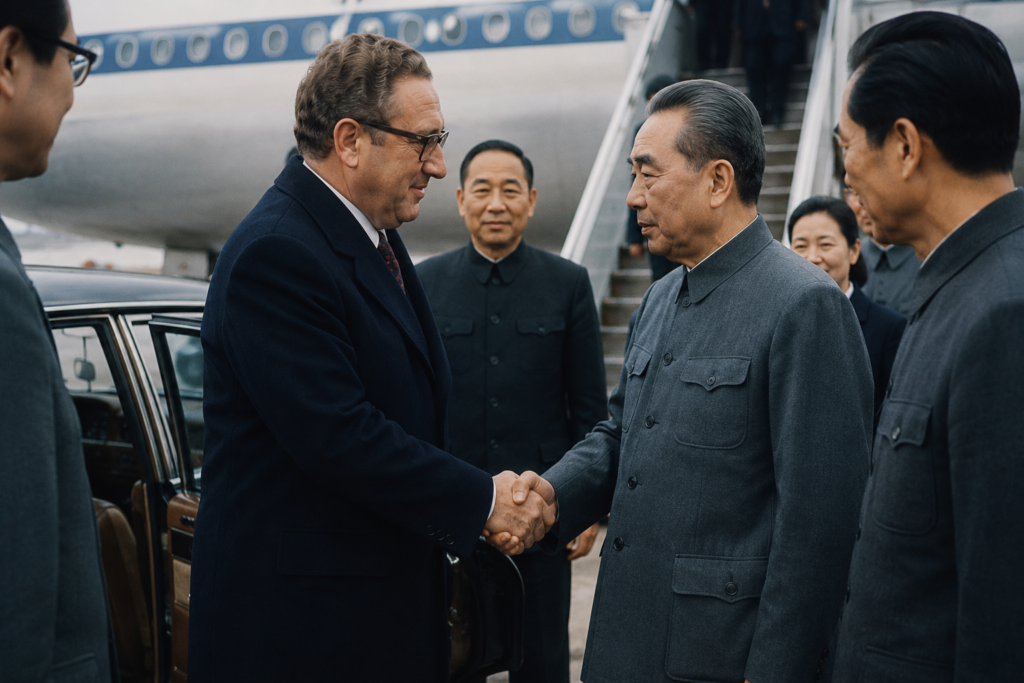
Image Credentials: Image Title: Today in History, July 9: 1971 Henry Kissinger Secretly Visits China to Begin Restoring Relations Between Beijing and Washington. Source: (chatgpt.com) Date: June 2026. Attribution: This image was created using AI-generated imagery (chatgpt.com) by Open Chronicle and does not depict a real-world scene.
By Open Chronicle
9 July 1971
On 9 July 1971, United States National Security Advisor Henry Kissinger arrived in the People’s Republic of China on a secret diplomatic mission that transformed international politics. Conducted under extraordinary secrecy, the visit marked the first high-level contact between the United States and Communist China in more than two decades and laid the foundation for one of the most significant diplomatic breakthroughs of the Cold War.
Since the establishment of the People’s Republic of China in 1949, relations between Washington and Beijing have been openly hostile. The United States recognized the Republic of China, based in Taiwan, as the legitimate Chinese government, while the People’s Republic remained diplomatically isolated from much of the Western world. The two countries found themselves on opposing sides during the Korean War and remained ideological rivals throughout the 1950s and 1960s.
By the beginning of the 1970s, however, the global strategic landscape had begun to change. Relations between China and the Soviet Union had deteriorated sharply, leading to border clashes and growing tensions between the two communist powers. President Richard Nixon and his National Security Advisor, Henry Kissinger, recognized that improving relations with Beijing could fundamentally reshape the balance of power and strengthen the United States’ position in the Cold War.
To preserve complete secrecy, Kissinger publicly traveled to Pakistan as part of an official diplomatic tour. During the visit, he disappeared from public view under the pretext of suffering a brief illness. Instead, he secretly boarded a Pakistani aircraft that flew him to Beijing, where he was welcomed by Chinese officials before meeting Premier Zhou Enlai.
Over two days of intensive discussions, Kissinger and Zhou explored issues ranging from Taiwan and the Vietnam War to the broader strategic rivalry with the Soviet Union. Although many difficult questions remained unresolved, both sides agreed that reopening dialogue served their long-term national interests.
The success of the secret mission surprised the world when President Nixon announced it on 15 July 1971. The revelation stunned governments across the globe, as few had suspected that the United States and China had been conducting direct negotiations after more than twenty years without formal diplomatic contact.
Kissinger’s visit paved the way for President Nixon’s historic journey to China in February 1972. The meetings between Nixon, Chairman Mao Zedong, and Premier Zhou Enlai culminated in the Shanghai Communiqué, which established the principles for improved bilateral relations while acknowledging the complex issue of Taiwan.
The diplomatic opening between Washington and Beijing altered the geopolitical landscape of the Cold War. It intensified pressure on the Soviet Union, encouraged greater strategic flexibility among the major powers, and contributed to a period of détente that influenced global diplomacy throughout the 1970s.
Although full diplomatic relations between the United States and the People’s Republic of China would not be established until 1979, Kissinger’s secret mission remains one of the most successful examples of modern diplomacy. Through careful planning, discreet negotiations, and strategic vision, the visit initiated a process that fundamentally reshaped international relations and continues to influence global politics today.
More than five decades later, the secret journey to Beijing is remembered as a defining moment in twentieth-century diplomacy, demonstrating how quiet negotiations conducted behind closed doors can change the course of world history.