
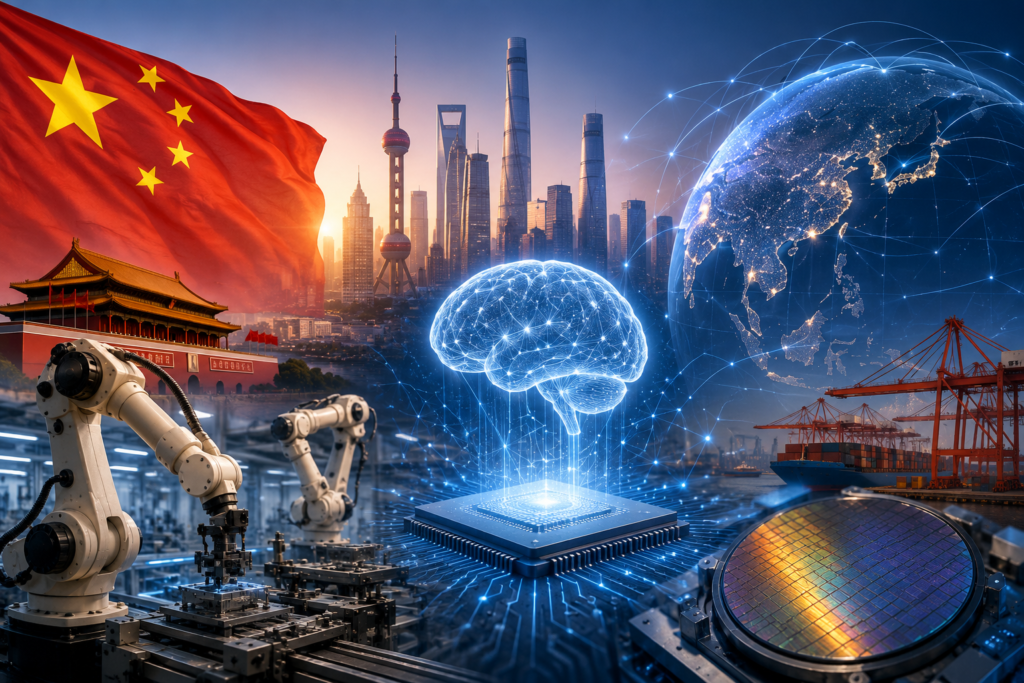
Image Credentials: Image Title: China’s Artificial Intelligence Strategy Could Reshape the Global Economy. Source: (chatgpt.com) Date: July 2026. Attribution: This image was created using AI-generated imagery (chatgpt.com) by Open Chronicle and does not depict a real-world scene.
By Open Chronicle
China is accelerating its artificial intelligence strategy as Beijing seeks to transform the technology into a central engine of industrial growth, economic modernization and geopolitical influence.
The strategy extends far beyond the development of large language models. China is integrating artificial intelligence into manufacturing, telecommunications, healthcare, education, transport, finance, and public administration, while attempting to reduce its dependence on foreign semiconductors and advanced computing infrastructure.
Beijing’s approach could have major consequences for global trade, productivity and technological competition. It may also deepen the division of the world economy into rival technology ecosystems led by China and the United States.
Artificial intelligence as an economic strategy
China views artificial intelligence as a tool for improving productivity at a time when the country faces slower economic growth, an aging population, pressure in the property sector and increasingly restrictive access to Western technology.
The government’s “AI Plus” policy promotes the widespread adoption of artificial intelligence across traditional industries. Rather than concentrating solely on consumer applications, Beijing wants advanced models, robotics and automated systems to improve factories, logistics networks, hospitals, farms and urban infrastructure.
A national plan announced in 2026 aims to apply several general-purpose models across manufacturing, create 100 high-quality industrial datasets and establish 500 representative artificial intelligence applications by 2027.
The government has also issued a three-year programme for integrating artificial intelligence into telecommunications and information networks. By 2028, China wants to develop more than 30 high-value use cases and expand rapid access to computing capacity across major urban areas.
Manufacturing at the centre of Beijing’s plan
China’s greatest advantage may not lie in producing the world’s most sophisticated individual model. Its strength comes from its enormous industrial base and its ability to deploy technology rapidly across supply chains.
Artificial intelligence can improve factory scheduling, quality control, predictive maintenance, product design, and energy efficiency. Combined with robotics, it could allow Chinese manufacturers to produce goods faster and at lower cost.
This has implications well beyond China. As artificial intelligence reduces production costs, Chinese companies could become more competitive in electric vehicles, batteries, industrial machinery, consumer electronics, and renewable energy equipment.
Greater efficiency in Chinese factories could lower prices for international consumers. However, it could also increase pressure on manufacturers in Europe, the United States and emerging economies that already struggle to compete with China’s industrial scale.
The race for technological independence
China’s artificial intelligence ambitions face a major obstacle: access to the most advanced semiconductors.
Export controls imposed by the United States and its allies have restricted Chinese access to cutting-edge processors and semiconductor production equipment. Beijing has responded by investing heavily in domestic chip design, manufacturing, cloud computing, and alternative approaches that require fewer advanced processors.
This technological competition is encouraging China to develop a more self-sufficient digital ecosystem. Domestic companies are expanding their own models, software platforms, and computing infrastructure while reducing dependence on American suppliers.
The result could be a more fragmented global technology market, with countries increasingly required to choose between Chinese and Western systems for telecommunications, cloud services, artificial intelligence and digital infrastructure.
Open source models as a tool of influence
China has also promoted open-source artificial intelligence as a way to increase international adoption of its technology.
Open models can be downloaded, modified, and deployed at a lower cost than many proprietary systems. This makes them attractive to companies, universities, and governments in developing countries that cannot afford expensive Western platforms.
Chinese officials have presented open-source development as part of a broader effort to make artificial intelligence more accessible. Beijing has also proposed new international cooperation mechanisms and governance initiatives intended to give China a larger role in shaping global rules for technology.
For countries across Africa, Asia, Latin America and the Middle East, Chinese platforms may offer an affordable path toward digital modernization. In return, China could gain access to new markets, data partnerships and long-term technological influence.
A new phase of global economic competition
The artificial intelligence race is increasingly becoming a contest between different economic models.
The United States remains dominant in private investment and advanced computing. American companies attracted about 75 percent of global artificial intelligence venture capital in 2025, while Chinese companies accounted for a much smaller share. Chinese investors nevertheless remained among the world’s most active sources of artificial intelligence funding.
China’s model relies more heavily on government planning, industrial coordination, infrastructure investment and the rapid adoption of technology across strategically important sectors.
The American system remains stronger in frontier research, private capital, and advanced semiconductors. China may hold an advantage in large-scale deployment, manufacturing integration, and the commercialization of artificial intelligence within physical industries.
The outcome will influence which countries set standards, control supply chains, and capture the economic value created by the technology.
Productivity opportunities and employment risks
Artificial intelligence could provide a major boost to the global economy by accelerating research, improving business efficiency, and increasing worker productivity.
The International Monetary Fund has argued that the technology could become an important source of economic growth, although the benefits will depend on investment, regulation, and how widely artificial intelligence spreads beyond the technology sector.
However, rapid adoption also carries significant risks.
Automation may displace workers in manufacturing, administration, finance, and customer services. Countries with limited digital infrastructure could fall further behind, while the economic benefits may become concentrated among companies that control data, computing power and advanced models.
The IMF has estimated that artificial intelligence could affect around 60 percent of jobs in advanced economies. Some workers will become more productive, while others could face weaker demand for their skills.
China faces the same challenge. Artificial intelligence may help offset demographic decline, but it could also create employment pressures on younger workers already struggling to find stable jobs.
Governance and global standards
China is seeking a leading role in international artificial intelligence governance.
Beijing argues that countries should respect national sovereignty, promote inclusive access, and prevent a small number of companies or states from monopolizing the technology. China’s Global Artificial Intelligence Governance Action Plan calls for international cooperation, infrastructure development and the broader use of artificial intelligence in areas such as healthcare, education, agriculture and urban management.
Critics are likely to remain concerned about surveillance, state control, censorship, and the use of artificial intelligence for political monitoring.
These competing approaches could make global agreement difficult. Western governments often emphasize transparency, individual rights, and corporate accountability, while China gives greater weight to state authority, social stability, and national development priorities.
The future of the global economy
China’s artificial intelligence strategy will influence much more than the country’s domestic technology sector.
Its success could strengthen Chinese manufacturing, reshape global supply chains, and accelerate the spread of affordable artificial intelligence systems throughout emerging markets. It could also intensify trade disputes and increase pressure on governments to protect strategic industries.
The global economy may increasingly be organized around access to computing power, energy, data, semiconductors, and artificial intelligence talent.
China is betting that the countries able to integrate artificial intelligence into the real economy, rather than merely produce the most advanced models, will gain the greatest long-term advantage.
Whether that strategy delivers a new productivity boom or contributes to deeper economic fragmentation will depend on how governments manage technological competition, labor disruption, and the growing struggle to control the infrastructure of the artificial intelligence age.