
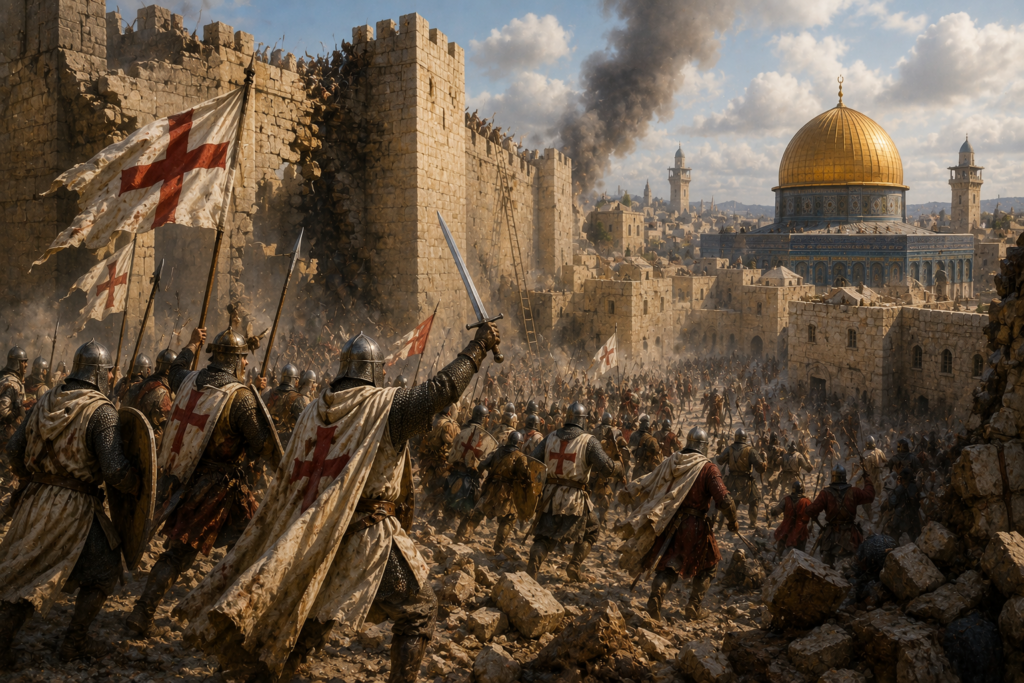
Image Credentials: Image Title: Today in History, July 15: Christian Crusaders Capture Jerusalem During the First Crusade. Source: (chatgpt.com) Date: July 2026. Attribution: This image was created using AI-generated imagery (chatgpt.com) by Open Chronicle and does not depict a real-world scene.
By Open Chronicle
15 July 1099
On 15 July 1099, Christian Crusaders captured Jerusalem after a six-week siege, bringing the First Crusade to its dramatic conclusion. The city’s fall marked one of the most significant events of the Middle Ages, establishing Christian control over Jerusalem for nearly a century while profoundly shaping relations between Europe and the Middle East for generations.
The First Crusade had been launched four years earlier after Pope Urban II called upon the nobles and knights of Western Europe to aid the Byzantine Empire and recover the Holy Land from Muslim rule. Speaking at the Council of Clermont in 1095, the pope urged Christians to undertake an armed pilgrimage to Jerusalem, promising spiritual rewards to those who joined the campaign.
Thousands of knights, soldiers, and pilgrims answered the call. Their journey across Europe and Asia Minor was marked by hardship, hunger, disease, and fierce battles against various Muslim forces. Against considerable odds, the Crusaders captured key cities including Nicaea and Antioch before advancing south toward their ultimate objective, Jerusalem.
When the Crusader army reached Jerusalem in June 1099, the city was under the control of the Fatimid Caliphate of Egypt. Lacking sufficient food, water, and siege equipment, the Crusaders initially struggled to make progress. Over the following weeks, however, they constructed siege towers, battering rams, and scaling ladders using timber gathered from the surrounding countryside.
On the morning of 15 July, the Crusaders launched their final assault. Forces led by Godfrey of Bouillon succeeded in breaching the city’s northern walls, allowing Crusader troops to enter Jerusalem. Once inside, fighting quickly spread through the streets as resistance collapsed.
The capture of Jerusalem was followed by a massacre in which many of the city’s Muslim and Jewish inhabitants were killed. Contemporary chronicles describe widespread violence, although estimates of the number of victims vary considerably among historical sources. The killings remain one of the most controversial and tragic episodes associated with the Crusades and continue to be studied by historians as an example of the brutality of medieval warfare.
Following the victory, the Crusaders established the Kingdom of Jerusalem, one of several Crusader states founded in the Levant. Godfrey of Bouillon declined the title of king, instead adopting the title Advocate of the Holy Sepulchre, reflecting his belief that no earthly ruler should wear a crown in the city where Jesus Christ was believed to have worn the Crown of Thorns. After his death the following year, his brother Baldwin I became the kingdom’s first crowned monarch.
The conquest of Jerusalem had far-reaching consequences. It strengthened Christian influence in the eastern Mediterranean while prompting renewed military campaigns throughout the Islamic world. Over the following decades, successive Crusades sought to defend or recover the Crusader states, culminating in the recapture of Jerusalem by Sultan Saladin in 1187 after the Battle of Hattin.
The First Crusade remains one of history’s most consequential religious and military campaigns. It reshaped political alliances, expanded cultural contacts between East and West, and left a legacy that influenced diplomacy, warfare, and interfaith relations for centuries.
Today, the capture of Jerusalem on 15 July 1099 is remembered as a pivotal moment in medieval history. While celebrated by many contemporaries in Christian Europe as the fulfilment of a sacred mission, it is also recognised as a deeply tragic event whose violence continues to inform historical understanding of the Crusades and their enduring impact on the world.