
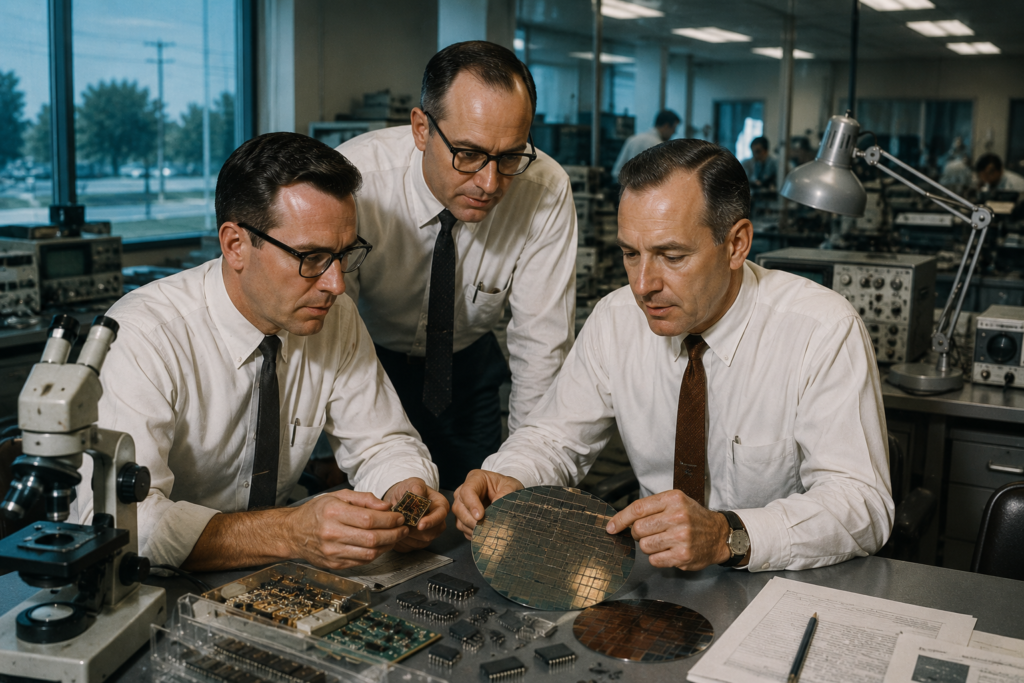
Image Credentials: Image Title: China’s Arctic Intelligence Strategy: How Scientific Access, Satellite Infrastructure and Commercial Presence Are Reshaping the High North. Source: (chatgpt.com) Date: July 2026. Attribution: This image was created using AI-generated imagery (chatgpt.com) by Open Chronicle and does not depict a real-world scene.
By Open Chronicle
18 July 1968
On 18 July 1968, Intel Corporation was founded in Santa Clara, California, by semiconductor pioneers Robert Noyce and Gordon Moore. Joined shortly afterward by Andrew Grove, the new company would become one of the world’s most influential technology firms, revolutionising the semiconductor industry and laying the foundation for the modern computing age.
Intel was established during a period of rapid innovation in electronics. Throughout the 1960s, advances in semiconductor technology had begun replacing bulky vacuum tubes with compact and reliable integrated circuits. Robert Noyce, one of the inventors of the integrated circuit and a co-founder of Fairchild Semiconductor, envisioned creating a company dedicated to pushing the limits of microelectronics. Gordon Moore, a renowned chemist and engineer, shared this ambition and brought extensive expertise in semiconductor manufacturing.
The company was originally incorporated as NM Electronics before adopting the name Intel, derived from the words “Integrated Electronics.” The name reflected its mission to design and manufacture advanced semiconductor devices capable of dramatically improving electronic systems.
Initially, Intel focused on producing semiconductor memory chips, particularly static random access memory (SRAM) and dynamic random access memory (DRAM). These products quickly earned a reputation for reliability and performance, establishing the young company as a leading innovator in the rapidly expanding electronics industry.
A defining breakthrough came in 1971 with the introduction of the Intel 4004, the world’s first commercially available single-chip microprocessor. Designed initially for use in programmable calculators, the 4004 integrated the functions of an entire central processing unit onto a single silicon chip. This technological achievement fundamentally changed computer engineering by making powerful computing capabilities smaller, more affordable, and more accessible.
The success of the 4004 was followed by increasingly sophisticated processors, including the 8008, 8080, 8086, and 8088. These chips became the foundation of countless personal computers and industrial systems. The release of the IBM Personal Computer in 1981, powered by an Intel processor, helped establish the company’s architecture as the dominant standard in the emerging personal computer industry.
Beyond its products, Intel became known for shaping the semiconductor industry’s pace of innovation. Gordon Moore’s famous observation, later known as Moore’s Law, predicted that the number of transistors on integrated circuits would approximately double every two years while costs declined. Although not a physical law, the principle guided technological development for decades and became a benchmark for the entire computing industry.
Under the leadership of executives including Andrew Grove, Intel expanded into one of the world’s largest technology companies. Its processors powered generations of desktop computers, laptops, servers and data centres, while its research contributed to advances in manufacturing techniques, processor architecture and high-performance computing.
Intel also played a central role in the development of Silicon Valley as the global centre of technological innovation. Alongside numerous other pioneering companies, it helped transform the region surrounding Santa Clara into a hub for entrepreneurship, engineering, and scientific research whose influence extended across the world.
Today, Intel remains one of the most recognised names in the semiconductor industry. While the global market has become increasingly competitive, the company’s innovations have shaped more than half a century of computing, enabling everything from personal computers and cloud computing to artificial intelligence and advanced scientific research.
The founding of Intel on 18 July 1968 stands as one of the defining moments in the history of modern technology. From a small startup created by visionary engineers, the company grew into a driving force behind the digital revolution that transformed how people work, communicate, and interact with the world.