
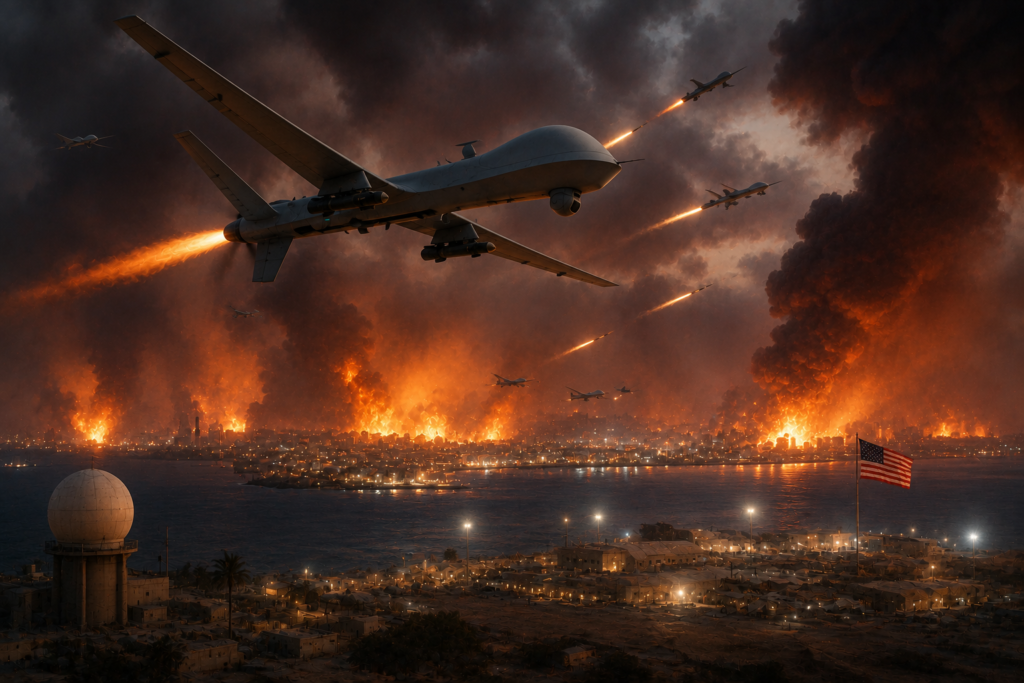
Image Credentials: Image Title: Iran Says Army Drones Targeted US Bases in Jordan, Kuwait and Bahrain. Source: (chatgpt.com) Date: July 2026. Attribution: This image was created using AI-generated imagery (chatgpt.com) by Open Chronicle and does not depict a real-world scene.
By Open Chronicle News Desk with Agencies
Iran’s armed forces said they launched attack drones against American military facilities in Jordan and Kuwait and claimed that explosions occurred at the headquarters of the United States Navy’s Fifth Fleet in Bahrain, marking another dangerous expansion of the confrontation between Tehran and Washington.
The Iranian army said the attacks formed part of the 14th phase of an operation known as “Thunder.” According to a statement carried by Iran’s semi-official Tasnim News Agency, the strikes targeted ammunition depots, fuel storage facilities and military communications links associated with United States forces in the region.
The operational claims, including the reported damage and precise locations struck, could not immediately be independently verified. There was no immediate comprehensive assessment from the United States confirming the extent of the attacks.
Iranian military announces new phase of drone campaign
Iran’s army said the latest operation involved one-way attack drones launched against American military infrastructure across several countries.
The military claimed that facilities in Jordan and Kuwait were struck and that explosions were recorded near the US Fifth Fleet base in Bahrain. The Fifth Fleet, headquartered in the Juffair district of Manama, is central to American naval operations in the Persian Gulf, the Arabian Sea, and surrounding maritime corridors.
Iran described the attacks as retaliation for continuing United States strikes on Iranian territory and infrastructure.
The announcement came after seven consecutive nights of American military operations against Iran. United States forces have targeted missile sites, drones, coastal defence systems, surveillance infrastructure and other military assets, while some attacks have also damaged transport, energy and water facilities.
Jordan and Kuwait drawn deeper into confrontation
The reported attacks demonstrate how the conflict is increasingly spreading into countries that host American forces but are not formally parties to the war.
Jordan is an important security partner of the United States and hosts American military personnel involved in regional defence, intelligence and counterterrorism operations. Iranian missiles and drones have previously crossed Jordanian airspace during regional confrontations, creating risks for both military installations and civilian communities.
Kuwait hosts several American military facilities and serves as a major logistics hub for US operations in the Middle East. Its bases support troop movements, equipment storage, air operations, and regional command structures.
Iran’s decision to target facilities in both countries is intended to weaken the broader infrastructure supporting American operations. It also places additional pressure on governments that have tried to preserve political distance from direct participation in the conflict.
Bahrain faces renewed threat to Fifth Fleet headquarters
Bahrain occupies a particularly important position in the confrontation because it hosts the headquarters of the US Navy’s Fifth Fleet.
The fleet is responsible for American maritime operations across a vast area that includes the Persian Gulf, the Gulf of Oman, the Red Sea, the Arabian Sea, and parts of the Indian Ocean.
Its forces play a central role in protecting shipping, monitoring Iran, and maintaining the United States naval presence around the Strait of Hormuz.
Iranian military statements have repeatedly identified the Bahrain base as a strategic target. Bahrain has activated air defence systems and security alerts during previous attacks, while regional authorities have reported interceptions and explosions around military and civilian areas.
The latest Iranian claim suggests that Tehran intends to demonstrate that American naval command centres remain vulnerable despite the significant air and missile defences deployed throughout the Gulf.
Conflict spreads across the Gulf
The drone attacks were part of a broader wave of Iranian retaliation that reportedly included strikes against targets in Kuwait, Bahrain, Jordan, and Saudi Arabia.
Reuters reported that Iran launched missiles and drones against Gulf states and Jordan following another night of American strikes. Kuwait suffered damage to infrastructure, including a desalination facility, an airport, and energy installations, while injuries were reported among emergency personnel and workers.
Iran also targeted Saudi Arabia for the first time in several months, according to reporting on the regional escalation. The strikes reportedly included an attack directed toward Prince Sultan Air Base, which hosts American forces.
These developments indicate that Tehran is no longer limiting its retaliation to American assets directly adjacent to Iranian territory. Instead, it is applying pressure across the regional network that supports the United States military presence.
A strategy of regional pressure
Iran’s approach appears designed to create strategic costs for Washington by threatening the bases, ports and logistics networks that make American power in the Middle East possible.
The United States operates through a distributed regional architecture rather than relying on a single large base. Aircraft may operate from one country, naval forces from another, and logistics or command systems from several others.
By attacking multiple locations, Iran can force the United States and its partners to disperse air defence systems, increase security precautions and protect a much wider geographic area.
This strategy also places political pressure on host governments. Countries such as Bahrain, Kuwait, and Jordan depend heavily on American security guarantees, but they also face domestic and regional consequences when their territory becomes part of an active military campaign.
Iran has repeatedly warned states hosting United States forces that their facilities could become targets if Washington continues its attacks.
Drone warfare expands the battlespace
The Iranian army’s emphasis on attack drones reflects the growing importance of unmanned systems in the conflict.
Drones are generally cheaper than ballistic missiles and can be launched in larger numbers. Their small radar signatures and low-altitude flight profiles may make them difficult to detect, particularly when used in coordinated waves alongside missiles or electronic warfare.
They can also force defenders to use costly interceptor missiles against comparatively inexpensive targets.
Even when most drones are intercepted, a limited number penetrating defensive systems may still damage exposed fuel depots, communications equipment, aircraft shelters, or logistical facilities.
Iran has invested heavily in different categories of unmanned aircraft, including reconnaissance platforms, long-range strike drones, and one-way attack systems. These weapons have become a central element of Tehran’s regional deterrence strategy.
Risks to civilians and critical infrastructure
The expansion of attacks into densely populated Gulf states increases the risk of civilian casualties and damage to essential infrastructure.
Military installations in Bahrain, Kuwait, and Jordan are often located near cities, airports, ports, and industrial facilities. Falling debris from intercepted missiles and drones may also injure civilians even when air defences successfully destroy incoming weapons.
Recent exchanges have already affected water production, electricity, airports, roads, and commercial shipping.
Kuwait’s reported damage to a desalination plant is particularly serious because Gulf states rely heavily on such facilities for drinking water. Attacks on energy and water infrastructure could rapidly create humanitarian pressures, especially during periods of extreme summer heat.
Strait of Hormuz remains central to the crisis
The military escalation is closely connected to the dispute over control and navigation in the Strait of Hormuz.
The United States says its operations are intended partly to protect commercial vessels and preserve freedom of navigation. Iran argues that Washington is attempting to interfere in waters essential to Iranian sovereignty and security.
Shipping through the strait has fallen sharply amid missile attacks, drone incidents, vessel seizures and the renewed American blockade of Iranian ports.
The waterway remains one of the world’s most important energy corridors. A prolonged confrontation could disrupt oil and gas exports, increase insurance costs and place further pressure on international markets.
The spread of Iranian attacks against bases in Jordan, Kuwait, and Bahrain demonstrates that the conflict is no longer confined to the immediate maritime area around Iran.
The diplomatic framework continues to collapse
The renewed fighting follows the breakdown of a memorandum intended to reduce tensions between Washington and Tehran.
Both sides accuse the other of violating the arrangement.
Iran says American strikes breached the agreement and rendered earlier diplomatic efforts ineffective. Washington argues that Iranian attacks on commercial vessels and regional facilities justified the resumption of military operations.
As strikes and counterstrikes intensify, space for mediation is narrowing. Regional governments that previously tried to facilitate negotiations are increasingly occupied with defending their own territory and infrastructure.
Danger of a wider regional war
The attacks underline the risk that a bilateral confrontation between the United States and Iran could develop into a broader Middle Eastern war.
Each additional country affected increases the possibility of miscalculation. A drone striking the wrong location, killing large numbers of civilians or causing severe damage to a strategic facility, could trigger a new round of retaliation.
The United States may respond more forcefully if its military personnel suffer significant casualties. Gulf governments could also become more directly involved if attacks on their territory continue.
Iran’s reported targeting of American facilities in three countries sends a clear message that Tehran views the entire regional US military network as part of the conflict.
Whether the attacks produced the damage claimed by Iran remains uncertain. What is increasingly clear is that the geographical boundaries of the war are expanding, placing military bases, civilian infrastructure and strategic shipping routes across the Middle East under growing threat.